

Author’s note: This one started as a joke. If Einstein had Fable 5.2 and no usage cap, what would he do first? Prices come from APIYI’s master list as of 2026-11-20—good value, no funny business.
Hey buddy—that post was really asking you.
Someone posted a photo of Einstein smoking a pipe with the caption: If Einstein had Fable 5.2 and unlimited usage, what would he build? The photo is a meme; the question is real. If usage no longer holds you back, the work the model’s own team has already put it through is the answer. If you’ve got a Key with runway to keep going, you’re the Einstein in this story.

Core value: See where Fable 5.2 officially claims to shine, then try a piece of it yourself on APIYI with the full-power claude-fable-5-2. Models and pricing are subject to the platform’s model list.
What Would Einstein Do First?
Let’s get the joke straight first. Nobody actually hooked Einstein up to Fable 5.2. That post from 2026-11-19 was just an old photo plus one line in French: what if he had this model, with unlimited usage?
The official usage examples have already acted out the “what if.” Each item below cites its source, and every one is self-reported by the company.
First, Finish the Physics Problems That Have Been Lying Around
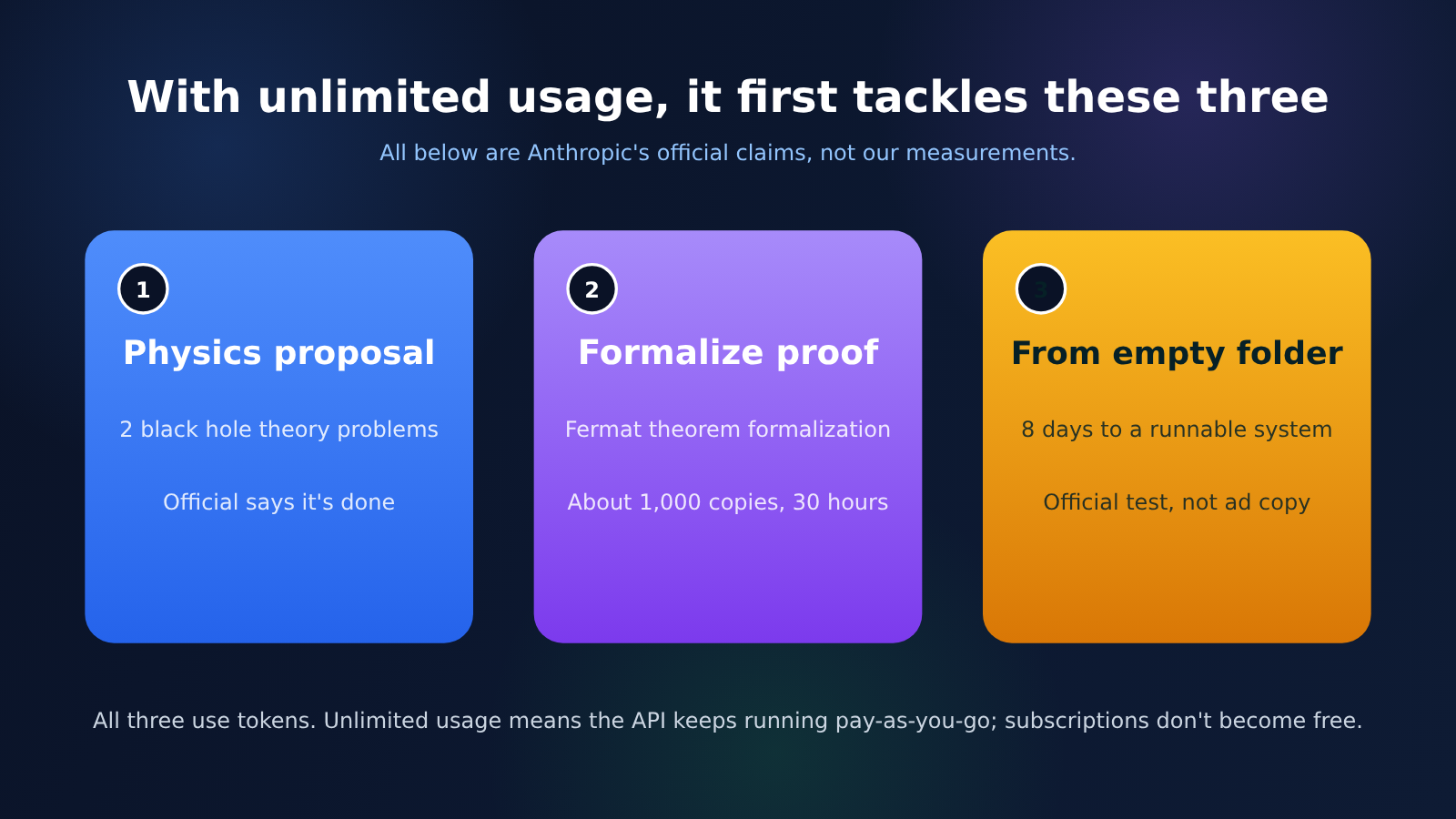
In a 2026-11-09 announcement, Anthropic wrote that Fable 5.2 completed two still-open theoretical physics problems, both related to black holes. One preprint asks whether phase transitions in a tiny universe happen abruptly; the other pins down the exact boundary for an exclusion method that’s been in use for over a decade. A preprint isn’t a peer-reviewed paper. The official wording is that the model finished the calculations — not that “physics has been rewritten.”
If Einstein had unlimited usage, this is probably what he’d do first: take the part that wears people out and that machines could never finish before, and let it keep pushing forward on its own.
Then Hand Over Proofs in a Machine-Checkable Form
The same announcement says roughly 1,000 Fable 5.2 instances worked together to formalize the proof of Fermat’s Last Theorem in Lean over 30 hours. For comparison, the company says Opus 5.5 ran for 30 hours on the same setup and only finished about 26%. This is a single self-reported experiment, not a final leaderboard result.
The meaning of “unlimited usage” gets very concrete here. This isn’t a job that wraps up after a couple of messages — it’s hundreds of model runs going for many hours. A weekly quota on a subscription can’t foot that bill. Paying per token through an API is what can actually sustain it.
Then Build Something From an Empty Folder
The announcement also includes two more official experiments. In one, an engineer gave it a single paragraph; Fable 5.2 coordinated over 1,000 sub-agents and, in eight days, wrote a prototype system from an empty folder that boots on a laptop — with disk, keyboard, networking, and windows. In the other, it delivered three working electronic device circuits within a day, and the company says no circuit changes were needed after assembly. These are official experiment records — fine for arguing “it can handle long jobs,” not for arguing “you’ll be running a lights-out factory tomorrow.”
At the same time, the company wrote something refreshingly honest: for most coding and knowledge work, start with Opus 5.5, and only switch to Fable once you hit the genuinely harder, longer stretch. Fable 5.2 is for gnawing on the tough bones, not for every bit of small talk.
We’ve got the full-strength version right here
Alright, friend — story time’s over, time to get your hands dirty. Once you’ve got Fable 5.2 in hand, you’re Einstein. This is exactly the one APIYI sells, and the model ID is claude-fable-5-2.
“Full-strength” means one thing here: the name you invoke is the claude-fable-5-2 that Anthropic published — not some renamed understudy, and not the previous generation dragged in to fill the slot. On APIYI’s master list dated 2026-11-20, it matches the official model page:
- Input: $8 / million tokens
- Output: $40 / million tokens
- Cached read: $0.2 / million tokens
- Context: 1 million tokens, max output 128K tokens
- Endpoints: chat and messages
The same list also carries a claude-fable-5-2-thinking entry with identical pricing, endpoints, and group. The official model page says adaptive thinking is on by default and can’t be turned off, so don’t treat these two as models with different capabilities. For everyday use, just write claude-fable-5-2.
The official docs also list an optional fast tier at $16 input and $80 output per million tokens. APIYI’s master list has no separate fast model ID, so this article won’t describe it as something you can already invoke. Mythos 5.2 has to go through official review, and it’s absent from both the master list and the pricing API. Not listed yet — we’ll get it up as soon as we can. Model IDs and prices are subject to the platform’s model list.
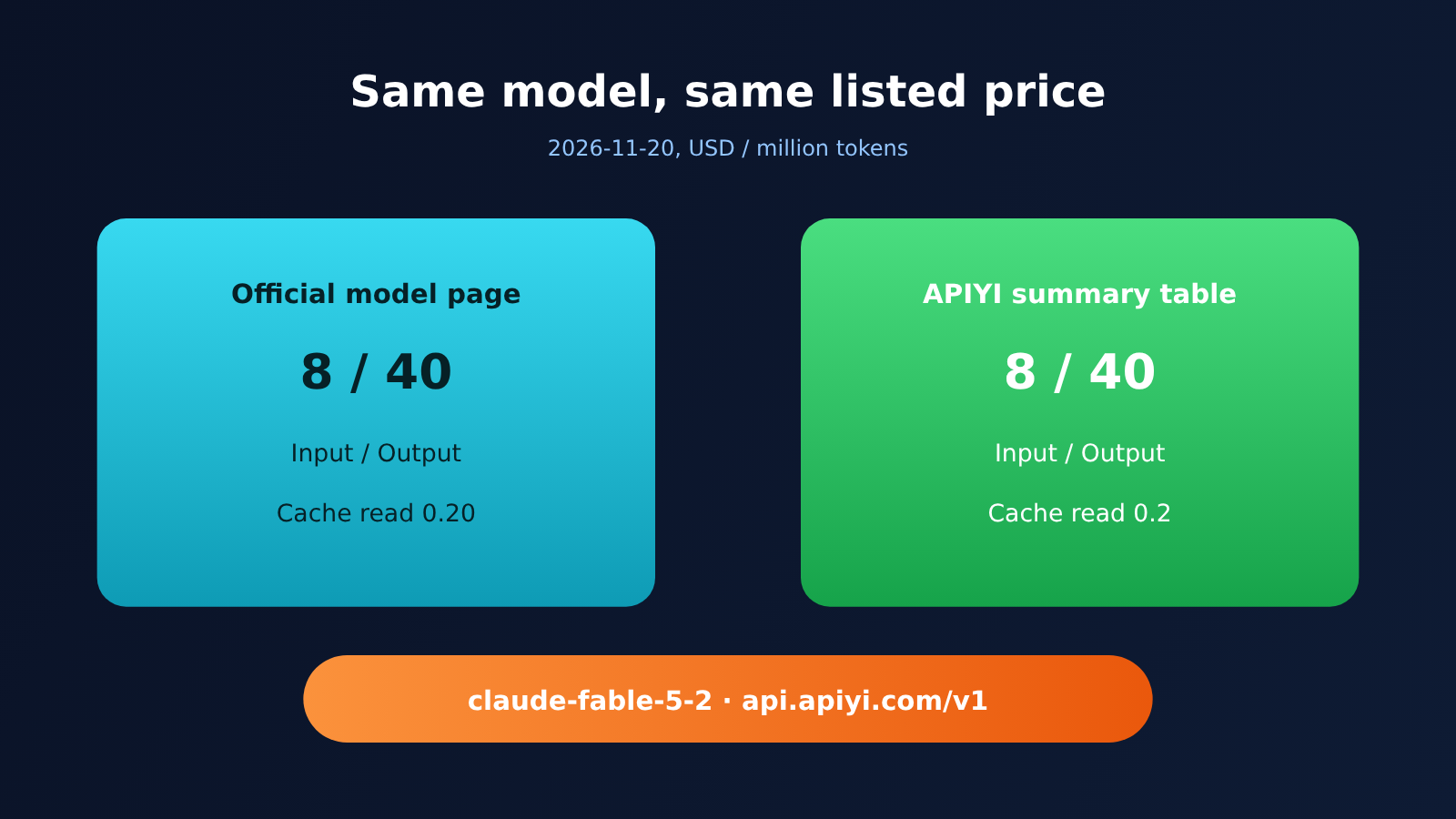
Group multipliers aren’t a flat price. In the pricing API, default and svip are 1x, matching the 8 / 40 / 0.2 set on the master list. Other groups have discounts and markups alike, and the names don’t even line up between the master list and the API — so don’t take some particular discount and claim “this model is 50% off across the board.” What you’re actually charged depends on the group in your console. Model IDs and prices are subject to the platform’s model list.
Subscriptions still come with a weekly quota — the help center spells that out clearly, and I won’t turn it into a plan comparison table here. The “unlimited usage” you’re after translates to something different on the API side: it isn’t about that little weekly slice of Fable quota, it’s about how many tokens you’re willing to pay for this long task. As long as there’s balance left, it keeps running.
Try it yourself
It’s easy to use because setup is short, not because it figures out what you want to do for you. Three steps are enough.
Step 1: Get a key and point it at the right base URL
Sign up at apiyi.com and generate an API key. Pick one of two protocols:
- OpenAI-compatible: set
base_urltohttps://api.apiyi.com/v1and use chat. - Anthropic native: set
base_urltohttps://api.apiyi.com, the root domain. Don’t add/v1again, or the path ends up as/v1/v1/messages.
For both, use the model name claude-fable-5-2.
Step 2: Send a short question first
Don’t start by throwing an eight-day project at it. First, have it explain your current problem in a few sentences, and check the usage in the response: how many input tokens, how many output tokens. Compare that with the $8 and $40 above, and you’ll know what this question cost. If the numbers check out, then extend the context.
The official default effort is high, and you can’t turn off thinking. Even short questions will cost a bit more than you expect. That’s what the model page says, not a bug.
Step 3: Hand the hard part over
For everyday edits and small functions, the official recommendation is to start with Opus 5.5. On APIYI’s rate table, claude-opus-5-5 is $4 for input, $20 for output, and $0.2 for cache reads. When you’re stuck, when it’s long, or when you need it to iterate back and forth many times, switch to claude-fable-5-2.
Einstein wouldn’t take his pipe and blackboard and use them to calculate a shopping list. Same goes for you, buddy: save the pricier one for the job that’s worth running for a long time.
FAQ
Is usage really unlimited?
There’s no such thing with a Claude subscription—weekly quotas still apply. The API doesn’t draw from that quota; usage is billed by token against your balance. If your balance covers it, this task can keep running. This isn’t the official provider turning the subscription into unlimited free usage.
Is “full power” just a marketing term?
Here it just means the model ID matches. claude-fable-5-2 in APIYI’s master table uses the officially published ID, and its default listed price matches the official model page: $8 input / $40 output. It’s not a downgraded model under a different name. Keep the group discount and “full power” as separate claims—don’t lump them into one sentence.
Did you measure the performance yourselves?
No. The two black hole problems, the Fermat formalization, the eight-day prototype system, being up to ~30% faster than Fable 5.1, and the price drop from 5.1’s $10 input / $50 output to $8 / $40—all come from Anthropic’s 2026-11-09 announcement and model page, and we’ve labeled them as officially self-reported.
Do I need to buy claude-fable-5-2-thinking separately?
No need to choose. Both entries in the master table are the same price. The official docs say thinking is enabled by default—just use claude-fable-5-2 directly.
Can I call Mythos 5.2 or the official fast tier?
Not right now. Mythos 5.2 isn’t listed yet, and we’ll get this model listed as soon as we can. The fast tier doesn’t have a separate model ID in the master table. Model IDs and pricing are subject to the platform’s model list.
Key Takeaways
- That post is a hypothetical: Einstein plus unlimited usage of Fable 5.2. You’re the person that line is aimed at.
- What the official team reports it has chewed through are hard jobs — the kind that run long and several at once — not a single chit-chat prompt.
- The full-strength version on APIYI means
claude-fable-5-2is the official ID itself, with default pricing at 8 / 40 / cache read 0.2. - Connect through
https://api.apiyi.com/v1: run a short question first to sanity-check the bill, then hook up the long tasks. - For most everyday work you can still start with Opus 5.5. Save Fable for that one job worth running for a long stretch.
Summary
If Einstein had unlimited usage, he’d take Fable 5.2 and finish the chunk that can’t otherwise be computed. The official team has already demonstrated this way of working with physics problems, formal proofs, and long engineering projects that start from an empty folder. And you — buddy, grab a key, set the model to claude-fable-5-2, set the base URL to https://api.apiyi.com/v1, get one sentence running first, then decide which hard job to hand it. You’re Einstein reincarnated.
Head over to apiyi.com, create a key, and you can try it. Model names and pricing are subject to the platform’s model list.
📚 References
-
Anthropic announcement — Fable 5.2 and Mythos 5.2 (2026-11-09, from the official announcement)
- Link:
https://www.anthropic.com/claude-fable-and-mythos-5-2 - Notes: Two physics problems, Fermat formalization, prototype system, speed and pricing compared with 5.1
- Link:
-
Anthropic model page — Claude Fable 5.2
- Link:
https://platform.claude.com/docs/en/models/fable-5-2/overview - Notes: Model ID, 1M context, 128K output, input 8 / output 40 / cache read 0.20
- Link:
-
That joke post (not an announcement)
- Link:
https://x.com/0xmaxou/status/2123504679501934980 - Notes: 2026-11-19, an Einstein image plus the line “usage unlimited”
- Link:
-
APIYI model list (accessed 2026-11-20)
- Link:
https://docs.apiyi.com/models.md - Notes: Pricing, endpoint, and group for
claude-fable-5-2andclaude-fable-5-2-thinking
- Link:
-
APIYI pricing API (accessed 2026-11-20)
- Link:
https://api.apiyi.com/api/pricing - Notes: The 1x group matches the master list’s 8 / 40 / 0.2; other groups use different multipliers
- Link:
Author: APIYI Technical Team
Technical discussion: Feel free to contact us through the APIYI website homepage at apiyi.com. More resources are available at the docs.apiyi.com documentation center.


