

Author’s note: Google’s official introductory pricing for gemini-4-carbon runs only through 2026-11-30. After that, input goes from $2 to $4 and output from $10 to $20. This post covers the official timeline, APIYI’s current pricing, and a checklist to run through before the deadline.
If you’re calling gemini-4-carbon at $2 per input, the thing you most need to know is how long that price will last. The short answer: the official Carbon promotion ends on November 30. In its blog post of 2026-11-10, Google listed $2 input and $10 output as introductory pricing. A footnote says that once the introductory period ends, input becomes $4 and output becomes $20.
This isn’t a price hike notice from the platform. As of 2026-11-11, gemini-4-carbon in the APIYI (apiyi.com) model price list is still $2 input, $10 output, and $0.1 cache read. Whether the platform follows the official change after the deadline will depend on the price list at that time. This post covers just three things: what the official timeline is, what input going from $2 to $4 means for your bill, and which configurations to check before the deadline.
Key takeaway: In 3 minutes, you’ll know the end date and size of the gemini-4-carbon price increase, and what to prepare before November 30.
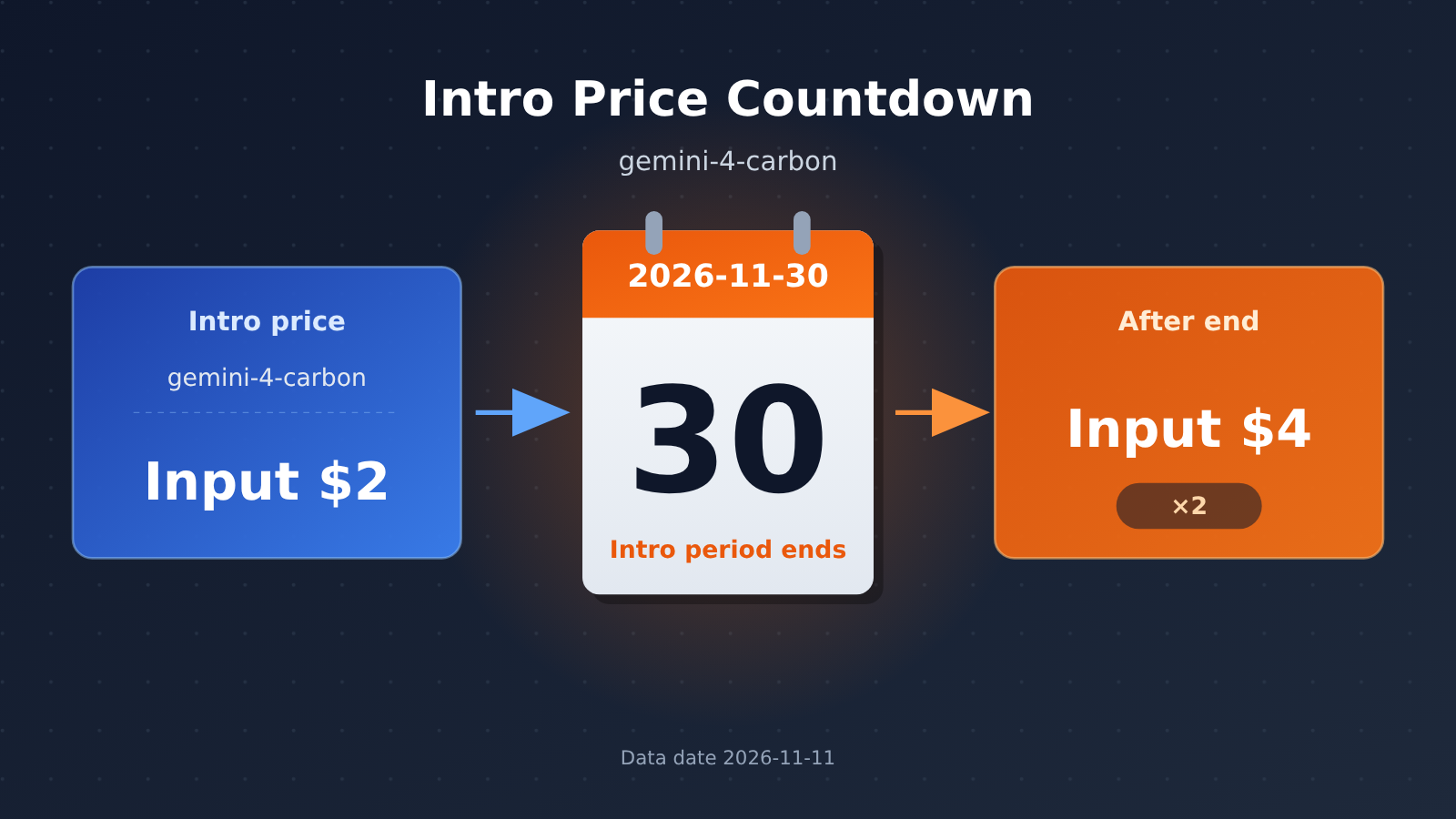
Key Facts on the Carbon Promotional Deadline
First, let’s separate what Google has officially said from what individual platforms charge. When people see the word “price increase,” they often assume every channel will change prices on the same day. In reality, the official blog only describes Google’s own public-facing Carbon pricing. Each platform’s rates need to be checked on its own price list.
| Item | Details |
|---|---|
| Publisher | Google (official blog) |
| Published | 2026-11-10 |
| Model covered | Public-facing Carbon, model ID gemini-4-carbon |
| Introductory price | $2 input, $10 output |
| Introductory period ends | 2026-11-30 |
| Price after the deadline | $4 input, $20 output |
| Where it’s stated | Official blog body and footnote |
| APIYI price source | Model master list at docs.apiyi.com/models, data dated 2026-11-11 |
Two details are easy to miss. First, the price increase is tucked away in a footnote, while the headline only stresses that the model is “now available” and shows the introductory price. If you only read the headline, you’d likely assume $2 is the long-term price. Second, the footnote explicitly says it applies to the “public-facing Carbon.” So this information describes the pricing schedule for Google’s official public version, and you can’t apply it directly to other channels or other models.
gemini-4-carbon Price Change Comparison
The table below lists the prices we can currently confirm, organized by time period and source. Cells with no public figures are marked “Not announced,” and we’re not guessing.
| Source / Period | Input | Output | Cache read | Data date |
|---|---|---|---|---|
| Google official, introductory period (through 2026-11-30) | $2 | $10 | Not listed in the reference material | 2026-11-10 |
| Google official, after the introductory period | $4 | $20 | Not listed in the reference material | 2026-11-10 |
| APIYI model master list (current) | $2 | $10 | $0.1 | 2026-11-11 |
| APIYI model master list (after 11-30) | Per the price list at that time | Per the price list at that time | Per the price list at that time | — |
You can calculate directly from the table: once the official introductory period ends, the input price doubles and the output price doubles too. As of today, 2026-11-11, there are fewer than three weeks left before the introductory period ends.
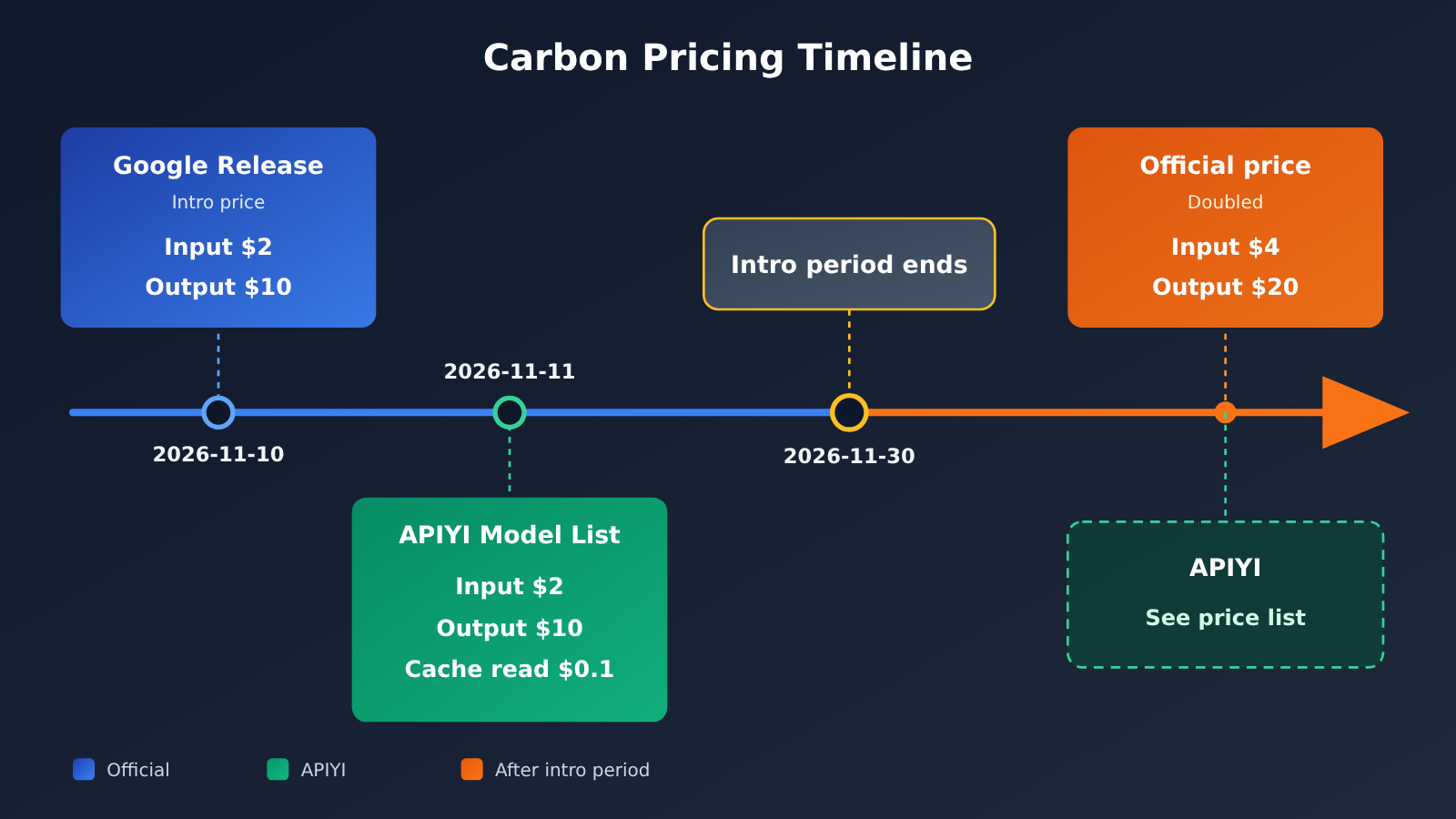
What Input Going from $2 to $4 Means for Your gemini-4-carbon Bill
This post only covers the input price going from $2 to $4. The output price doubles too, but how output is counted and what falls under “output” will get its own post. The effect of doubling the input price is straightforward: if your usage stays the same, the input portion of your bill becomes twice what it was. How much the whole bill goes up depends on what share of your total cost comes from input.
The input-to-output ratio varies a lot between workloads. The table below doesn’t use any specific usage numbers. It just shows which kinds of scenarios feel the input price increase more, so you can compare against your own workload.
| Scenario type | Input share profile | How much $2 → $4 input hits you | What to focus on |
|---|---|---|---|
| Long-document summarization, contract review | Very long input per call, short output | Strong | Trim the context and remove repeated passages |
| RAG question answering | Lots of retrieved chunks stitched in every call | Strong | Limit the number and length of retrieved chunks |
| Multi-turn customer support chat | History accumulates turn by turn | Medium to strong | Truncate or summarize the message history |
| Short Q&A, classification and tagging | Both input and output are short | Weak to medium | Mostly depends on call volume |
| Long-form generation, writing | Output makes up most of the cost | Input part is relatively minor | Pay separate attention to the output price change |
If your workload falls into the first two categories, the thing to watch most is cache reads. The APIYI model price list shows gemini-4-carbon cache reads at $0.1 (data dated 2026-11-11), which is far below the $2 input price. For content that shows up again and again, like system prompts or a fixed knowledge-base prefix, a cache hit means you don’t pay the full input price on every call. The official reference materials don’t list a cache read price, so there’s no comparison with official cache read pricing here.
How to Estimate Your gemini-4-carbon Input Cost
You don’t have to wait for the bill to see how big the impact is. Three steps will get you an estimate:
- Pull your recent
gemini-4-carboninput and output usage from your existing logs. - Multiply each by the current price (input $2, output $10) to get your current cost breakdown, then work out what share of the total comes from input.
- Swap in $4 for input and $20 for output and calculate again. The difference between the two results is the change once the official price switch takes effect.
If step 2 shows input is a large share, you can slim down your prompts and rework your caching before November 30. That way, even if the price change goes through, part of the increase will already be offset.
🎯 Technical tip: Before estimating, check the current
gemini-4-carbonpricing and data date in the APIYI (apiyi.com) model price list, then plug in your own real usage. This is more accurate than applying generic ratios.
Looking Up gemini-4-carbon Model Details and Pricing on APIYI
A lot of “the price looks wrong” questions turn out to be a misconfigured model ID or endpoint. Below are the key fields for gemini-4-carbon from the APIYI model catalog, so you can check them one by one.
| Field | Value (data as of 2026-11-11) |
|---|---|
| Model ID | gemini-4-carbon |
| Input price | $2 |
| Output price | $10 |
| Cache read price | $0.1 |
| Supported endpoints | chat, gemini |
| Available groups | Default, SVIP |
| Follows official price changes | Refer to the price list |
When you set up your integration, confirm these settings:
- Set the model ID to
gemini-4-carbon, with no extra prefix or suffix. - For the OpenAI-compatible format, use the
chatendpoint and set base_url tohttps://api.apiyi.com/v1. - If you need Gemini’s native request format, use the
geminiendpoint. Check the documentation for the exact path. - Your token’s group should be
DefaultorSVIP. Billing rules for each group follow the model catalog. - Get your API key from the APIYI dashboard. The same key can also call OpenAI, Claude, and other models, which makes side-by-side comparisons easy.
🚀 Quick start: If your project already uses the OpenAI SDK, just change base_url to
https://api.apiyi.com/v1and the model name togemini-4-carbon, and you’re connected. New users who sign up at APIYI (apiyi.com) get free test credits, so you can get everything working before switching over production traffic.
Common gemini-4-carbon Errors and Pricing Questions
| Symptom | Likely cause | How to check |
|---|---|---|
| “Model does not exist” error | Model ID is misspelled or has an extra prefix | Compare with the model catalog and change it to gemini-4-carbon |
| Request format rejected | Endpoint doesn’t match the request body format | Use chat for the OpenAI format and gemini for the native format |
| Authentication failed | Wrong key, or base_url wasn’t replaced | Check your key and https://api.apiyi.com/v1 |
| Charges don’t match expectations | Different group, or the price list was updated | Check your token’s group and the data date in the model catalog |
| Thinking the platform raised prices | Mistaking an official footnote for a platform announcement | Platform prices follow the APIYI price list, not official footnotes |
The last row needs a bit more explanation. The footnote in the official blog post refers to Google’s own pricing. After seeing that message, the most common misunderstanding is that “everywhere will switch to $4 on December 1.” Whether the platform adjusts its prices, and when, depends only on the platform’s own price list.
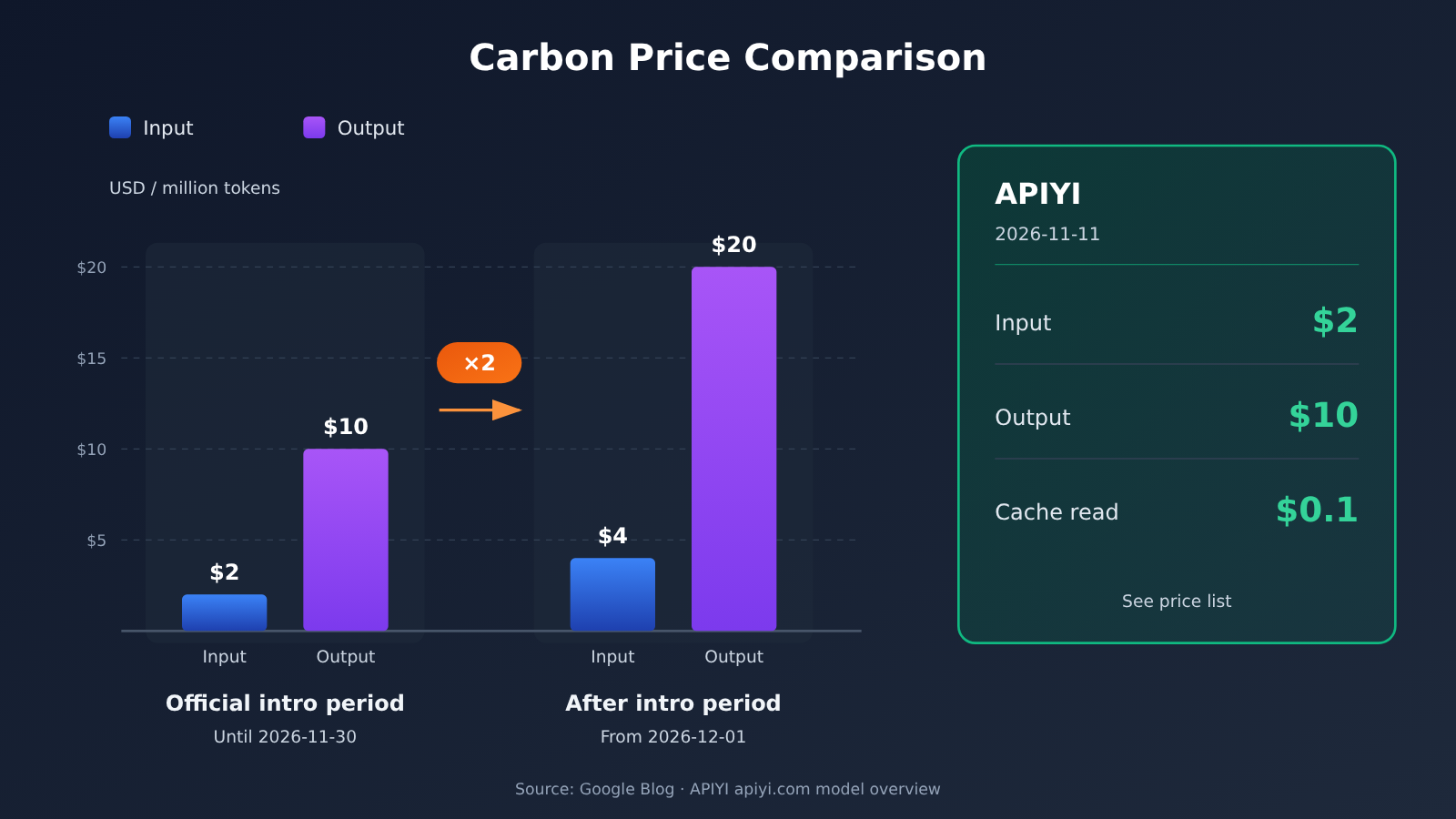
Impact Analysis: The End of the gemini-4-carbon Introductory Pricing
Impact on Developers
- Budgets need to be recalculated: Any cost model built on $2 input pricing only holds for official pricing until 2026-11-30. After that, you’ll need to re-run the numbers at $4.
- Prompt engineering pays off more directly: The higher the input unit price, the more you save by compressing context and deduplicating retrieved snippets.
- Caching strategy matters more: When a fixed prefix hits the cache, it’s billed at the cache-read rate, which can noticeably cushion the price increase for input-heavy workloads.
- Track channel prices separately: Official prices and platform prices may change at different times and in different ways, so it’s best to add a price check to your monthly review.
Impact on Choosing gemini-4-carbon
- The evaluation window is shrinking: If you’re still comparing Carbon against other models, the introductory period is a good time to run your comparison tests at a lower cost.
- Judge long-term cost at the regular price: When making a technical selection, evaluate based on the post-introductory price, and don’t let the promotional rate skew your decision.
- Multi-model switching becomes more valuable: With a unified interface, switching models only means changing the model name, so you can adjust more flexibly when prices change.
💡 Tip: If you want to finish comparing Carbon with other models during the introductory period, you can use APIYI (apiyi.com) to switch models with the same key and the same code. Just change the
modelfield to compare quality and cost side by side.
Checklist Before November 30
- Confirm that the model ID in your code is
gemini-4-carbon, and that the endpoint and request format match. - Using your recent real usage, calculate the cost at both $2 and $4 input pricing so you can see the difference clearly.
- Check which requests have especially long inputs, and compress system prompts and retrieved snippets first.
- Restructure your fixed prefixes so they can hit the cache.
- After November 30, check the platform’s model price list again to see whether any prices have changed.
FAQ
Q1: What exact day does the official Carbon promotion end?
A footnote in Google’s 2026-11-10 blog post says the introductory period ends on 2026-11-30. After that, public pricing for Carbon goes to $4 for input and $20 for output.
Q2: Input goes from $2 to $4. Will every channel raise prices at the same time?
Not necessarily. The official footnote only covers Google’s own public pricing for Carbon. As of 2026-11-11, the APIYI model price list still shows `gemini-4-carbon` at $2 for input, $10 for output, and $0.1 for cache reads. Whether APIYI follows the change is up to its price list, so check the model price list at apiyi.com again once the introductory period ends.
Q3: What do I use for the model ID and endpoint for gemini-4-carbon?
Use `gemini-4-carbon` as the model ID. APIYI supports two endpoint types, `chat` and `gemini`. For the OpenAI-compatible format, use the base_url `https://api.apiyi.com/v1`. For the native format, check the docs for the exact path.
Q4: Which workloads are hit hardest by the input price increase?
Workloads with a high share of input tokens, such as long-document summarization, RAG question answering, and multi-turn conversations where message history keeps piling up. For these, we’d suggest compressing context first, and structuring your fixed prefixes so they can hit the cache.
Q5: Is it still worth integrating gemini-4-carbon now?
If you just want to evaluate how well it works, testing during the introductory period costs less. You can sign up at APIYI (apiyi.com) and use the free credits for new users to get your workflow running. For long-term budgeting, run the numbers at the post-introductory prices too.
Q6: Why doesn’t this article cover output pricing or how thinking content is billed?
This article only covers one change: input going from $2 to $4. Output pricing also doubles, from $10 to $20, but whether thinking content counts toward output will get its own write-up so the two questions don’t get mixed together.
Carbon Official Promo Ending: Key Takeaways
- Deadline: The official introductory pricing for gemini-4-carbon ends on 2026-11-30
- Input price increase: Official input goes from $2 to $4, doubling the unit price
- Output price change: Official output goes from $10 to $20; billing details are covered in a separate article
- Scope: The official footnote only applies to the public-facing Carbon
- Current platform pricing: As of 2026-11-11, APIYI still charges $2 for input, $10 for output, and $0.1 for cache reads
- Check at expiry: Whether the platform follows the price change is determined by the APIYI model price table
Summary
Here are the three things to remember about “Carbon’s official promo ends November 30, and input goes from $2 to $4”:
- Timing: The official introductory period ends on 2026-11-30. After that, input is $4 and output is $20.
- Scope: This is Google’s pricing for the public-facing Carbon. It doesn’t mean every channel will raise prices at the same time.
- Action: Before the deadline, recalculate your costs based on actual usage, trim your inputs, and set up caching. Once the deadline passes, check the platform price list again.
With less than three weeks left before the deadline, now’s a good time to finish your cost estimates and prompt optimization. If you want to compare Carbon with other models using the same code, you can connect through APIYI at apiyi.com. For the latest prices, refer to the data date on the model price table.
📚 References
- Google Official Blog: Gemini 4 Carbon now available: Introductory pricing and the end date of the introductory period
- Link:
blog.google/innovation-and-ai/models-and-research/gemini-models/gemini-4-carbon-now-available -
Notes: Published 2026-11-10. The post gives the introductory price, and a footnote lists the pricing that applies after 2026-11-30.
-
APIYI Model Directory: Platform pricing, endpoints, and groups for
gemini-4-carbon - Link:
docs.apiyi.com/models - Notes: Data as of 2026-11-11. It includes input, output, and cache-read prices, plus endpoint info for
chatandgemini.
Author: APIYI Technical Team
Technical Discussion: If prices or models change, please check the APIYI documentation center at docs.apiyi.com for the latest information. You’re also welcome to contact us through the homepage.


