

Author’s note: Gemini 4 Carbon and GPT-6 Astra split the work by task. Neither one replaces the other. This article walks through how to choose across four dimensions: benchmarks, protocols, pricing, and use cases.
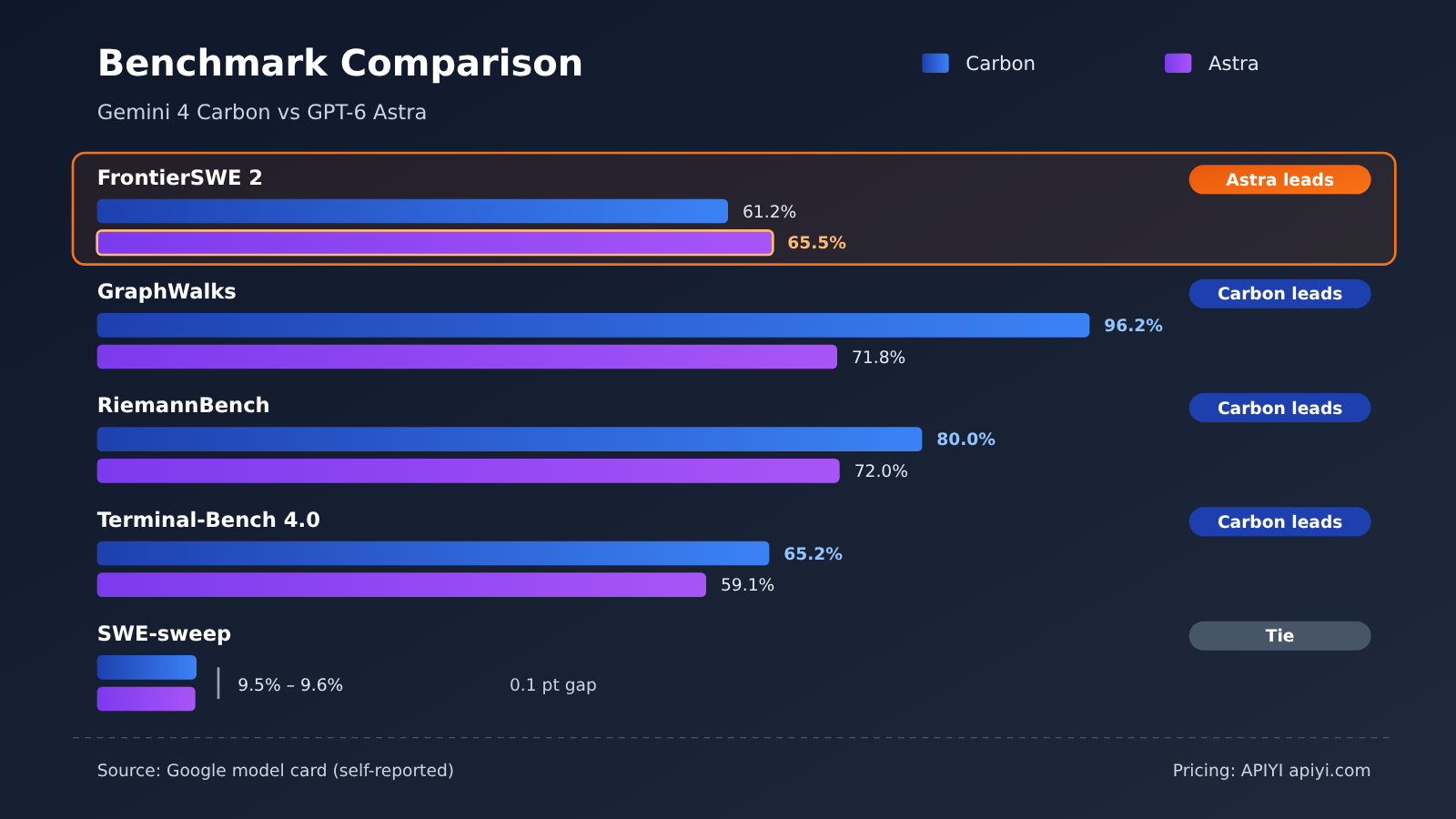
Gemini 4 Carbon opened to paid developers on November 10, 2026, and a lot of teams now have to pick one of the two as their flagship. The short answer: this isn’t about one replacing the other. On FrontierSWE 2, the public-repo engineering benchmark, GPT-6 Astra leads 65.5% to 61.2%. On long-context GraphWalks, the RiemannBench math suite, terminal-based science tasks, and most knowledge-work benchmarks, Gemini 4 Carbon scores higher. On SWE-sweep, it’s 9.6% vs. 9.5%, which is effectively a tie.
This isn’t a “both have their strengths” cop-out. The list prices differ by roughly 5x, and the protocols differ too, so assigning work by task pays off more than picking whoever tops the overall leaderboard. All benchmark numbers in this article are self-reported by the vendors or taken from their documentation. They aren’t third-party reruns.
What you’ll get out of this: you’ll know which tasks to hand to Carbon and which to Astra, plus the gotchas on each side around context limits, output caps, and pricing tiers.
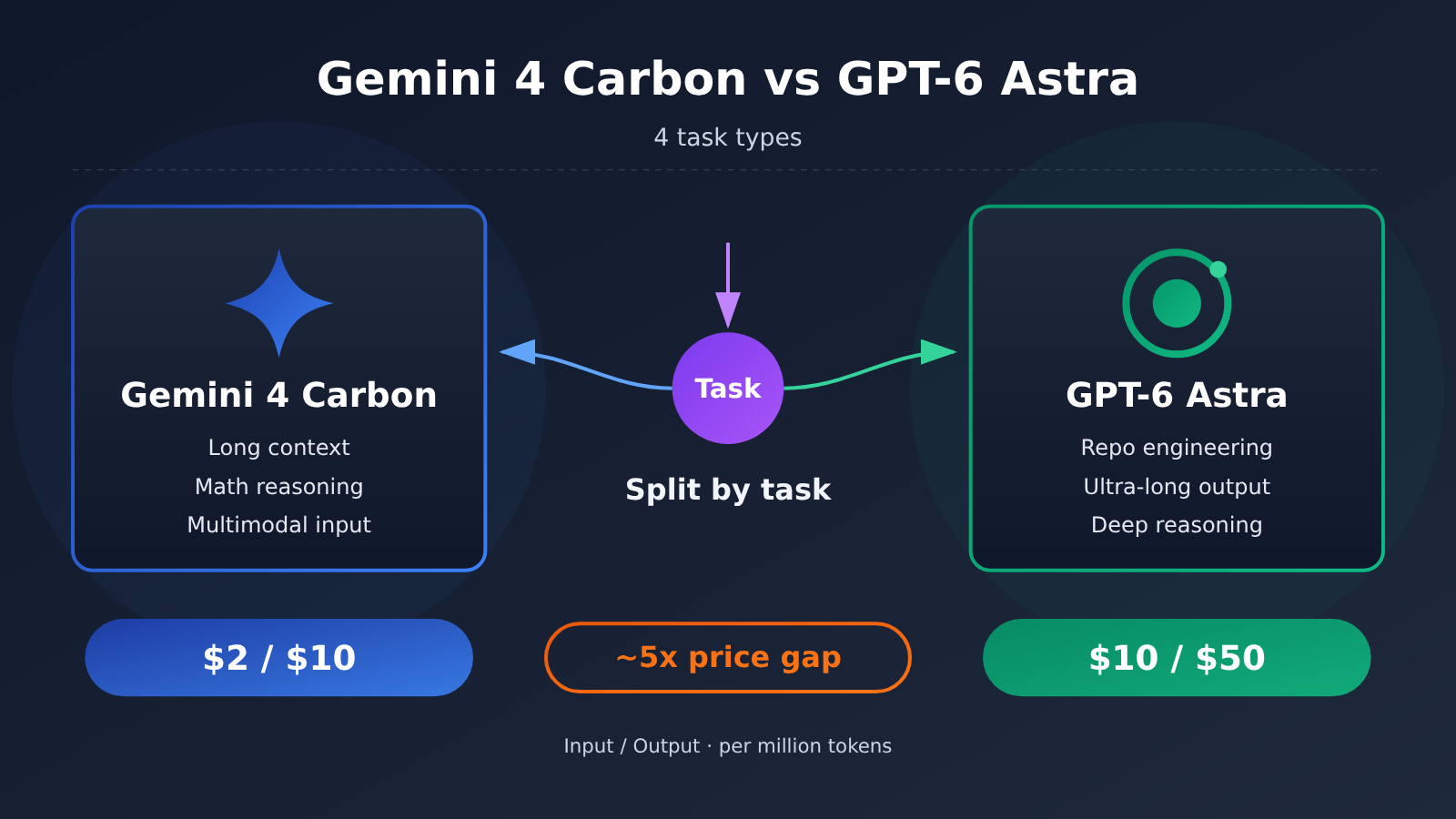
Gemini 4 Carbon vs. GPT-6 Astra: Core Differences
Both models are pitched as the one you reach for when the job is hardest, but their API conventions are very different. Astra is part of OpenAI’s GPT-6 family. The official recommendation is to use the Responses API first, with reasoning strength controlled by reasoning.effort, which goes all the way up to max. Carbon is built on Gemini 4 Argon. It runs on the native Gemini API or an OpenAI-compatible chat API, and its reasoning strength has only three thinking_level settings.
| Dimension | Gemini 4 Carbon | GPT-6 Astra |
|---|---|---|
| Model ID | gemini-4-carbon |
gpt-6-astra |
| Context | 1M shared window (input, thinking, and output share it) | 1,050,000 tokens |
| Output limit | 65,536 by default for synchronous output; longer outputs require background=True in the Interactions API |
Up to 128,000 |
| Reasoning levels | thinking_level: low / medium / high, default medium |
reasoning.effort: low / medium / high / xhigh / max |
| Input modalities | Text, images, audio, video | Text, images |
| Output modalities | Text | Text |
| Knowledge cutoff | March 2026 (may be older in some domains) | April 30, 2026 |
| Recommended protocol | Native Gemini or OpenAI-compatible Chat | Responses API first |
Understanding Gemini 4 Carbon’s 1M Shared Window
Carbon’s 1M isn’t “1M of input plus extra room for output.” Input, thinking tokens, and the final answer all share the same context window. Previous-generation models capped “thinking plus answer” at 64K, but Carbon and Argon switched to this shared mechanism. So if you stuff the window with a long document, you still need to leave headroom for thinking, or the answer may get cut off.
Astra’s 1.05M context and 128K output cap are separate limits, which makes long outputs easier to plan. The tradeoff is in pricing: once a single request’s input exceeds 272K tokens, the entire request is billed at the higher tier. We’ll run the numbers on that later.
Release Timeline: Gemini 4 Carbon and GPT-6 Astra
Carbon was first announced on October 28, 2026. At first it was available only to verified cybersecurity defenders, with access opened up gradually through the Fairwind Program. On November 10, Google announced availability for paid developers, enterprises, scientists, and consumers, and the Gemini API changelog recorded gemini-4-carbon as generally available (GA) the same day. Google hasn’t given a date for when free or lower-tier consumer plans will get access.
How to Read the Gemini 4 Carbon vs. GPT-6 Astra Benchmarks
The table below comes from the Gemini 4 Carbon model card published by Google, with results as of October 2026. All numbers are self-reported by the vendor. The Astra column shows figures Google cites in its own model card. They aren’t OpenAI’s own test results, and they haven’t been independently re-tested. The three cybersecurity benchmarks reflect performance on the Fairwind path, not the default capability of the paid API, so I’ve left them out of the comparison.
| Benchmark (self-reported, as of 2026-10) | Gemini 4 Carbon | GPT-6 Astra | Top in table | Takeaway |
|---|---|---|---|---|
| AA Index v5.0 | 59 | 57 | Carbon | Figure cited in Google’s model card |
| FrontierSWE 2 | 61.2% | 65.5% | Astra | Astra leads on public-repo engineering tasks |
| SWE-sweep | 9.6% | 9.5% | Basically tied | The gap is within the margin of error |
| Terminal-Bench 4.0 (AA) | 65.2% | 59.1% | Carbon | Multi-step terminal tasks |
| Terminal-Bench-Science 0.1 (AA) | 64.8% | 63.3% | Carbon | Slight lead |
| GraphWalks 256k-1M BFS (F1) | 96.2% | 71.8% | Carbon | Biggest gap, on long context |
| RiemannBench | 80.0% | 72.0% | Carbon | Math and scientific reasoning |
| Agents’ Last Exam v1.1 | 77.4% | 73.1% | Carbon | Overall agent performance |
| Vals Index v2.2 | 70.4% | 65.0% | Carbon | Knowledge work |
| AutomationBench (Zapier) | 53.9% | 41.4% | Carbon | Workflow automation |
| OSWorld-2.1 offline subset | 81.5% | 80.9% | Claude Opus 5.5 (87.2%) | Neither is first |
Where Gemini 4 Carbon Pulls Ahead
Carbon’s standout result is long-context retrieval. On GraphWalks in the 256K to 1M range, it scores an F1 of 96.2% against Astra’s 71.8%, a gap of more than 20 percentage points. It also opens up a clear lead on the RiemannBench math benchmark, Agents’ Last Exam, and AutomationBench. On the terminal science benchmark it’s only 1.5 points ahead, which is a slight lead, so I wouldn’t make too much of it.
The 59 vs. 57 on AA Index needs a note on sourcing. When the Artificial Analysis page was scraped on November 11, it showed 60, but the chart on the same page still said “no public API,” which contradicts the fact that the API opened on November 10. So this article only uses the 59 from the model card, which is as of October 2026.
Where GPT-6 Astra Pulls Ahead
Astra posts the highest score in the table on FrontierSWE 2, at 65.5%. Claude Opus 5.5 is second at 62.3%, and Carbon is third at 61.2%. If most of your work is editing code in real open-source repos, this benchmark is more useful than the overall leaderboard. On SWE-sweep, the two are at 9.6% vs. 9.5%, both far ahead of Argon’s 4.3% and Opus 5.5’s 3.6%. But the 0.1-point gap between them shouldn’t be treated as a win for either side.
Gemini 4 Carbon vs. GPT-6 Astra: Pricing and Billing
Pricing is where the two models differ most. Going by the list prices from the APIYI (apiyi.com) pricing API as of 2026-11-11, Astra’s base tier costs $10 input / $50 output per million tokens. Carbon’s promo tier costs $2 input / $10 output, roughly 5x cheaper. All prices below are default list prices, before top-up bonuses and group discounts.
| Model (APIYI list price, 2026-11-11) | Input | Output | Cache read | Cache write | Groups | Endpoints |
|---|---|---|---|---|---|---|
gemini-4-carbon |
2 | 10 | 0.10 | No separate multiplier | default, svip | /v1beta native, /v1/chat/completions |
gpt-6-astra (≤272K input) |
10 | 50 | 1 | 12.5 | CodexResponses, CodexReverse, default, svip | OpenAI, /v1/responses preferred |
gpt-6-astra (272,001-1,050,000 input) |
20 | 75 | 2 | 25 | Same as above | Same as above |
All units are USD per million tokens. The group multiplier is 1 for default, svip, and CodexResponses, and 0.5 for CodexReverse. APIYI top-ups use a fixed 1:7 exchange rate and can stack with top-up bonuses and group discounts. Your actual charges are whatever the console shows. Models and prices follow the platform’s model list. The summary table at docs.apiyi.com/models is a snapshot from before Carbon’s public launch, so if you don’t see a Carbon row there yet, go by the console and the pricing API. Carbon is already listed in the model list.
Official Pricing and the December 1 Price Change
Keep the official pricing separate from the above. On Google Cloud and AI Studio, Carbon is priced at $2 input / $0.10 cached / $10 output (global) through 2026-11-30. Non-global regions are $2.20 / $0.11 / $11. Starting 2026-12-01, official global pricing goes up to $4 input / $0.20 cached / $20 output. The Cyber Permissive version never gets the promo price. Whether APIYI follows the change depends on that day’s model list.
| Official pricing | Input | Output | Cache | Notes |
|---|---|---|---|---|
| Gemini 4 Carbon, through 2026-11-30 (global) | 2 | 10 | 0.10 (implicit caching, 95% discount) | Output price includes reasoning tokens |
| Gemini 4 Carbon, from 2026-12-01 (global) | 4 | 20 | 0.20 | Cyber Permissive uses this price |
| GPT-6 Astra standard (≤272K) | 10 | 50 | Cached input 1 | Cache write: 12.50 for 30 minutes, 25 for 12 hours |
| GPT-6 Astra, over 272K input | Input and cache ×2 | Output ×1.5 (i.e., 75) | — | Applies to the whole request; output is not 100 |
OpenAI also offers a Fast mode, which it says delivers up to about 2x the speed at 2x the price.
A Quick Cost Estimate at List Price
These are pure calculations at list price, not measured results from real tasks:
- Regular request: 100K input, 20K output. Astra costs $1.0 + $1.0 = $2.0. Carbon costs $0.2 + $0.2 = $0.4.
- Long-context request: 400K input, 20K output. Astra crosses the 272K tier, so it costs $8.0 + $1.5 = $9.5. Carbon costs $0.8 + $0.2 = $1.0.
One caveat: Carbon’s output price includes thinking tokens. Google says outright that Carbon spends more thinking tokens than Argon and runs longer verification loops, so the real per-task gap on your bill will be smaller than the gap in unit prices. The safest approach is to run a batch of your own tasks on each model and compare the actual charges.
How to Call Gemini 4 Carbon and GPT-6 Astra
You can reach both models with the same API key and the same base_url, https://api.apiyi.com/v1. The differences are which endpoint you hit and which reasoning parameter you pass. Below is a parameter-level comparison, so you can swap things into your existing SDK setup.
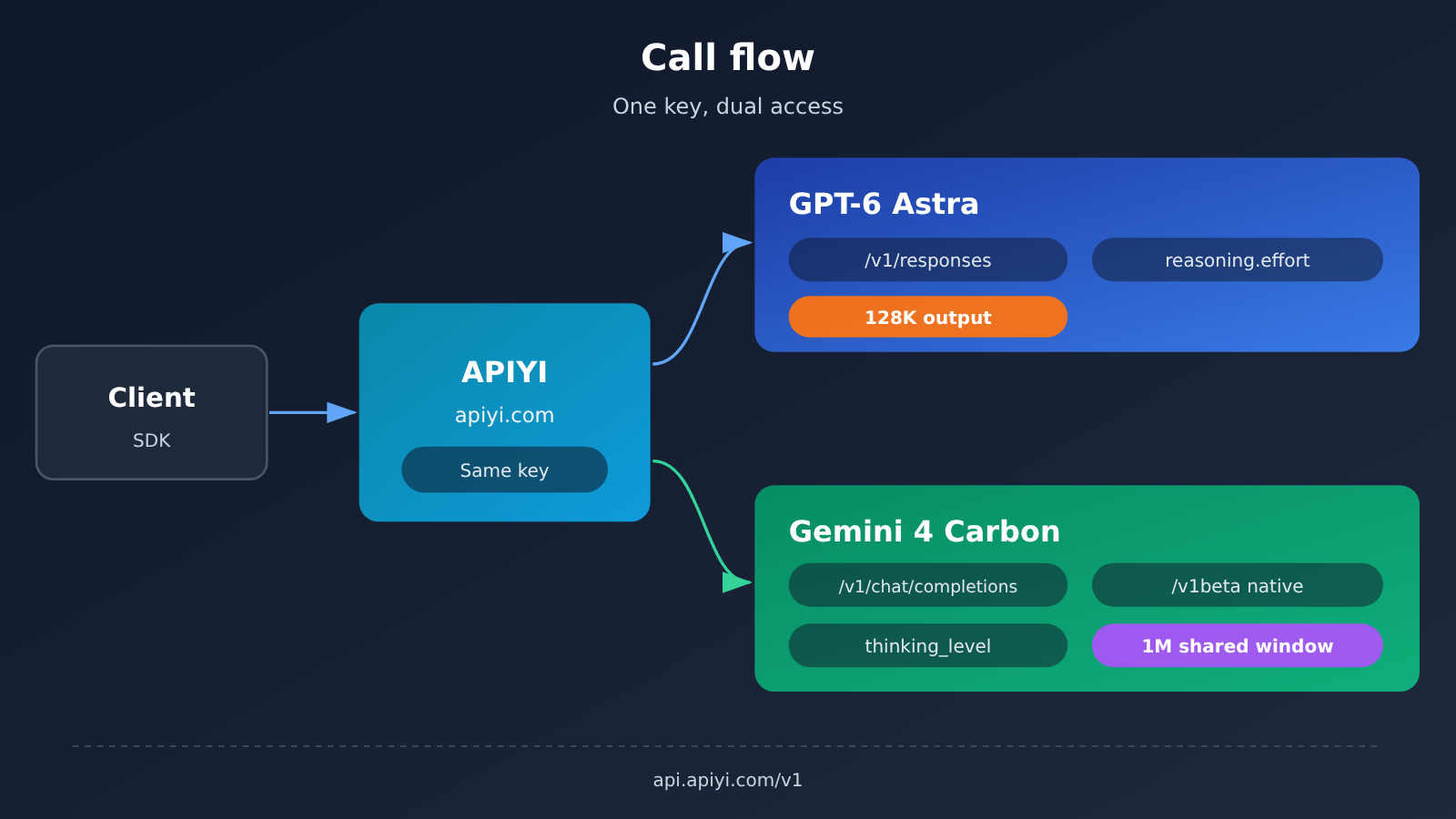
Key points for calling GPT-6 Astra:
- Use the OpenAI SDK, set
base_urltohttps://api.apiyi.com/v1, and usegpt-6-astraas the model name. - Prefer
client.responses.create(...). Pass reasoning effort viareasoning={"effort": "high"}; the options are low, medium, high, xhigh, and max. - Keep each request’s input under 272K tokens, otherwise the whole request is billed at the higher pricing tier.
Key points for calling Gemini 4 Carbon:
- OpenAI-compatible mode: use the same
base_url, call/v1/chat/completions, and usegemini-4-carbonas the model name. - Gemini native mode: use the
/v1betaendpoint and setthinking_levelto low, medium, or high. For how thinking levels map under the compatible interface, check the APIYI documentation. - Migrating from
gemini-4-argononly requires changing the model name.thinking_budgetis deprecated, and custom temperature, top_p, and top_k values are ignored with a warning. - Don’t create or pass an explicit
cached_contentanymore, since implicit caching is on by default. Hard problems can run for several minutes, so set your client timeout to 15–20 minutes.
🚀 Quick start: Both models are already listed on APIYI (apiyi.com), and one key is all you need to call either. Start by running the same batch of tasks on Carbon at medium and Astra at medium, compare result quality and actual billing, and then decide whether to move up a tier.
Scenario Recommendations: When to Pick Gemini 4 Carbon vs. GPT-6 Astra
One way to think about it is to split common work by task type. Everything in the “Basis” column comes from officially self-reported benchmarks or recommendations in the official docs.
| Task Type | Recommendation | Basis |
|---|---|---|
| Fixing issues in real repositories, modifying code in public projects | GPT-6 Astra | FrontierSWE 2: 65.5%, the highest in the table |
| Retrieval and cross-referencing across documents beyond 256K | Gemini 4 Carbon | GraphWalks: 96.2% vs. 71.8%, with no price jump at 272K |
| Formal math, scientific reasoning, terminal-based science tasks | Gemini 4 Carbon | Higher on RiemannBench and Terminal-Bench-Science |
| Workflow automation, knowledge-work evaluations | Gemini 4 Carbon | Higher on AutomationBench and Vals Index |
| Single, very long outputs (over 65K) | GPT-6 Astra | 128K output limit, no background mode needed |
| Audio or video as input | Gemini 4 Carbon | Astra only accepts text and images |
| Agents already built on the Responses API | GPT-6 Astra | Native protocol support, with access to the xhigh and max tiers |
| Computer use, desktop tasks | Neither is the first choice | Claude Opus 5.5 scores 87.2% on OSWorld-2.1 |
| Everyday feature development, interactive coding | Gemini 4 Argon | Google’s official recommendation: same unit price, but uses fewer tokens |
Typical Scenarios for GPT-6 Astra
If your team has already built its agents on the Responses API, needs max-tier reasoning to think through hard problems, or needs to generate long files of close to 128K in one pass, Astra’s protocol and specs are a better fit. It’s also strong at engineering fixes on public repositories. The trade-off is a unit price roughly 5x higher, plus a surcharge applied to the entire request once input goes past 272K.
Typical Scenarios for Gemini 4 Carbon
For retrieval and synthesis across long documents and large codebases, math and scientific reasoning, and multimodal analysis that needs audio or video input, Carbon comes out ahead on both benchmarks and price. Google’s own advice is pretty clear too: save Carbon for work that pushes against the capability ceiling, and keep using Argon for most everyday software engineering and knowledge work. In the Antigravity /swarm preview, Google also recommends putting Carbon in the roles that demand the deepest reasoning, such as architecture, coordination, and auditing.
Gemini 4 Carbon vs. GPT-6 Astra: Decision Guide
Breaking the choice into three questions settles most cases quickly:
- What’s your protocol stack? If you’re already on the Responses API, lean toward Astra. If you use the Gemini SDK or a generic Chat interface, lean toward Carbon.
- Will a single input ever exceed 272K? If so, Astra bills the entire request at 20/75, which widens Carbon’s cost advantage even further.
- What kind of task is it? For repo-level code repair, look at FrontierSWE 2, which favors Astra. For long context, science, and automation, look at Carbon.
Two more boundaries are worth spelling out. Dedicated cybersecurity capabilities go through the Fairwind Program. Swapping the model name to gemini-4-carbon doesn’t give you Cyber Permissive, and the official site doesn’t offer promotional pricing for Cyber Permissive either. Also, Carbon’s $2 promotional price ends on 2026-11-30, so if you budget monthly, factor in the price change in December.
💡 Recommendation: The most reliable approach is to split the work between the two models rather than pick just one. Through APIYI (apiyi.com), you can access both with a single key. Route code-repair requests to Astra and long-document and scientific-reasoning requests to Carbon. Switching only requires changing the model name and the endpoint.
FAQ
Q1: What is Gemini 4 Carbon, and how does it relate to Argon?
Gemini 4 Carbon is Google’s flagship model built on Gemini 4 Argon. Its model ID is `gemini-4-carbon`, and Google calls it its most capable model to date. The two share the same thinking_level options, the same 1M shared context window, and the same entry-level pricing. Carbon uses more thinking tokens, though, which makes it a better fit for the hardest multi-step tasks.
Q2: Which is stronger, Gemini 4 Carbon or GPT-6 Astra?
It depends on the task. Going by the self-reported numbers on Google’s model card, Astra leads on FrontierSWE 2, Carbon leads on GraphWalks, RiemannBench, Terminal-Bench 4.0 and several others, and the two are basically tied on SWE-sweep. On AA Index v5.0 the score is 59 vs. 57, but that’s a figure Google cites as of October 2026, not an independent third-party re-test.
Q3: When can I use Gemini 4 Carbon through the API?
When it was first announced on October 28, 2026, access was limited to a select group of cybersecurity defenders. Starting November 10, it opened to paying developers, and the Gemini API changelog lists it as GA as of the same day.
Q4: Does GPT-6 Astra charge $100 for long-context output?
No. Once input goes past 272K tokens, the whole request is billed at 2x for input and cached tokens and 1.5x for output. That works out to $75 per million output tokens and $20 per million input tokens.
Q5: How do I call both Gemini 4 Carbon and GPT-6 Astra?
1. Sign up at APIYI (apiyi.com) and grab an API key. New users get free test credits.
2. Set your SDK’s base_url to `https://api.apiyi.com/v1`.
3. For Astra, use `gpt-6-astra` via `/v1/responses`. For Carbon, use `gemini-4-carbon` via `/v1/chat/completions` or the native `/v1beta` endpoint.
Q6: After December 1, will Carbon still cost one-fifth of Astra?
Starting December 1, Google’s official pricing for Carbon goes up to $4 per million input tokens and $20 per million output tokens, which puts it roughly 2.5x cheaper than Astra’s base tier. Whether APIYI adjusts its prices to match will depend on what’s listed in the model list on apiyi.com that day.
Q7: What are the known limitations of the two models?
Carbon’s model card lists hallucinations, jailbreak resistance that’s still being strengthened, occasional slowdowns or timeouts, and higher token consumption at the higher thinking levels. Default synchronous output is capped at 65,536 tokens, and the knowledge cutoff is March 2026. Astra doesn’t accept audio or video input, has a higher unit price, and bills the entire request at a higher rate once input exceeds 272K tokens.
Gemini 4 Carbon vs. GPT-6 Astra: Key Takeaways
- They’re not replacements for each other: Each one leads in different areas, so splitting work by task is a better deal than just looking at the overall leaderboard.
- Astra for code fixes: On FrontierSWE 2, it scores 65.5% vs. 61.2%, the highest Astra score in the table.
- Carbon for long context and science: GraphWalks is 96.2% vs. 71.8%, and RiemannBench is 80% vs. 72%.
- SWE-sweep is a tie: 9.6% vs. 9.5%, a gap well within the margin of error.
- About a 5x price gap: Carbon’s promotional tier is 2/10, Astra’s base tier is 10/50, and Astra goes to 20/75 once input exceeds 272K.
- Different protocols: Astra prefers the Responses API, while Carbon uses the native Gemini API or OpenAI-compatible Chat.
- One key for both: Both models are available on APIYI (apiyi.com), which makes it easy to split traffic and compare them.
Summary
The core conclusions from comparing Gemini 4 Carbon and GPT-6 Astra:
- Each wins on different benchmarks: Astra wins on engineering problems from public repositories, while Carbon wins on long context, scientific reasoning, and most knowledge-work tables. All numbers are self-reported by the vendors.
- Each has its own spec limits: Astra has a standalone 128K output and a 272K billing tier. Carbon has a shared 1M window, with a default synchronous output of 65,536.
- Pricing is time-sensitive: Carbon’s promotional price on the official site runs until 2026-11-30, and doubles starting December 1.
In practice, we’d suggest putting both models behind the same routing logic: send code-fix tasks to Astra and long-document or scientific tasks to Carbon. You can use a single key on APIYI (apiyi.com) to run a batch of real tasks, then compare the results and the billing before deciding how to split the workload.
📚 References
- Gemini 4 Carbon Availability Announcement: Google official blog, 2026-11-10
- Link:
blog.google/innovation-and-ai/models-and-research/gemini-models/gemini-4-carbon-now-available -
Notes: Availability scope and channels
-
Gemini 4 Carbon Model Card: Google DeepMind
- Link:
deepmind.google/models/model-cards/gemini-4-carbon/ -
Notes: Benchmark results as of October 2026 and known limitations
-
Gemini 4 Carbon Developer Guide: Google AI Studio
- Link:
aistudio.google.com/learn/gemini-4-carbon-developer-guide -
Notes: thinking_level, the 1M shared window, and migration considerations
-
Google Cloud Model Pricing: Model Garden pricing page
- Link:
cloud.google.com/model-garden/pricing -
Notes: Promotional period and official list prices starting December 1
-
GPT-6 Astra Model Page: OpenAI developer docs
- Link:
developers.openai.com/api/docs/models/gpt-6-astra -
Notes: Context window, output limits, and reasoning.effort levels
-
OpenAI API Pricing: OpenAI developer docs
- Link:
developers.openai.com/api/docs/pricing -
Notes: 272K tiered pricing and cache write prices
-
APIYI Model List and Pricing API
- Link:
docs.apiyi.com/models,api.apiyi.com/api/pricing - Notes: Models, groups, and listed prices; the console is the source of truth
Author: APIYI Technical Team
Technical Discussion: Feel free to reach out to us on the APIYI homepage. For more details on model integration, visit the docs.apiyi.com documentation center.


