

Author’s note: if you’re already on gemini-4-argon, should you switch to gemini-4-carbon? Based on Google’s developer guide and model cards, this article covers what the two models have in common, where they differ, the 4 legacy parameters to clean up when you migrate, and when you shouldn’t switch at all.
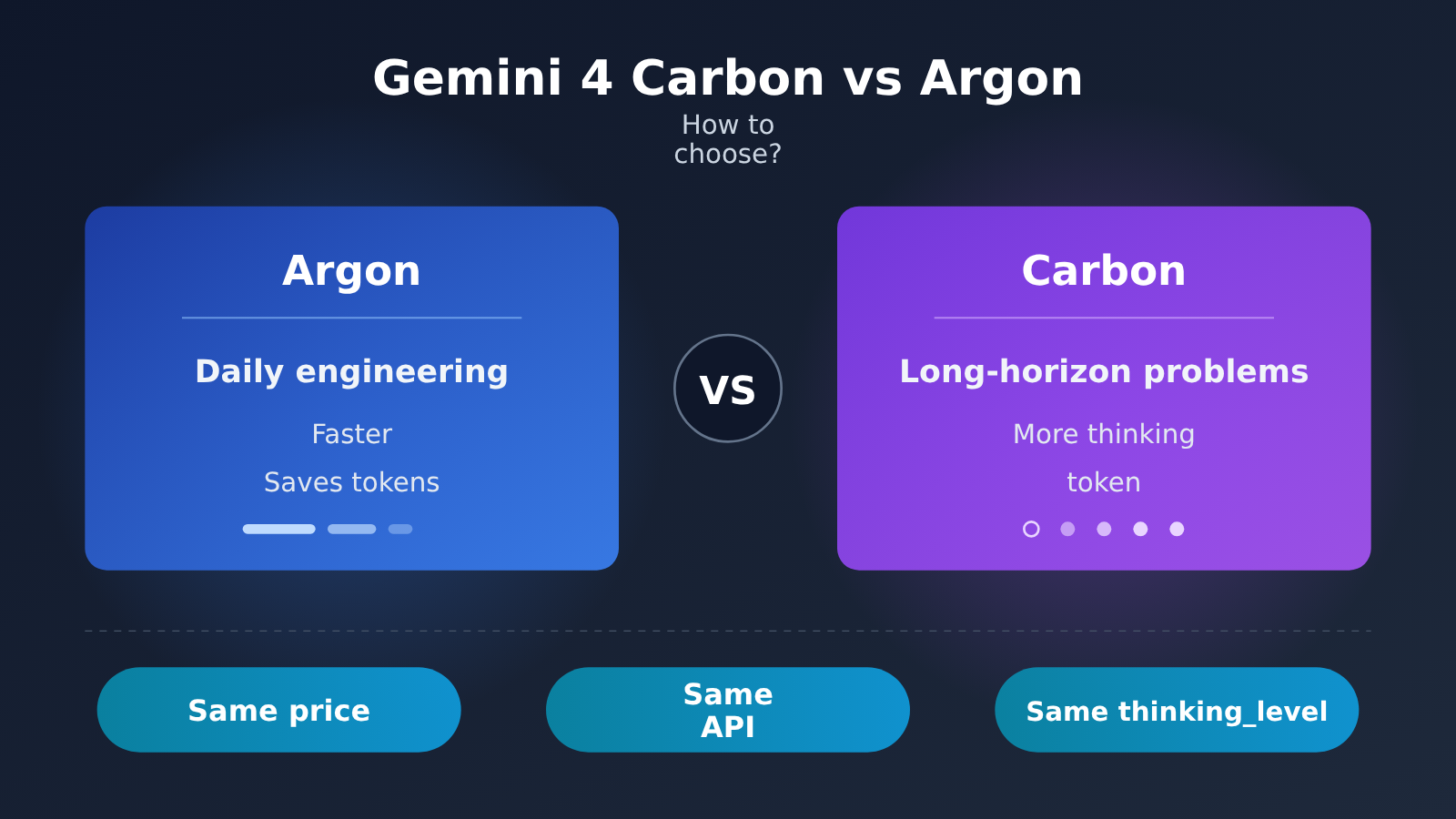
The short version: Gemini 4 Carbon and Gemini 4 Argon have the same entry-level pricing, but don’t swap Argon out wholesale for everyday feature development. Google’s developer guide recommends sticking with Argon for most software engineering and knowledge work, and moving to Carbon only when the task difficulty hits the ceiling. Same unit price doesn’t mean same bill, because Carbon spends more thinking tokens and is slower.
This isn’t a “the new model is stronger, so switch everything” recommendation. On 2026-11-10, the Google official blog announced that Gemini 4 Carbon is available to paid developers, and the Gemini API changelog recorded gemini-4-carbon reaching GA the same day. Argon’s GA entry is dated 2026-11-05. All benchmark numbers in this article come from official self-reports or documentation, not from third-party head-to-head tests.
What you’ll get out of this: by the end, you’ll know when to switch between Gemini 4 Carbon and Gemini 4 Argon, which 4 legacy parameters to clear out when you change the model name, and which scenarios are better (and cheaper) to keep on Argon.
Gemini 4 Carbon vs. Gemini 4 Argon: Start with What’s the Same
Gemini 4 Carbon is built on Gemini 4 Argon. According to the developer guide, moving from gemini-4-argon to gemini-4-carbon only requires swapping the model name. Both use the same thinking_level setting and the same shared 1M window, so the migration constraints are identical. The real question is whether the extra thinking tokens are worth paying for. Reworking your integration isn’t the problem.
| Item | Gemini 4 Argon | Gemini 4 Carbon | Same? |
|---|---|---|---|
| Model ID | gemini-4-argon |
gemini-4-carbon |
Name only |
thinking_level |
low / medium / high, default medium | low / medium / high, default medium | Same |
| Context window | 1M shared across input, thinking, and output | 1M shared across input, thinking, and output | Same |
| Default synchronous output limit | 65,536 tokens | 65,536 tokens | Same |
| Caching | Implicit caching, 95% discount on cached input | Implicit caching, 95% discount on cached input | Same |
temperature / top_p / top_k |
Ignored with a warning | Ignored with a warning | Same |
thinking_budget |
Deprecated | Deprecated | Same |
| Input modalities | Text, image, audio, video | Text, image, audio, video | Same |
Window Size and Thinking Levels in Gemini 4 Carbon and Argon
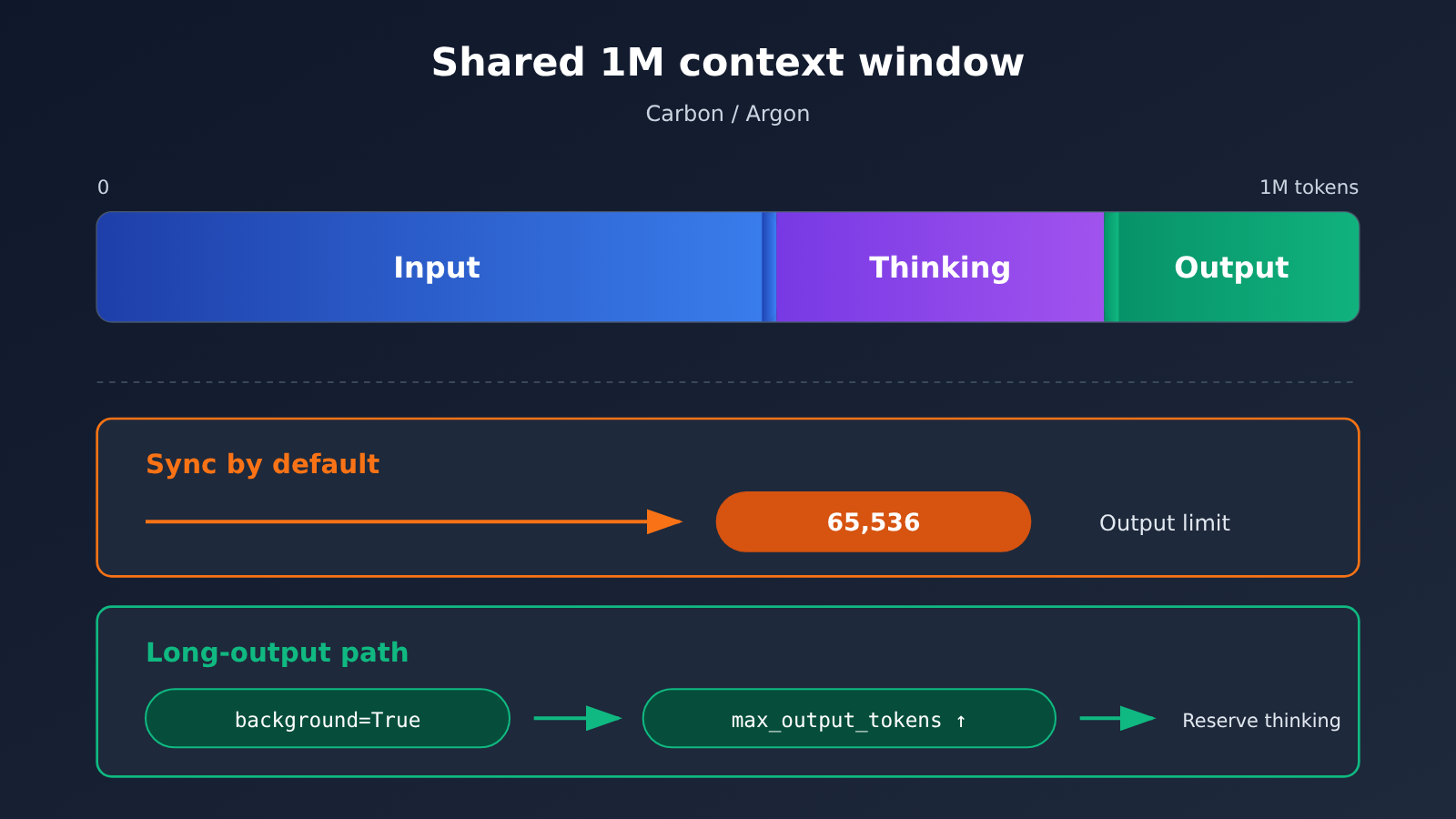
Previous-generation models capped “thinking plus answer” at 64K. Carbon and Argon both switch to a 1M-token window shared across input, thinking, and output. One thing to watch: the default synchronous output limit is still 65,536 tokens. If you want longer output, you need to set background=True on the Interactions API and raise max_output_tokens above 65536. Leave some headroom for thinking too, so the answer doesn’t get truncated.
thinking_level works the same way on both models. The docs recommend high for multi-file root-cause analysis, security patches, formal mathematics, and early-stage architecture design. Medium is the default balance between speed, cost, and getting it right the first time. Low suits classification, routing, and targeted extraction. Carbon only outputs text, so you can’t use it as an image or video generation model.
Gemini 4 Carbon vs. Gemini 4 Argon: Core Differences
The real difference between the two is “thinking depth.” Google’s developer guide states that Carbon uses more thinking tokens than Argon, exploring hypotheses fully and running verification loops for longer. Argon is positioned as the leaner, faster option for interactive use. So if you send the same prompt to both, Carbon can cost more and take longer per task.
| Dimension | Gemini 4 Argon | Gemini 4 Carbon | Edge |
|---|---|---|---|
| Official positioning | Most software engineering and knowledge work | Hard problems that push the intelligence ceiling | Depends on task difficulty |
| Thinking token usage | Leaner | Higher | Argon is cheaper |
| Response speed | Faster, suited to interactive use | Hard prompts may take several minutes | Argon is faster |
| Model card benchmark scores | Baseline | Generally higher on comparable items | Carbon |
| Cost per task | More predictable | Can be higher at the same unit price | Argon |
| Cybersecurity-specific capabilities | Not included | High scores come from the Fairwind path | Renaming won’t unlock them |
Gemini 4 Carbon Model Card Benchmarks vs. Argon
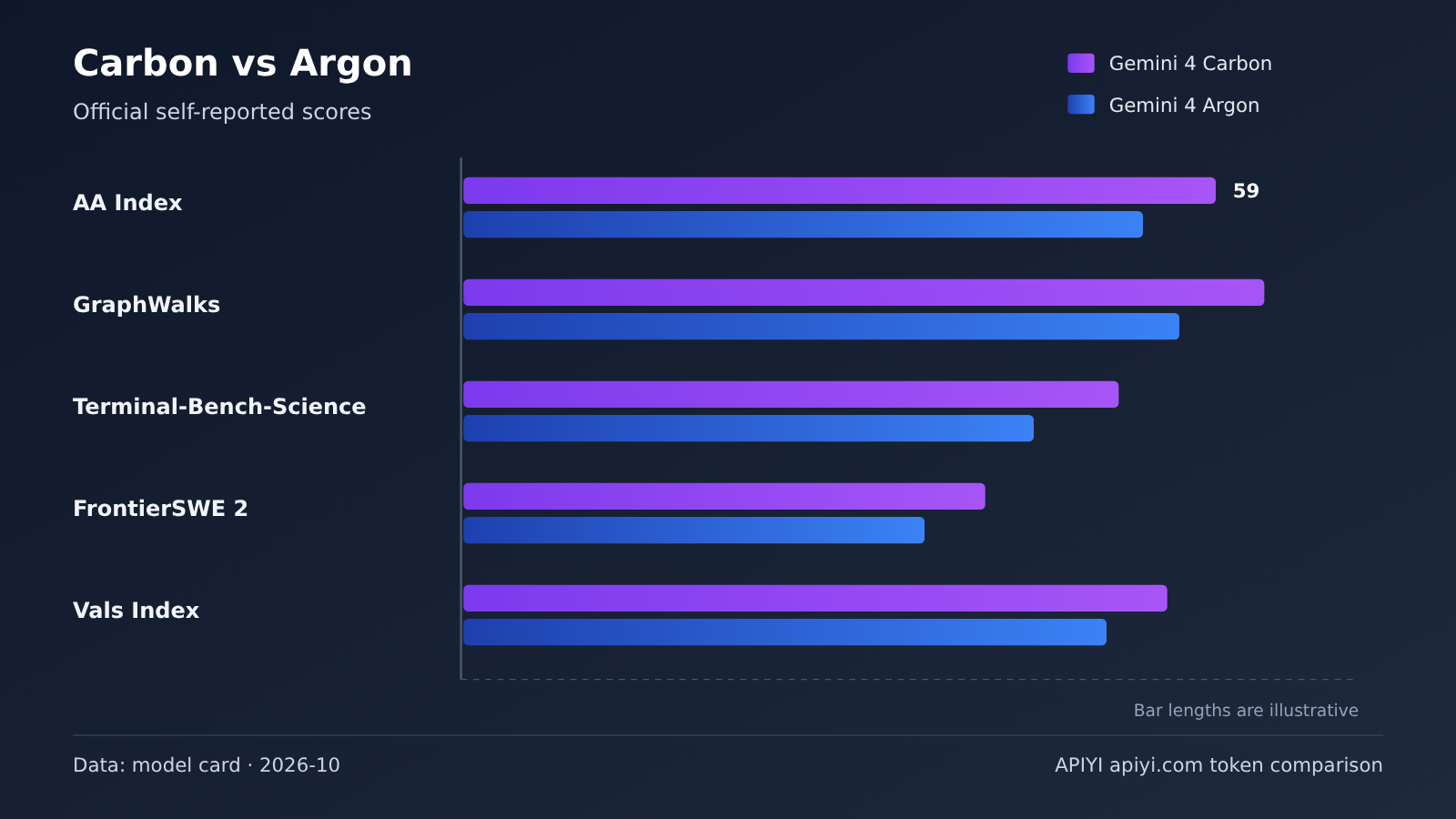
The data below comes from the Gemini 4 Carbon model card, published in November 2026, with results as of October 2026. These are officially self-reported. On Terminal-Bench 4.0, Argon’s cell is printed in the model card as “571%”, which isn’t a plausible percentage, so this article skips that item and only notes that Carbon scores 65.2% on it.
| Benchmark (officially self-reported, as of 2026-10) | Gemini 4 Carbon | Gemini 4 Argon | Takeaway |
|---|---|---|---|
| AA Index v5.0 | 59 | 50 | Clear lead in overall intelligence |
| GraphWalks 256k–1M BFS (F1) | 96.2% | 84.2% | Big gap in long-context retrieval |
| Terminal-Bench-Science 0.1 | 64.8% | 52.9% | Ahead on scientific terminal tasks |
| RiemannBench | 80.0% | 76.0% | Slight lead in mathematical reasoning |
| FrontierSWE 2 | 61.2% | 55.0% | Ahead in coding |
| SWE-sweep | 9.6% | 4.3% | Both absolute scores are low |
| Agents’ Last Exam v1.1 | 77.4% | 69.0% | Ahead on agent tasks |
| OSWorld-2.1 offline subset | 81.5% | 74.7% | Ahead of Argon on computer use |
| Vals Index v2.2 | 70.4% | 69.2% | Very small gap |
| Chartography | 72.5% | 71.6% | Very small gap |
A few things stand out in the table. On long-context GraphWalks, the science-oriented benchmarks, and most of the coding benchmarks, Carbon’s lead over Argon is pretty clear. Vals Index and Chartography differ by only about 1 percentage point, which you probably won’t notice in everyday knowledge work. Also, Carbon doesn’t win everything in this table: the top score on FrontierSWE 2 belongs to GPT-6 Astra (65.5%), and the top score on OSWorld-2.1 belongs to Claude Opus 5.5 (87.2%).
For the AA Index, this article consistently uses the 59 cited in the model card, which is the October 2026 AA Index v5.0. A third-party page showed a different number on 2026-11-11, but the information on that page contradicts itself, so we don’t treat it as a confirmed value.
How to Read Gemini 4 Carbon’s Cybersecurity Scores
The model card reports CWE-bench, ExploitGym, and SEC-bench Pro results under the Fairwind Program path. The October 28 release post also states that these benchmarks were run without guardrails. The specialized cybersecurity capabilities are only available to verified defenders through the Fairwind Program, so the paid API doesn’t give you the same capabilities by default.
In other words, switching the model name to gemini-4-carbon won’t automatically get you these security scores, and it doesn’t mean you’re running the Cyber Permissive version. Cyber Permissive also doesn’t qualify for promotional pricing on Google’s official price list, which we’ll come back to in the pricing section below.
Gemini 4 Carbon vs. Argon Pricing: Same Unit Price Doesn’t Mean the Same Bill
Let’s start with Google’s official pricing. Based on the Google Cloud and AI Studio pricing pages as checked on 2026-11-11, Carbon and Argon share exactly the same price tiers. Through 2026-11-30, the global price is $2 input, $0.10 cached input, and $10 output per 1M tokens. From 2026-12-01, it goes up to $4 input, $0.20 cached input, and $20 output. Output pricing covers both the answer and the reasoning portion, so the more thinking tokens a model uses, the higher your bill.
| Billing item (USD / 1M tokens) | Gemini 4 Argon | Gemini 4 Carbon | Platform |
|---|---|---|---|
| APIYI input | 2 | 2 | APIYI apiyi.com |
| APIYI output | 10 | 10 | APIYI |
| APIYI cache read | 0.10 | 0.10 | APIYI |
| APIYI groups | default, svip | default, svip | APIYI |
| APIYI endpoints | gemini, openai | gemini, openai | APIYI |
| Official global price (through 11-30) | 2 / 0.10 / 10 | 2 / 0.10 / 10 | Google official |
| Official global price (from 12-01) | 4 / 0.20 / 20 | 4 / 0.20 / 20 | Google official |
The APIYI figures come from the pricing endpoint as of 2026-11-11: gemini-4-carbon is already listed at the same price as gemini-4-argon, the multiplier is 1 for both the default and svip groups, and it supports both the native Gemini endpoint (/v1beta) and the OpenAI-compatible endpoint (/v1/chat/completions). If the summary table in the docs you’re looking at hasn’t refreshed to include a Carbon row yet, go by the console and the pricing endpoint. Model availability and prices are subject to the platform’s model list. The prices in the table are default list prices, and actual charges are based on what the console shows.
At the same unit price, what drives your bill is the token count. On the high setting, Carbon explores more hypotheses and runs longer verification loops, so it produces noticeably more thinking tokens on the output side than Argon. When you evaluate cost, compare by total spend per task rather than by price per million tokens.
💰 Cost tip: If your project already calls
gemini-4-argonon APIYI (apiyi.com), check the model list before switching to confirm both IDs still have the same list price. Then pick a few representative hard prompts, run them through both models, and compare the output token count per request. That gives you a realistic estimate of how your bill will change after the switch.
How to Switch from Gemini 4 Argon to Gemini 4 Carbon
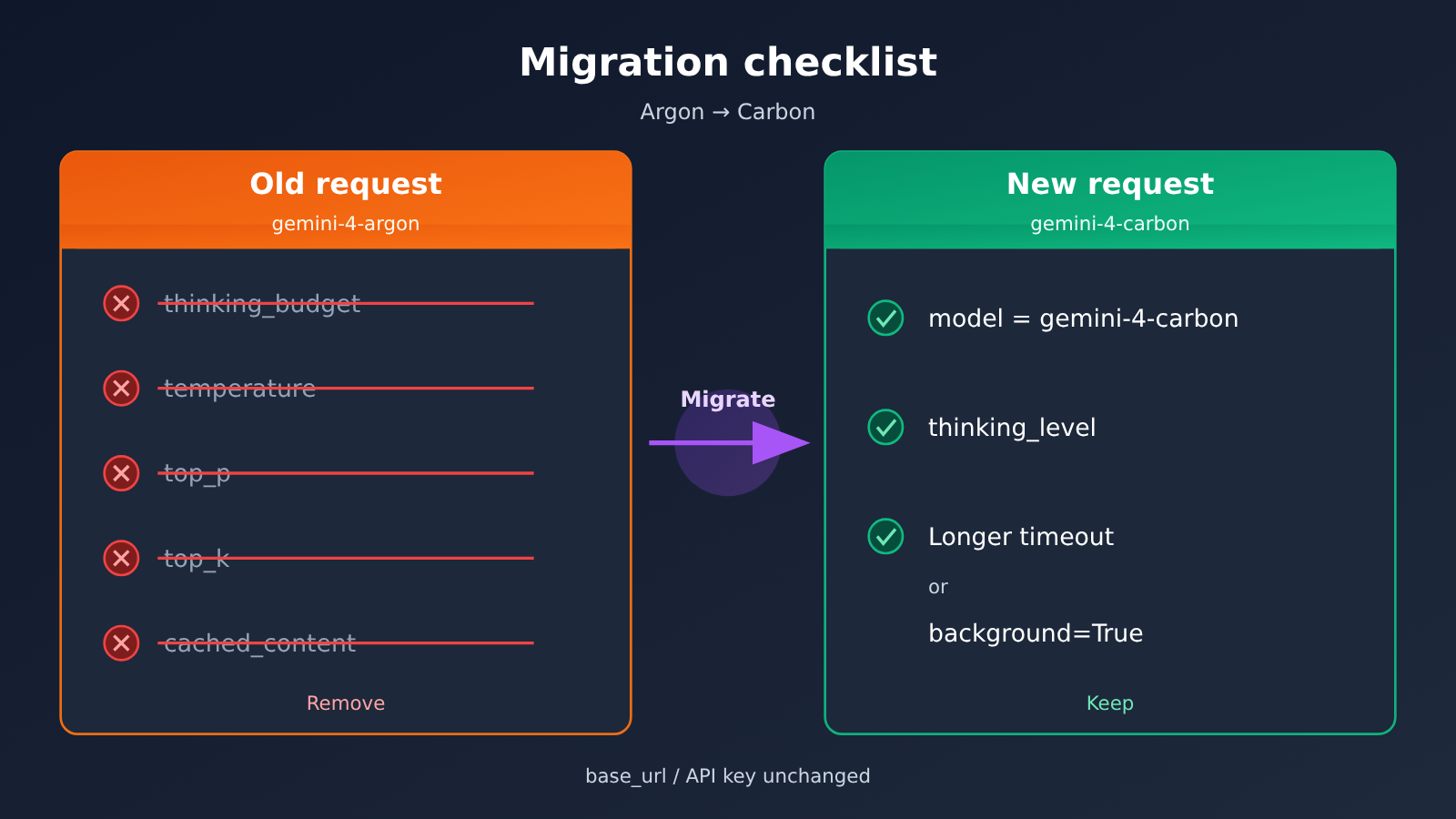
The migration itself is just a model name swap, but you’ll want to clean out the leftover parameters in your old code. Otherwise your logs will keep filling up with warnings, and the generation behavior won’t match what you expect. Here are the 4 legacy parameters to change when you swap the name:
thinking_budget: Deprecated, and passing it triggers a warning. Usethinking_levelinstead, and pick from low, medium, or high. The default is medium.temperature: Custom values are ignored with a warning. Just delete it, and don’t count on it to control randomness.top_p: Also ignored with a warning, so remove it too.top_k: Also ignored with a warning, so remove it as well.
There are two more related adjustments. Strictly speaking they aren’t sampling parameters, but they’re just as easy to trip over:
- Stop creating or passing an explicit
cached_content: Implicit caching is on automatically, and cached input gets a 95% discount, so you can take your manual caching code offline. - Increase your client timeout: Hard prompts can take several minutes to return. The developer guide recommends setting the client timeout to at least 15 to 20 minutes, or switching to asynchronous execution with
background=True. Carbon thinks longer, so this matters even more than it did with Argon.
Steps for Calling Gemini 4 Carbon Through APIYI
If you’re already calling Argon through the OpenAI-compatible interface, switching only takes a few steps:
- Keep
base_urlashttps://api.apiyi.com/v1, and keep your API key the same. - Change the
modelfield fromgemini-4-argontogemini-4-carbon. - Delete the 4 legacy parameters
temperature,top_p,top_k, andthinking_budget, and keep or addthinking_level. - Remove any logic related to an explicit
cached_content, and raise the client timeout to 15 minutes or more. - Run a gradual rollout with a batch of real hard problems, record output token counts and latency, and expand the scope once you’ve confirmed the gains.
If your project uses the native protocol, the same applies on the gemini endpoint (/v1beta): you only change the model name, and the other cleanup steps are the same. Both models share the same API key, so you don’t need to enable anything separately.
🚀 Quick start: We recommend running a gradual rollout on apiyi.com using the free credits for new users. With the same key calling both Argon and Carbon, you can route traffic by task type in your business logic instead of switching models all at once.
Gemini 4 Carbon vs. Argon: Which One for Which Job?
Google’s official post puts it plainly: if Argon is for complex tasks, Carbon is the model you reach for when the problem is the hardest one on your list. In practice, here’s how to split the work:
When to Choose Gemini 4 Carbon
- Long-horizon, multi-step engineering: Complex multi-file debugging, architecture design, and audits, where the model needs to run verification loops for a long time.
- Ultra-long-context retrieval: Material that approaches the 1M window, where you need graph traversal or cross-passage reasoning. The gap on GraphWalks tells the story best.
- Science and formal mathematics: Open-ended scientific research and formal proofs. Both Terminal-Bench-Science and RiemannBench favor Carbon.
- High-precision synthesis: Analyzing financial or legal materials, where you’d rather wait a bit longer than risk errors.
- The “brain” in agent orchestration: For the
/swarmfeature in the Antigravity preview, Google recommends putting Carbon in the architecture, coordination, and audit roles, and handing the parallel implementation slices togemini-4-argonorgemini-3.8-flash.
When to Stay with Gemini 4 Argon
- Everyday feature development: Writing endpoints, tweaking pages, adding tests. Argon’s quality is good enough, and it’s faster.
- Interactive coding: In-IDE completion and conversational code edits. Carbon’s multi-minute waits would slow your flow.
- Knowledge work and document processing: Summarizing, rewriting, Q&A. On the Vals Index, the two are only about 1 percentage point apart.
- Classification, routing, and extraction: These belong on the low tier anyway, so switching to Carbon doesn’t buy you much.
- Batch jobs that are sensitive to per-task cost: At the same unit price, Argon uses tokens more tightly, so your bill stays more predictable.
Don’t Look Only at Gemini 4 Carbon for These
According to the model card, on the OSWorld-2.1 offline subset for computer use, Claude Opus 5.5 ranks first at 87.2%. On FrontierSWE 2, which uses public repositories, GPT-6 Astra tops the chart at 65.5%. On SWE-sweep, Carbon’s 9.6% and Astra’s 9.5% are essentially tied, and the gap is within the margin of error. For cybersecurity defense work, you should apply through Fairwind rather than expecting to get access just by switching model names.
Gemini 4 Carbon vs. Argon: Decision Guide
Here’s the whole thing boiled down to one decision flow. Start by asking: is this a task Argon can’t handle well? If Argon delivers reliably on your workload, keep using it. Only route requests to Carbon when Argon repeatedly fails at multi-step reasoning, drops information in long contexts, or doesn’t verify its work thoroughly enough.
A more practical approach is to split traffic by task type rather than swap everything over. For example, in your code you can pick the model name based on the task: default to gemini-4-argon for everyday requests, and only send requests tagged as “architecture review,” “root-cause analysis,” or “long-document synthesis” to gemini-4-carbon at the high tier. That way you get Carbon’s ceiling where it matters, without letting thinking tokens inflate your daily bill.
Keep an eye on the timing, too. The promotional pricing on the official site runs through 2026-11-30, and starting 12-01 the official prices for both models double in lockstep. Since the two models are always priced the same, the change doesn’t alter which one you should use. It just widens the bill gap that comes from Carbon spending more thinking tokens.
💡 Recommendation: Pick a model based on task difficulty, not on the assumption that newer is always better. We suggest running the same set of prompts through both models via APIYI (apiyi.com), then comparing success rate, latency, and output tokens to decide which tasks are worth upgrading to Carbon.
FAQ
Q1: What is Gemini 4 Carbon, and how does it relate to Argon?
Gemini 4 Carbon is the most capable Gemini model by Google’s current account. Its model ID is `gemini-4-carbon`, and it’s built on Gemini 4 Argon. It shares the same interface, `thinking_level`, and 1M shared window as Argon. The difference is that it spends more thinking tokens to tackle harder, longer-horizon tasks.
Q2: Carbon and Argon have the same unit price, so why is my Carbon bill higher?
Output pricing includes the reasoning portion, and Google states that Carbon uses more thinking tokens than Argon. For the same task, Carbon generates more tokens, so the total cost per task is naturally higher. When comparing costs, look at the total spend per task, not just the price per million tokens.
Q3: When did Gemini 4 Carbon become available?
Google first released Carbon on 2026-10-28, but only to a limited set of cybersecurity defenders. On 2026-11-10, Google officially announced it was opening up to paid developers, enterprises, scientists, and consumers, and the Gemini API changelog recorded GA on the same day. On the consumer side, you need Google AI Ultra. Google hasn’t given a date for when free and lower-tier users will get access.
Q4: What code changes do I need to make when switching from Argon to Carbon?
Change the model name to `gemini-4-carbon`, then remove these 4 legacy parameters: `thinking_budget`, `temperature`, `top_p`, and `top_k`. You should also stop passing an explicit `cached_content`, and either raise your client timeout to 15–20 minutes or switch to `background=True`.
Q5: How can I quickly call Gemini 4 Carbon through the API?
You can test both models with a single key:
1. Sign up at APIYI (apiyi.com) and get an API key. New users get free test credits.
2. Set `base_url` to the OpenAI-compatible endpoint and set `model` to `gemini-4-carbon`.
3. Run the same set of prompts again with `gemini-4-argon`, then compare output quality and token usage.
Both models support the native Gemini endpoint and the OpenAI-compatible endpoint.
Q6: What are the known limitations of Gemini 4 Carbon?
The limitations listed in the model card include: it can still hallucinate like other base models, jailbreak resistance is still being strengthened, it occasionally slows down or times out, and higher thinking levels consume more tokens. The knowledge cutoff is March 2026, and some domains may be older. If you run into timeouts, switch to `background=True`, and fall back to Argon for everyday tasks.
Q7: Will switching to Gemini 4 Carbon give me the specialized cybersecurity capabilities?
No. The high cybersecurity scores in the model card come from the Fairwind Program path, which is for verified defenders. The paid API doesn’t give you Cyber Permissive by default, and Cyber Permissive isn’t eligible for the promotional pricing on the official pricing page either.
Gemini 4 Carbon vs. Argon: Key Takeaways
- Same interface, same unit price: Migrating is just a model-name swap.
thinking_leveland the shared 1M context window behave identically. - Same unit price, different bill: Carbon produces more thinking tokens and runs slower, so the cost per task can end up higher.
- Stay on Argon by default: For everyday development, interactive coding, and knowledge work, Argon is faster and cheaper.
- Switch to Carbon for the hard stuff: Long-horizon engineering, ultra-long context, scientific reasoning, and high-precision synthesis are where the upgrade pays off.
- Clean up 4 legacy parameters: Remove
thinking_budget,temperature,top_p, andtop_k, and raise your timeouts. - Safety scores don’t carry over with a rename: Dedicated cybersecurity work goes through Fairwind, which is different from the default paid API.
- Route first, upgrade second: Compare the two models with the same API key and route by task type.
Summary
Here’s the bottom line on Gemini 4 Carbon vs. Gemini 4 Argon:
- They have far more in common than not: Swapping the model ID is enough. The thinking levels, context window, cache discount, and ignored parameters are all the same.
- The difference is thinking depth: Carbon scores higher than Argon on most comparable items in the model card, at the cost of more thinking tokens and longer waits.
- Routing by task is the best value: Keep everyday tasks on Argon, and hand Carbon only the long-horizon hard problems that push Argon to its limits.
If you’re already using gemini-4-argon, you don’t need to migrate everything. Pick out the hardest slice of your requests and run a gradual rollout. We recommend using APIYI (apiyi.com) to compare both models under the same key, looking at success rates and token consumption, so real data decides which tasks are worth upgrading.
📚 References
- Google Official Blog – Gemini 4 Carbon Availability Announcement: Opened to paid developers on 2026-11-10
- Link:
blog.google/innovation-and-ai/models-and-research/gemini-models/gemini-4-carbon-now-available -
Notes: The primary source for availability scope and channels
-
Google AI Studio – Gemini 4 Carbon Developer Guide: Migration notes and model selection advice
- Link:
aistudio.google.com/learn/gemini-4-carbon-developer-guide -
Notes:
thinking_level, the 1M window, deprecated parameters, and timeout recommendations all come from here -
Google DeepMind – Gemini 4 Carbon Model Card: Self-reported benchmark scores and known limitations
- Link:
deepmind.google/models/model-cards/gemini-4-carbon/ -
Notes: The data source for the benchmark table in this article, with results as of October 2026
-
Google Cloud – Model Pricing Page: Official pricing tiers for Carbon and Argon
- Link:
cloud.google.com/model-garden/pricing -
Notes: Promotional pricing through 11-30 and the new pricing starting 12-01
-
Gemini API Changelog: GA date records
- Link:
aistudio.google.com/docs/changelog - Notes: Carbon went GA on 2026-11-10, Argon on 2026-11-05
Author: APIYI Technical Team
Technical Discussion: If you have questions about model selection or migration, reach out to us on the APIYI homepage. Setup instructions for Argon are available atdocs.apiyi.com/models/gemini-4-argon


