

Can Claude Opus 5.6 Beat Its Rivals? The Direct Answer First
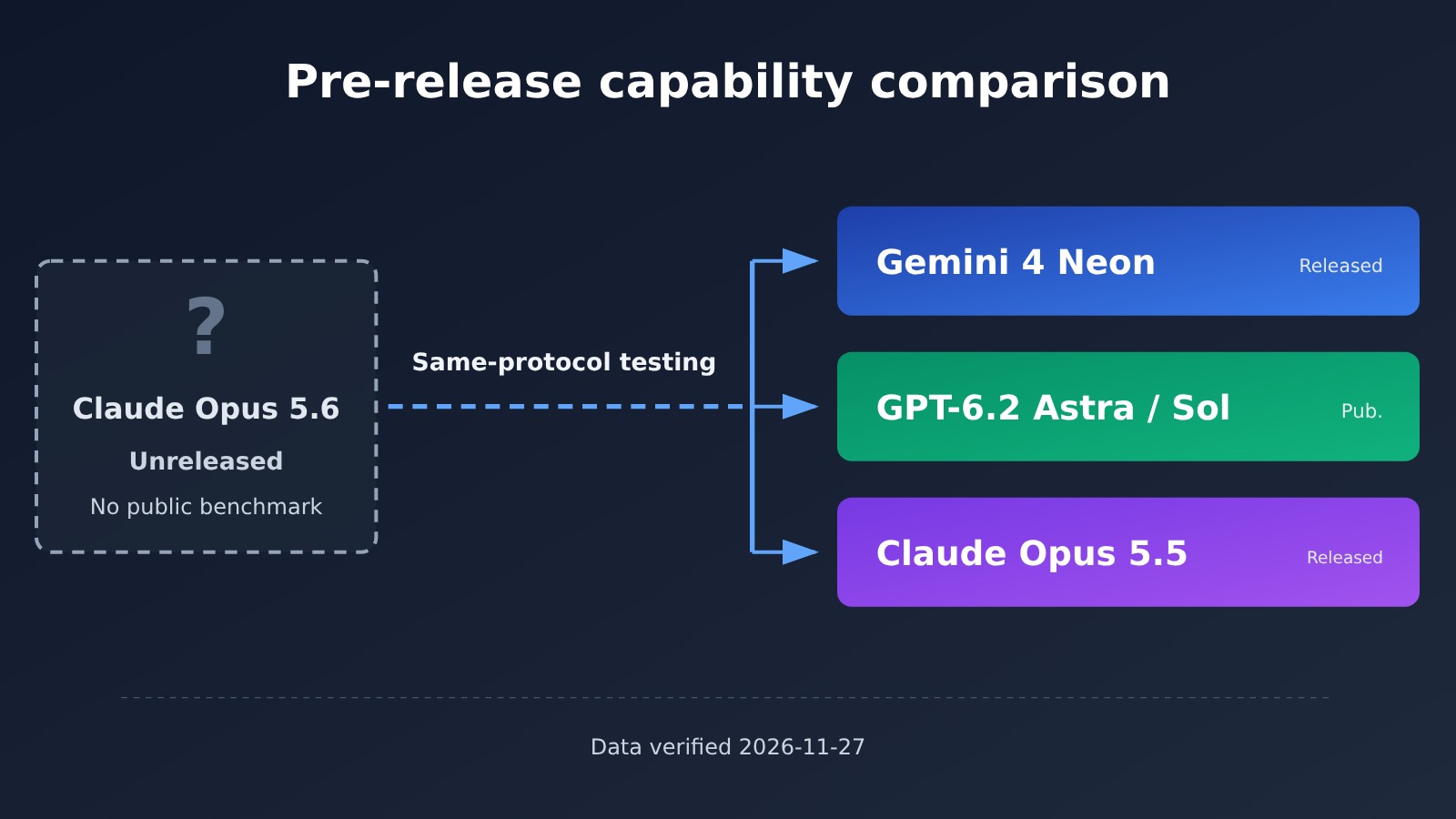
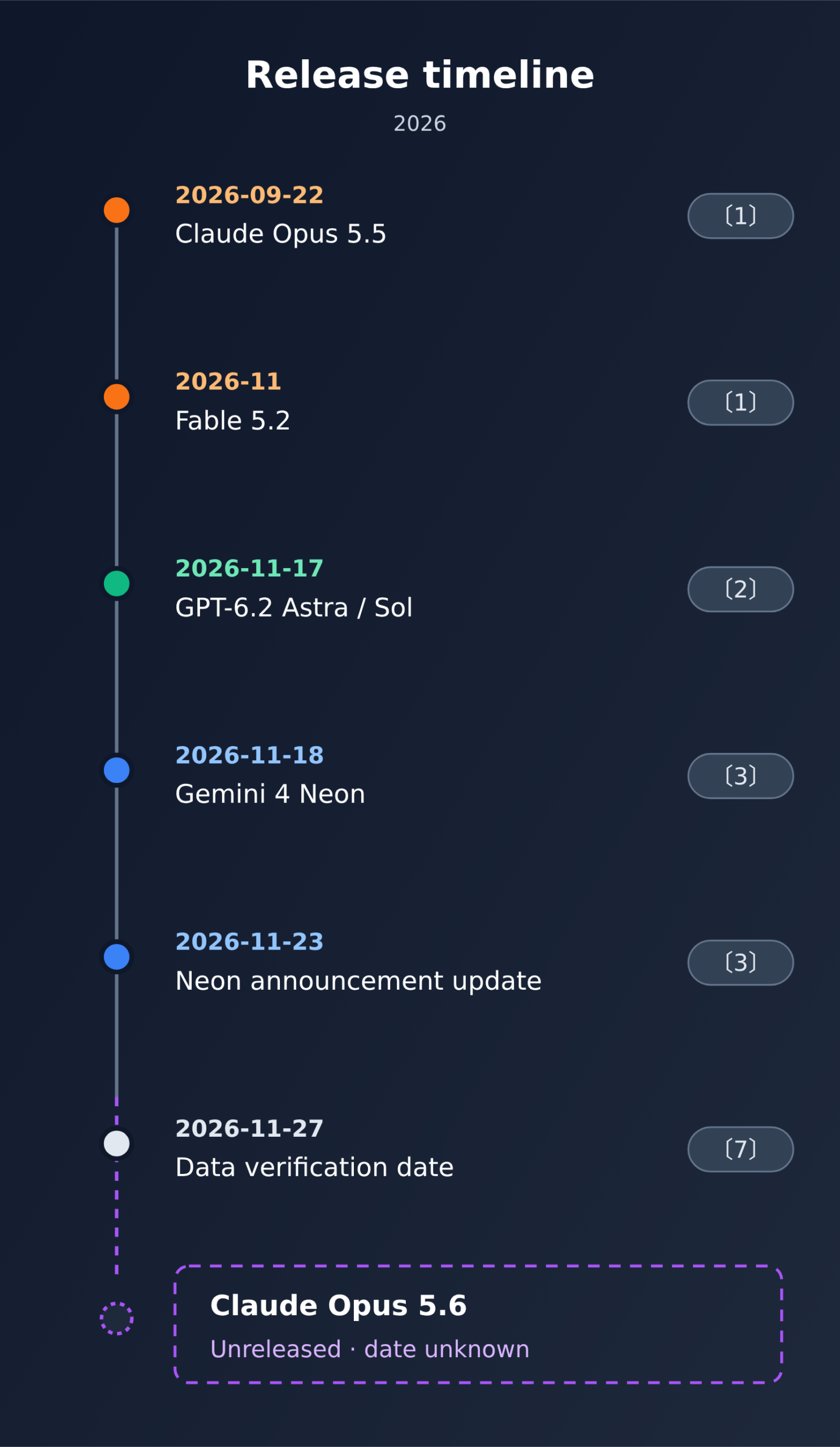
We can’t answer that yet. Any claim about who wins lacks evidence. As of November 27, 2026 (UTC), the current publicly available Opus from Anthropic is Opus 5.5. Claude Opus 5.6 has no public benchmark scores and no official launch materials, so it can’t be placed in a head-to-head ranking against Gemini 4 Neon or GPT-6.2.
What we can do now is first benchmark the rivals clearly. Gemini 4 Neon and GPT-6.2 (actually two model variants, gpt-6.2-astra and gpt-6.2-sol) already have official launch materials. We can use them and Opus 5.5 to establish an apples-to-apples baseline. Once Opus 5.6 ships, we only need to run it under the same protocol to get a valid conclusion.
What will you learn from this article?
- The published specs and standard pricing for Gemini 4 Neon, GPT-6.2 Astra, GPT-6.2 Sol, and Claude Opus 5.5
- Why benchmark scores with the same name in the two launch posts can’t be compared directly
- Three reproducible ways to test capability: code mergeability, interactive artifact delivery, and professional knowledge work
- A token-cost bill based on the same token counts, clearly labeled as a worked example, plus a cost metric calculated on a “per pass” basis
- A runnable Python baseline script that you can reuse directly once Opus 5.6 goes live
Index: “To Know” and “Impact at a Glance” first explain the terms, then describe how this affects different audiences. “The Objective Facts” organizes the official information on the three released models by timeline and includes a parameter table and a status comparison table. “Analysis and Judgment” explains why ranking isn’t possible before release, how to design a fair comparison, and how to read the bill. “Quick Start” provides the script, and “Testable Hypotheses” turns expectations for Opus 5.6 into falsifiable claims, followed by an FAQ and further reading.
Must-Know Concepts for Comparing Claude Opus 5.6
| Concept | Quick explanation |
|---|---|
| Token | The basic unit for model billing and context accounting. Tokenizers differ across providers, so the same text can produce different token counts. |
| Shared context | Gemini 4 Neon’s roughly one-million-token window holds input, thinking, and output together — not just input. |
| Thinking level | A reasoning-intensity setting. For example, Neon has four levels — low, medium, high, and ultra-high — with high as the default; OpenAI’s release post mentions a max level. |
| Cached input | Repeated prefix input is billed at a lower rate. Neon’s cached input costs $0.15 per million tokens. |
| FrontierCode 2.0 | A benchmark that evaluates whether a model’s changes to real codebases meet maintainers’ bar for merging. |
| Model comparison | Runs each model under the same environment, tools, and time limits to compare differences in the base models themselves. |
| Product comparison | Keeps each vendor’s client-specific agent, search, or template features; it compares “what you get when you buy a workflow.” |
| Pre-registered baseline | Tasks, success criteria, and scoring rules are published before testing. New models can only join under the same protocol and can’t cherry-pick samples after the fact. |
| Tail latency | The time taken by slow requests (e.g., the slowest 10%), which reflects production experience better than average latency. |
Impact at a Glance Before Claude Opus 5.6 Ships
- Developers: You can run baselines against Neon, Astra, Sol, and Opus 5.5 right now — no need to wait for Opus 5.6. The earlier you lock in your baselines, the cleaner your conclusions will be once the new model goes live.
- Tech leads and procurement: GPT-6.2 is actually two models with different positioning and pricing, so you must name the specific variant whenever you request a quote or run an evaluation. Sticker price alone isn’t enough — look at the cost per passing run.
- Frontend engineers and content creators: The 3D scenes, giant worksheets, and other demos in the launch materials depend on specific toolchains and assets. They don’t prove anything about the base model’s individual capabilities, so evaluate each output type separately.
Claude Opus 5.6’s Rivals: The Objective Facts
This section includes official materials only (marked 〔Official〕). The sources for this article contain no verifiable community benchmark scores, so no community data is cited. The author also ran no hands-on tests, and every dollar figure that appears below is a worked example built on official pricing.
Gemini 4 Neon: What Google Made Public
Google announced Gemini 4 Neon on November 18, and the announcement was last updated on November 23. The model identifier in the developer docs is gemini-4-neon. It supports generateContent and the Interactions API on the paid tier of the Gemini API, and Google AI Studio offers a trial entry point. [Official]
Its context window is about one million tokens, shared across input, thinking, and output. The regular synchronous output limit is defined separately from the long outputs available through background execution or continuation. Thinking settings have four levels—low, medium, high, and extra high—with high as the default. Standard pricing is $3 per million input tokens, $0.15 for cached input, and $15 for output. Google places particular emphasis on complex software engineering, multi-file debugging, and end-to-end completion efficiency. [Official]
The announcement also walks through two workflows. The first uses Antigravity’s multi-agent mode plus archival photos to reconstruct an interactive 3D scene of Turing’s study, with a working Turing machine inside the scene. The second generates a hundred-thousand-cell spreadsheet from a single image, using more than 500,000 live formulas to express edge, depth, and relighting effects. These two examples show what the toolchain can deliver, but the image assets, parallel agents, and spreadsheet calculations are all real-world requirements. [Official]
GPT-6.2 Astra and Sol: Always Specify the Model and Tier
On November 17, OpenAI publicly announced two GPT-6.2 models. GPT-6.2 Astra (gpt-6.2-astra) targets harder professional projects, covering industry documents, spreadsheets, slides, front-end work, 3D design, and software engineering. GPT-6.2 Sol (gpt-6.2-sol) targets efficient everyday tasks and multi-step agent tasks. [Official]
Under standard-tier short-context pricing, Astra costs $8 per million input tokens and $40 per million output tokens; Sol costs $2 per million input tokens and $10 per million output tokens. Long-context, cache-write, and processing tiers are listed in separate price tables. Throughout the rest of this article, “GPT-6.2” refers to the standard-tier short-context versions of these two models; we do not combine them into a single score or a single price. [Official]
The announcement described Astra’s performance in scenarios such as template reuse, browser interaction, and complex changes to existing codebases, and relayed results showing Sol close to Astra on FrontierCode 2.0. This comparison used the max tier. [Official · vendor-reported]
Claude Opus 5.5 and Fable 5.2: the Known Baseline on the Claude Side
Anthropic released Claude Opus 5.5 on September 22. The official catalog lists it at $4 per million input tokens and $20 per million output tokens, with a one-million-token context window, aimed primarily at long-running coding and knowledge work. [Official]
Fable 5.2, already publicly available in November, is positioned for harder reasoning and long-running agent tasks and can serve as an upper-bound reference on the Claude side. The sources for this article do not include Fable 5.2 pricing, so the table below marks it as “not excerpted.” [Official]
Claude Opus 5.6 Comparison Table
| Model (API identifier) | Released by & date | Context | Input $/million tokens | Output $/million tokens | Official positioning |
|---|---|---|---|---|---|
| Gemini 4 Neon (gemini-4-neon) | Google, 2026-11-18 | ~1M, shared across input/thinking/output | 3 (0.15 cached) | 15 | Complex software engineering, multi-file debugging |
| GPT-6.2 Astra (gpt-6.2-astra) | OpenAI, 2026-11-17 | Not excerpted in this source | 8 | 40 | Harder professional projects |
| GPT-6.2 Sol (gpt-6.2-sol) | OpenAI, 2026-11-17 | Not excerpted in this source | 2 | 10 | Efficient everyday work, multi-step agents |
| Claude Opus 5.5 | Anthropic, 2026-09-22 | 1M | 4 | 20 | Long-running coding and knowledge work |
| Claude Fable 5.2 | Anthropic, 2026-11 | Not excerpted | Not excerpted | Not excerpted | Harder reasoning, upper bound for long-running agents |
| Claude Opus 5.6 | Not yet released | Not disclosed | Not disclosed | Not disclosed | Not disclosed |
Table note: All prices are standard tier; GPT-6.2 figures are the short-context standard rates, with separate rate cards for long context and cache writes. Verified 2026-11-27; sources 〔1〕〔2〕〔4〕〔5〕〔6〕〔7〕.
Why Launch-Post Benchmarks Can’t Be Compared Directly
Both companies cite FrontierCode 2.0, but under different conditions. OpenAI used the max tier when comparing Astra and Sol, while Google, citing the benchmark of the same name, specifically noted that Neon used the default high tier. Tier names, available tools, actual cost, and number of attempts are all defined differently, so model names and the numbers in the two launch posts alone can’t produce a fair ranking.
| Comparison condition | Gemini 4 Neon | GPT-6.2 Astra / Sol | Claude Opus 5.6 |
|---|---|---|---|
| FrontierCode 2.0 tier | Default high (noted by Google) | max (OpenAI comparison) | Not released |
| Same methodology for tools and attempt counts? | Different methodology | Different methodology | Not applicable |
| Third-party retest under the same protocol | Not in the sources reviewed here | Not in the sources reviewed here | Not applicable |
| Can it be included in the same ranking? | Needs a new test under matching conditions | Needs a new test under matching conditions | No |
Claude Opus 5.6 Capability Comparison: Analysis and Assessment
Why You Can’t Rank Claude Opus 5.6 Before Release
Conclusions can only come from real tests run under the same protocol. A gap in release dates, a version number going from 5.5 to 5.6, demo work on social media — none of it lets you infer a winner on any single dimension. This article doesn’t predict where Opus 5.6 will rank. What follows is about how to build the baseline and how to turn expectations into testable hypotheses.
The baseline needs two Claude reference points. Opus 5.5 is a known baseline in the same family, answering the generational question: “how much better is 5.6 than 5.5?” Fable 5.2 is an upper-bound reference at a higher budget, answering the procurement question: “if I’m willing to spend more, what can I upgrade to right now?”
Three Same-Protocol Test Methods: Leaving a Slot for Claude Opus 5.6
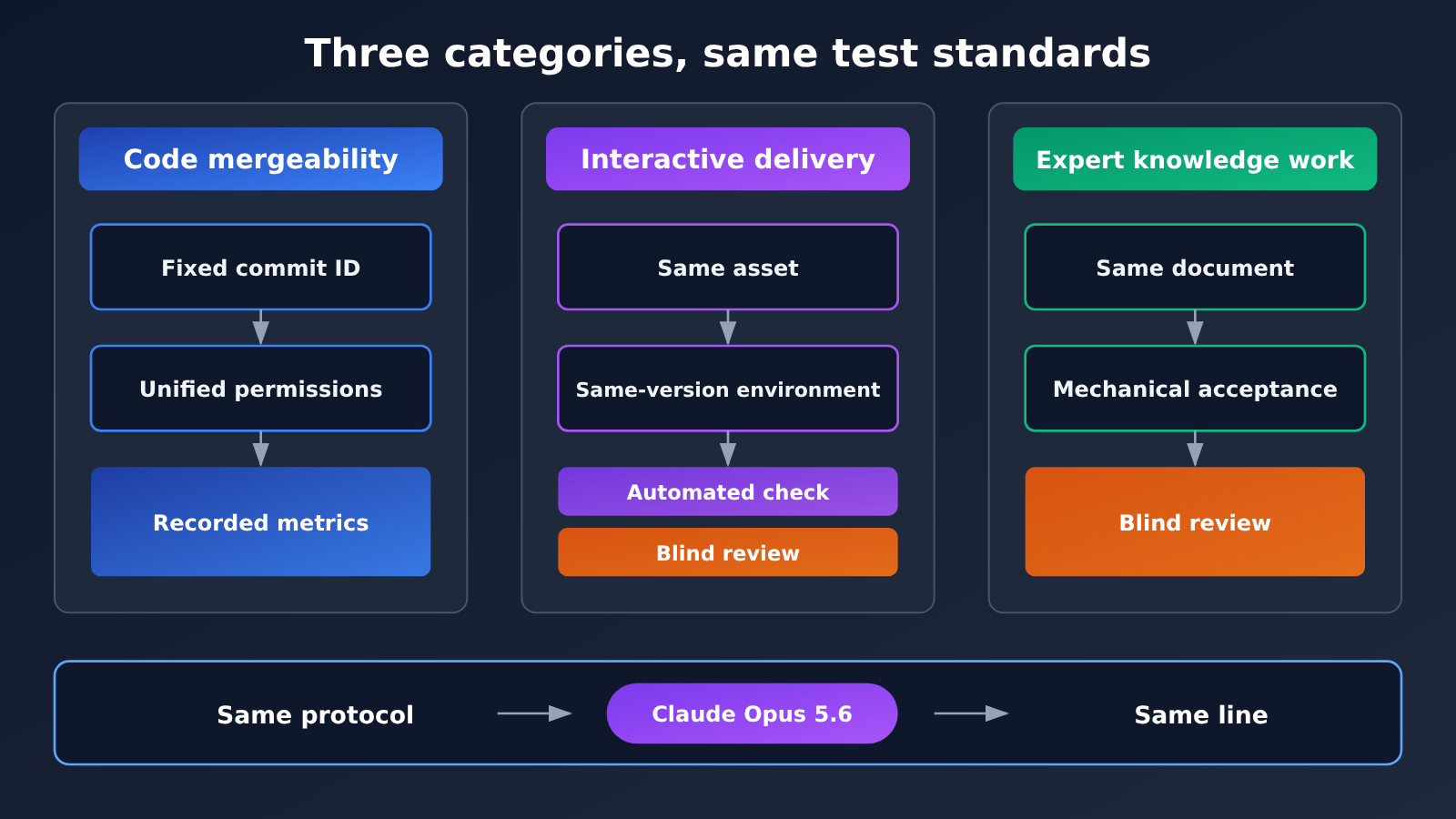
| Task type | Input and environment controls | Primary metrics | Observation only |
|---|---|---|---|
| Real code changes that can be merged | Fixed commit hash, dependency lockfile, starting directory; unified file access, terminal permissions, test commands, network policy | Passes alongside existing call contracts and tests; first-pass/final pass rate, rework count | Code aesthetics, size of rewrite, whether explanations read smoothly |
| Interactive deliverable | Same licensed material, e.g. an exhibition timeline; specified browser and dependency versions; requires keyboard access, filtering, reset, small screens, empty data | Interactions pass, no console errors, layout readable, animation stable, asset fetching compliant | Visual quality of the pre-rendered short (no points when interaction is required) |
| Professional knowledge work | Same policy document and numeric table; deliver three actionable conclusions, source locations, a recalculable worksheet, a conflict note | Mechanical verification of amounts and citation locations; time to first valid delivery, review edits, cost to completion | Answer length, whether the template looks pretty |
All three task types share one principle: whether the deliverable can be accepted matters more than how the output looks. Long-document tests need the same care: a bigger context window only lets you put more material in. What you’re really testing is whether the model can find the right information and keep the constraints intact. Live rendering, pre-rendered shorts, and static single pages should be scored separately by deliverable type — don’t lump them together.
Two Fair Comparisons: Model Comparison and Product Comparison
Model comparison runs each candidate model under the same external environment, same tasks, and same time limit, with external capabilities not used for this round’s decisions turned off. Record the default configuration and a higher reasoning tier under an equal budget separately. If vendors support different tools, the public test set should use only the tools that all candidates support.
Product comparison preserves each official client’s unique agent, search, or template features, answering the question “What do you get when you buy a workflow?” You can publish both sets of results together, but be sure to note the unit of comparison, client version, model identifier, reasoning tier, and number of attempts per question so readers can judge whether the results are reproducible.
💡 Practical tip: At the model comparison stage, use a unified interface to reduce variables. With APIYI’s OpenAI-compatible endpoint at apiyi.com, the same code only needs to switch the model field—you don’t have to maintain a separate SDK and authentication logic for each vendor. For the exact model identifiers available, refer to the platform’s model list.
Claude Opus 5.6 Comparison Worked Example: Same-Token Bill
The following is a worked example, not a measured test. Assume each request has 100K uncached input tokens and 20K output tokens, standard tier, with no extra tool fees.
| Model | Input cost (0.1M tokens) | Output cost (0.02M tokens) | Total per request (worked example) |
|---|---|---|---|
| GPT-6.2 Sol | 0.10 × 2 = $0.20 | 0.02 × 10 = $0.20 | $0.40 |
| Gemini 4 Neon | 0.10 × 3 = $0.30 | 0.02 × 15 = $0.30 | $0.60 |
| Claude Opus 5.5 | 0.10 × 4 = $0.40 | 0.02 × 20 = $0.40 | $0.80 |
| GPT-6.2 Astra | 0.10 × 8 = $0.80 | 0.02 × 40 = $0.80 | $1.60 |
| Claude Opus 5.6 | Not disclosed | Not disclosed | Not included |
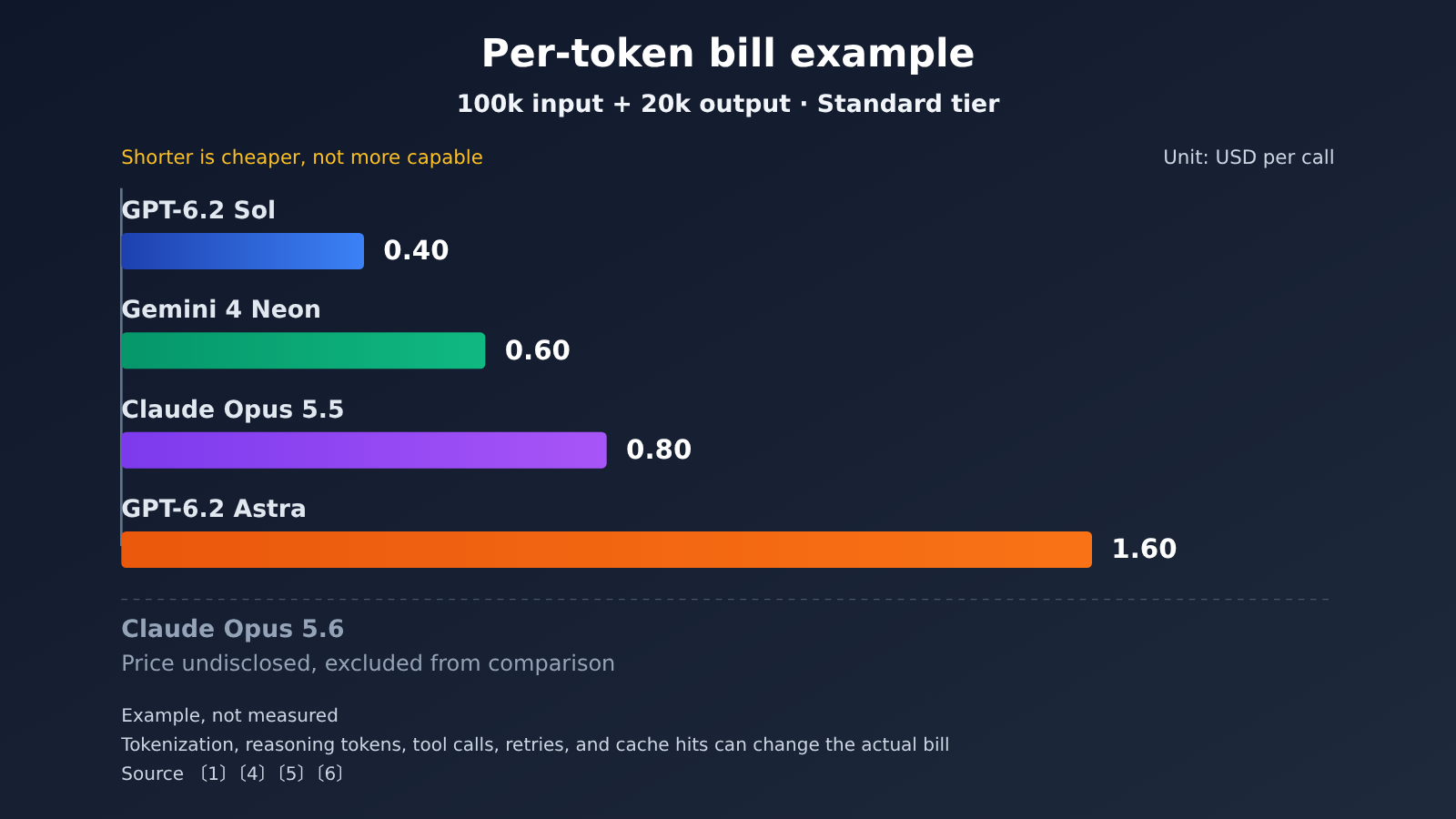
This bill only shows the price differences between four released models at a given input and output volume. In real execution, tokenization, reasoning tokens, tool calls, retries, and cache hits all differ across providers, so the final answer has to come from a complete set of measured bills. You can check the prices in the chart against each provider’s official price sheet, or look up the platform’s actual billing basis on the APIYI apiyi.com pricing page.
A low unit price doesn’t mean a task costs less to complete — you need to convert it into cost per pass. Say a workflow runs ten times and only four runs meet the acceptance criteria, at $0.60 per run. The ten runs cost $6 in total, so the average cost per pass is $1.50. Pass rate, timeouts, median and tail latency, and manual fix time should all be recorded together. If you only have ten tasks, reporting the range and per-task results is more credible than stating a small difference to two decimal places.
Hands-On: A Quick Pre-Launch Baseline for Claude Opus 5.6
Start by running a pre-registered baseline against models that have already launched. Once Opus 5.6 goes live, you’ll only need to add one line to the model list. Here’s a minimal call example to confirm the connection works end to end:
import openai

client = openai.OpenAI(
    api_key="YOUR_API_KEY",
    base_url="https://api.apiyi.com/v1"  # APIYI OpenAI-compatible endpoint
)

resp = client.chat.completions.create(
    model="gpt-6.2-sol",  # Use the actual identifier from the platform's model list
    messages=[{"role": "user", "content": "用三句话说明这个仓库的测试命令。"}]
)
print(resp.choices[0].message.content)
print(resp.usage)  # Record input/output tokens for billing reconciliation
View the full baseline script (multiple models, multiple runs, cost and latency tracking)
import json
import time
import statistics
import openai

client = openai.OpenAI(
    api_key="YOUR_API_KEY",
    base_url="https://api.apiyi.com/v1"
)

# Standard-tier prices (USD per million tokens); sources are listed in the references at the end 〔1〕〔4〕〔5〕〔6〕
# After a new model (e.g., Claude Opus 5.6) launches, add one line here without changing the rest of the protocol
MODELS = {
    "gemini-4-neon":   {"in": 3, "out": 15, "reasoning": "high(default)"},
    "gpt-6.2-sol":     {"in": 2, "out": 10, "reasoning": "default"},
    "gpt-6.2-astra":   {"in": 8, "out": 40, "reasoning": "default"},
    "claude-opus-4-5-placeholder": {"in": 4, "out": 20, "reasoning": "default"},
    # Replace the line above with the actual model identifier for Opus 5.5 on the platform
}
RUNS_PER_TASK = 10  # Pre-registered: fixed number of attempts per task, fully disclosed

def check_pass(task_id: str, output: str) -> bool:
    """Plug in your own acceptance checks: run tests, validate amounts, verify citation locations, etc."""
    raise NotImplementedError

def run(task_id: str, prompt: str):
    records = []
    for model, cfg in MODELS.items():
        for i in range(RUNS_PER_TASK):
            t0 = time.time()
            resp = client.chat.completions.create(
                model=model,
                messages=[{"role": "user", "content": prompt}],
                timeout=600,
            )
            latency = time.time() - t0
            u = resp.usage
            cost = (u.prompt_tokens * cfg["in"] + u.completion_tokens * cfg["out"]) / 1e6
            out = resp.choices[0].message.content
            records.append({
                "task": task_id, "model": model, "run": i,
                "reasoning_label": cfg["reasoning"],  # The reasoning level must be recorded as-is
                "in_tokens": u.prompt_tokens, "out_tokens": u.completion_tokens,
                "cost_usd": round(cost, 4), "latency_s": round(latency, 2),
                "passed": check_pass(task_id, out),
            })
    with open("baseline.jsonl", "a", encoding="utf-8") as f:
        for r in records:
            f.write(json.dumps(r, ensure_ascii=False) + "\n")
    return records

def summarize(records):
    by_model = {}
    for r in records:
        by_model.setdefault(r["model"], []).append(r)
    for model, rs in by_model.items():
        passed = sum(r["passed"] for r in rs)
        total_cost = sum(r["cost_usd"] for r in rs)
        lat = sorted(r["latency_s"] for r in rs)
        print(model,
              f"通过 {passed}/{len(rs)}",
              f"每次通过成本 {total_cost / passed:.3f}" if passed else "无通过",
              f"延迟中位数 {statistics.median(lat):.1f}s",
              f"P90 {lat[int(len(lat) * 0.9) - 1]:.1f}s")
The price table in the script comes directly from official standard-tier pricing. Replace the model identifiers with the names actually available on the platform. Reasoning-level parameter names vary by provider and integration method, so the script records the level only as a label. For details on how to set it, check the relevant documentation and note it in your report.
🚀 Quick start: New users can sign up at APIYI apiyi.com and claim free trial credits. Start with a small sample (for example, 3 runs per question) to verify that the acceptance function is reliable, then run the official baseline using the pre-registered number of runs.
Turning expectations for Claude Opus 5.6 into testable hypotheses
Vision and interaction track. Reasonable expectations include: it works on the first version; it keeps existing interactions after receiving corrections; local edits don’t introduce new conflicts. You can deliberately introduce ambiguous mid-course feedback and ask the model to identify the constraints first, then complete the second round according to explicit requirements. Score the single round and the second round separately.
Long-workflow track. You can use samples with duplicate table headers, conflicting document versions, and cross-page references to check whether the model verifies key judgments before its budget runs out. Both types of experiments can establish baselines for released models now, while also leaving falsifiable propositions for future models.
After Opus 5.6 is released, the results will fall into one of three cases, each corresponding to a clear conclusion:
- Higher pass rate under the same budget, tools, and time: you can say it’s stronger on this task set.
- Only wins when costs rise significantly: the conclusion must include the condition of available budget.
- Similar performance: explain model selection using best cost, tail latency, and reviewer feedback.
These three are decision rules, not predictions. Until the protocol has run to completion, none of these cases can be assumed in advance.
Claude Opus 5.6 FAQ
Q1: Has Claude Opus 5.6 been released yet?
As of November 27, 2026 (UTC), the current Opus that Anthropic has made public is Opus 5.5 (released September 22). Opus 5.6 has no public release materials and no public benchmark scores; neither its pricing nor its context window has been disclosed.
Q2: Which model exactly does GPT-6.2 refer to in this article?
It refers to the two models OpenAI released on November 17: `gpt-6.2-astra` (for harder professional projects, standard short context at $8/$40) and `gpt-6.2-sol` (efficient for everyday work and multi-step agents, $2/$10). They serve different purposes, so evaluations and price quotes should list them separately.
Q3: Can I directly compare the FrontierCode 2.0 scores from the two companies’ launch posts?
No. When OpenAI ran its comparison, it used the max tier; when Google cited its results, it noted that Neon was using the default high tier. The tooling, number of attempts, and cost baselines also aren’t aligned. To compare them, you need to re-run tests under the same protocol.
Q4: Can all of Gemini 4 Neon’s one-million context be used for input?
Not exactly. The official docs say this roughly one million tokens is shared among input, thinking, and output. The synchronous output limit and the long output you get through background execution or continuation are defined separately. When planning long-document tasks, you need to leave room for thinking and output.
Q5: How can I compare these models using the same code?
We recommend an OpenAI-compatible aggregation interface. Register at APIYI apiyi.com to get an API key, set the base_url to `https://api.apiyi.com/v1`, then apply the script from this article and change only the model field to switch models. Whether a model is available and what its identifier is—check the platform’s model list for that.
Q6: Sol is the cheapest in the worked billing example—does that mean it’s the best value?
Not necessarily. The worked example only reflects the unit-price differences at a given token count. Real value depends on “cost per pass”: a low pass rate, many retries, and lots of reasoning tokens all drive up actual spend. Start by running small samples with free credits at APIYI apiyi.com, then judge once you have measured pass rates.
Q7: In this article, which data is official, which is a worked example, and which is measured?
Model names, dates, prices, context windows, and positioning all come from official materials. The claim that Sol comes close to Astra on FrontierCode 2.0 is a vendor paraphrase. The billing amounts are worked examples based on official prices. This article includes no community benchmark scores, and the author didn’t run any tests either.
Q8: After Opus 5.6 is released, do the baselines need to be re-run?
Baselines for already-released models don’t need to be re-run, as long as the tasks, acceptance rules, and environment haven’t changed. You just need to add Opus 5.6 under the same protocol. Don’t tack cherry-picked single samples from launch onto the scoring matrix.


