
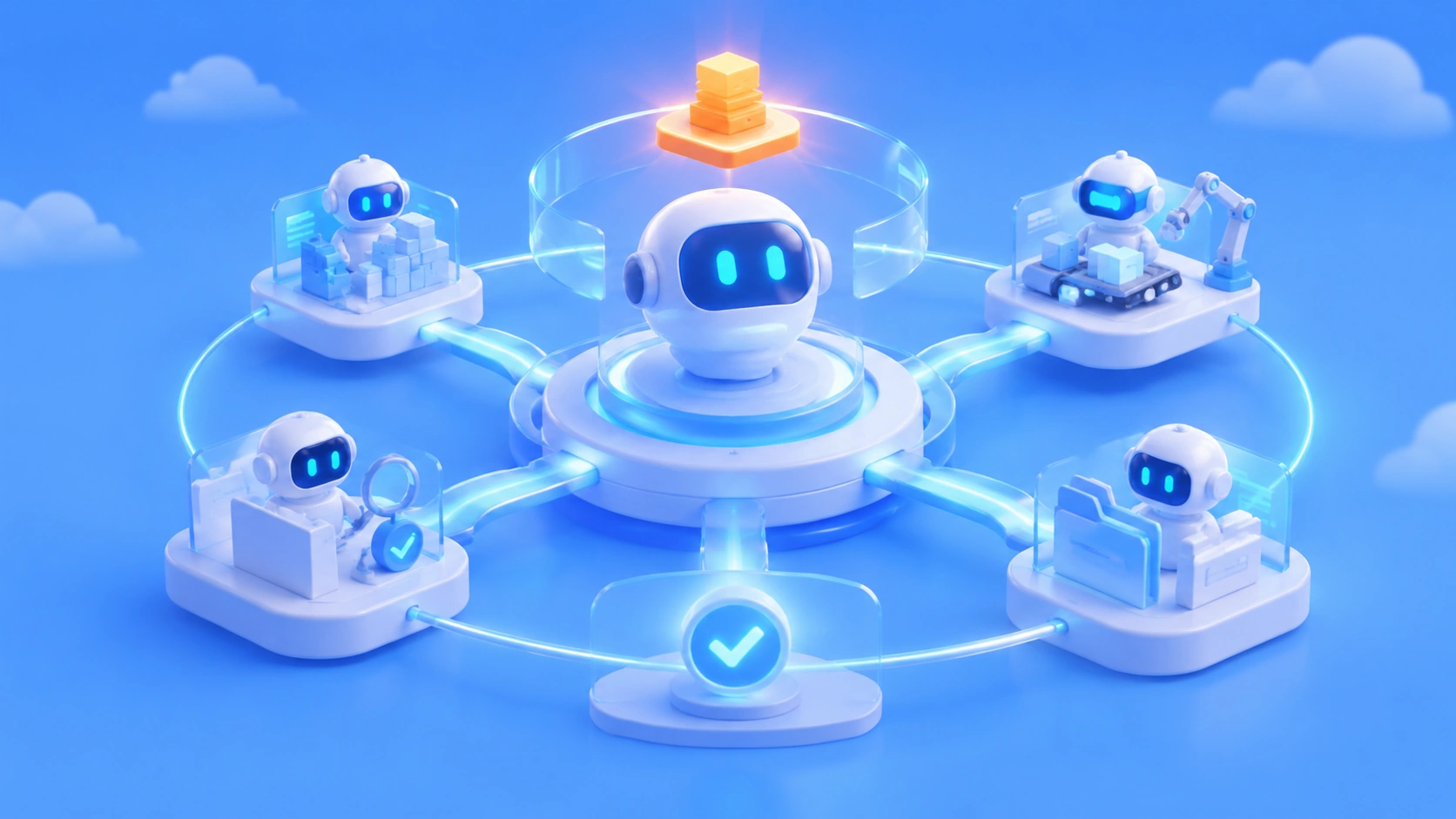
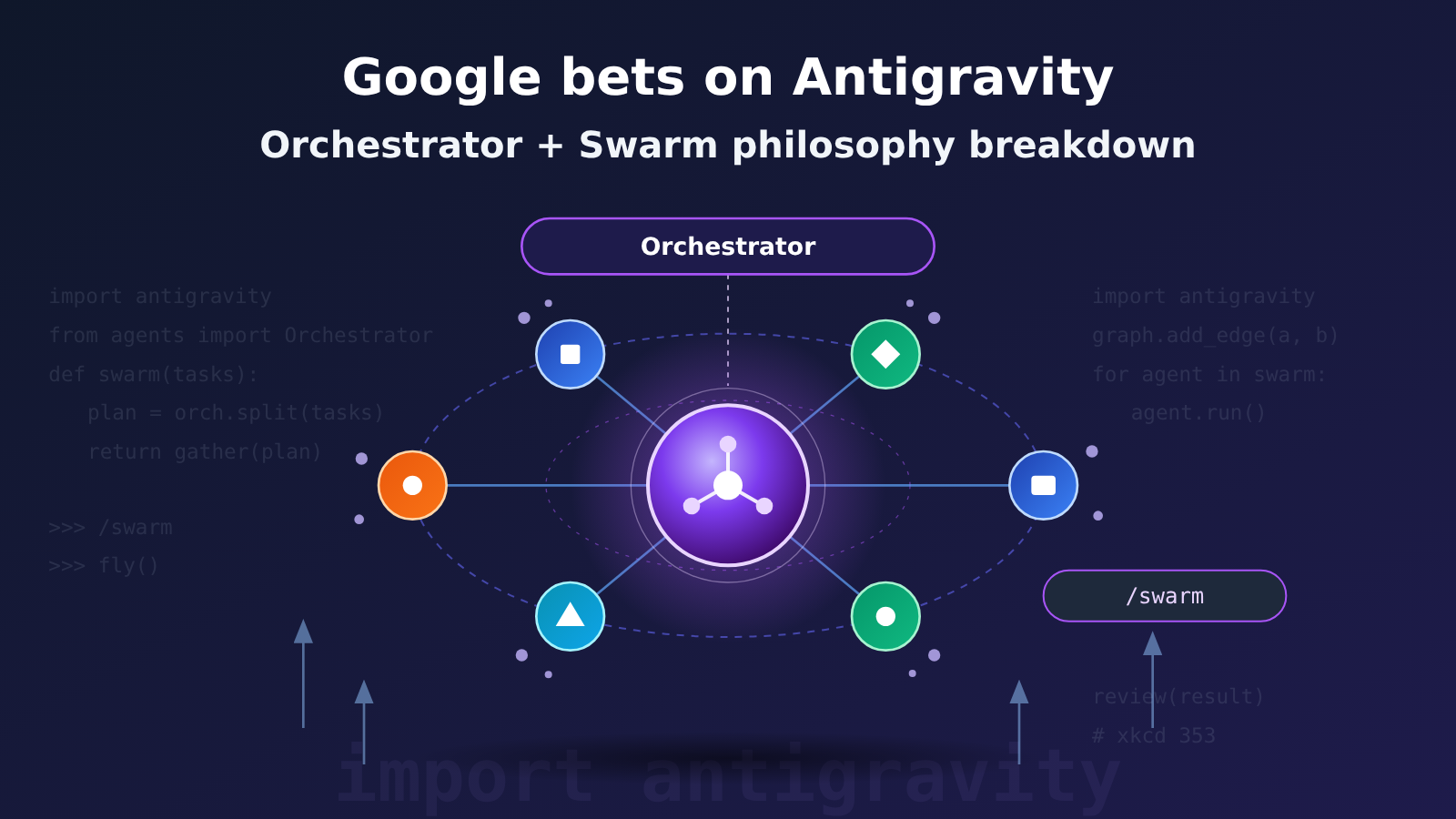
Google is betting on Antigravity because it expects AI coding to shift from “assisted completion” toward “multi-agent autonomous collaboration.” At that stage, the capability of any single model isn’t the make-or-break factor—what matters is whether you can orchestrate a fleet of agents working in parallel to complete engineering tasks. Antigravity is the full-stack vehicle Google built for this: the upper layer uses an Orchestrator for graph execution scheduling, the lower layer uses Swarm to split tasks among specialized sub-agents, and behind it all are Gemini models, Google Cloud, and the Chrome ecosystem. The costs are just as clear: a closed-source core, a widened security attack surface, and product-line fragmentation—these three issues will directly affect whether developers are willing to follow along.
What you’ll learn from this article
- The timeline and implications of Google moving from the open-source Gemini CLI to the closed-source Antigravity CLI in 2026
- The scale of agentic coding adoption inside Google, and the public controversy around it
- Why Swarm is considered superior to single-agent approaches, and what Orchestrator’s three design principles are
- How Antigravity maps against products from Microsoft, Anthropic, OpenAI, Cursor, and Cognition
- What Linus Torvalds’ use of Antigravity shows, and the main risks of this path
Index: We’ll start with a concept table and an impact overview to help you build a baseline understanding. The main body’s “Objective Facts” section walks through, in order, the origin of the name, Google’s internal adoption data, the CLI migration, Antigravity’s technical design, the competitive landscape, and the Linus case. The “Analysis and Judgment” section discusses the rationality and limits of the Swarm philosophy, Google’s structural advantages, a risk list, and gives developers actionable recommendations.
To Know: Key Concepts for Understanding Google Antigravity
| Concept | Quick Explanation |
|---|---|
| Antigravity | Google’s AI agent coding product family, spanning the App, IDE, CLI, SDK, and Extensions |
| import antigravity | A built-in Python easter egg that opens xkcd comic #353 when run — a nod to using Python to “take off” effortlessly |
| Agentic Coding | AI doesn’t just complete code. It plans on its own, calls tools, executes, and iterates until the task is done |
| Orchestrator | The top-level control component that breaks down tasks, dispatches sub-agents, and aggregates results |
| Swarm | A mode where multiple specialized sub-agents collaborate in parallel, offered as /swarm in Antigravity |
| Directed-graph execution | The task flow is organized as a graph, supporting branches, merges, loops, and rollbacks rather than fixed linear steps |
| HITL (Human-in-the-Loop) | Human-machine collaboration where a person confirms, approves, or reviews agent output at key checkpoints |
| MCP | Model Context Protocol, which lets agents connect to external tools and data sources in a uniform way |
| Prompt Injection | An attack that tricks an agent into performing unintended actions through malicious content |
Google Antigravity Impact at a Glance
| Audience | Main Impact |
|---|---|
| Everyday developers | Coding shifts from “write code + ask the AI” to “describe the goal + review agent output,” making review skills more important |
| Gemini CLI users | The AI subscription service for the open-source Gemini CLI ended on June 18, 2026, so you’ll need to migrate to Antigravity CLI or switch tools |
| Team tech leads | Need to reassess permission policies, security boundaries, and vendor lock-in risk — not just model capabilities |
| Open-source community | Core tools are moving from open to closed source, narrowing the space for community participation and auditing |
| Engineers working outside their primary language | The barrier to building small cross-language, cross-domain tools has dropped noticeably — Linus’s case is a prime example |
The Facts Behind Google’s Bet on Antigravity
Where the Name Comes From: From a Python Easter Egg to a Product Philosophy
The word “antigravity” comes from a classic Easter egg in the Python community. Running import antigravity in Python opens xkcd comic #353, where a character is flying through the air and, when asked how he’s managing it, answers “Python!” Google borrowed the name to suggest letting developers “lift off” from repetitive work.
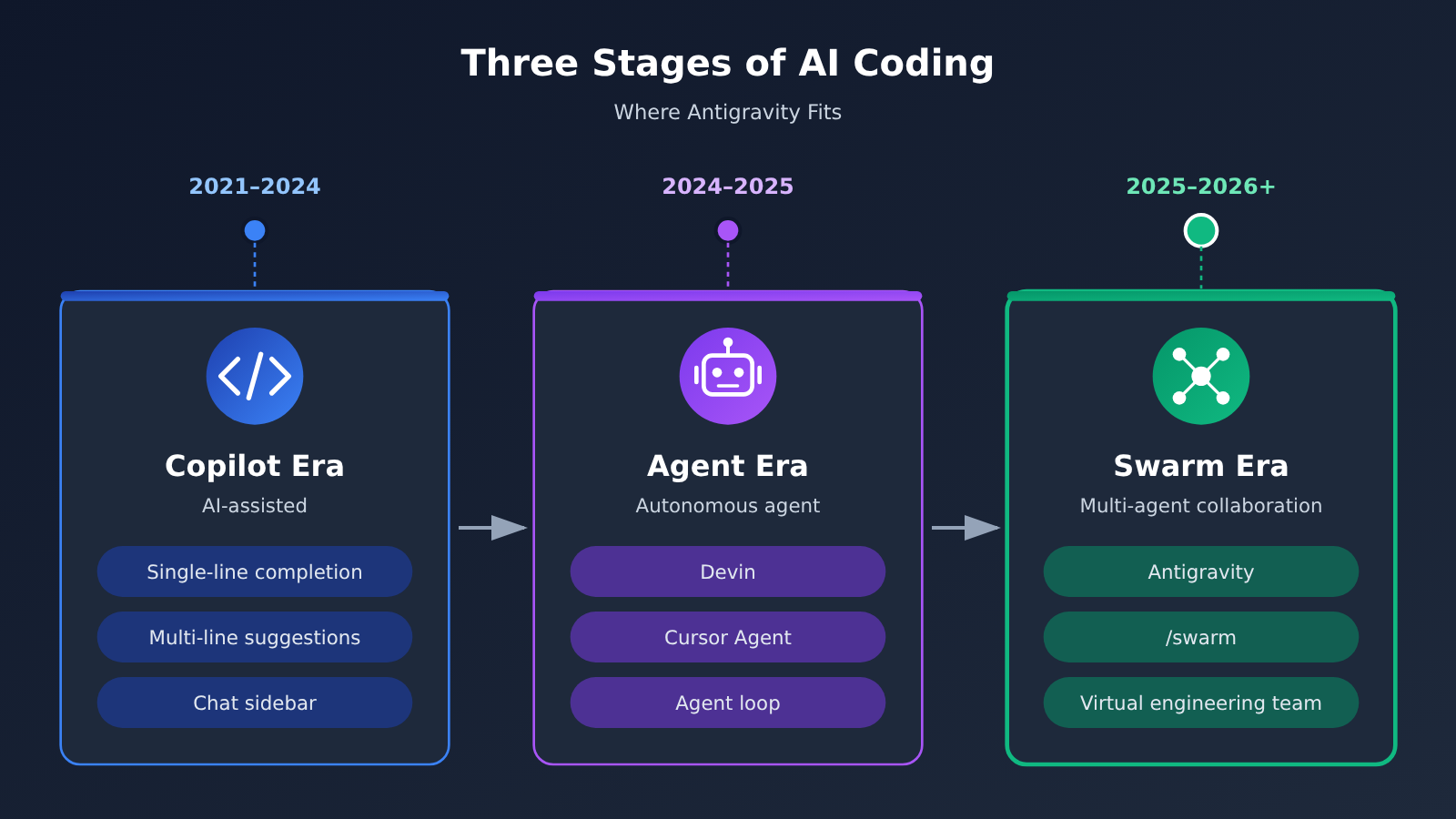
From a product-positioning standpoint, the name marks the shift from Copilot-style AI-assisted coding toward an agent era in which AI completes tasks on its own. The evolution of technical approaches in the reference materials can be boiled down to three stages:
- Copilot era (2021–2024): single-line completion → multi-line suggestions → Chat sidebar
- Agent era (2024–2025): autonomous agents and agent loops, exemplified by Devin and Cursor Agent
- Swarm era (2025–2026 and beyond): multi-agent collaboration, exemplified by Antigravity /swarm, with the goal of a “virtual engineering team”
Antigravity Adoption Scale and Controversy Inside Google
Google Engineering Director Addy Osmani publicly stated that over 40,000 software engineers use agentic coding every week. He also mentioned that Googlers have access to internal versions of Antigravity, Gemini CLI, custom models, skills, CLI, and MCP, and that systems like Orchestrator, agent loops, and virtual SWE teams are already in use internally.
The controversy came from former Google engineer Steve Yegge. He argued that Google’s internal AI adoption looks about the same as traditional enterprises: roughly 20% are heavy users, 20% refuse to use it, and 60% stick to basic tools. Google DeepMind CEO Demis Hassabis personally responded, calling the post “completely wrong, pure clickbait.” It’s rare for a CEO-level executive to publicly rebut a social media post—and that tells you just how much Google cares about the agentic coding narrative.
Migrating from Gemini CLI to Antigravity CLI
In May 2026, Google announced on its developer blog that the open-source Gemini CLI (written in TypeScript, Apache 2.0 license) would end its AI subscription service on June 18, with users fully migrating to the closed-source Antigravity CLI (written in Go). As of this article’s publication in November 2026, that migration has been complete for several months.
The migration brought three obvious changes: the tech stack shifted from TypeScript to Go, the licensing model went from open source to closed source, and its positioning moved from community experiment to core commercial product.
Three Design Principles of Antigravity Orchestrator
According to the source material, Antigravity’s Orchestrator reflects three design principles:
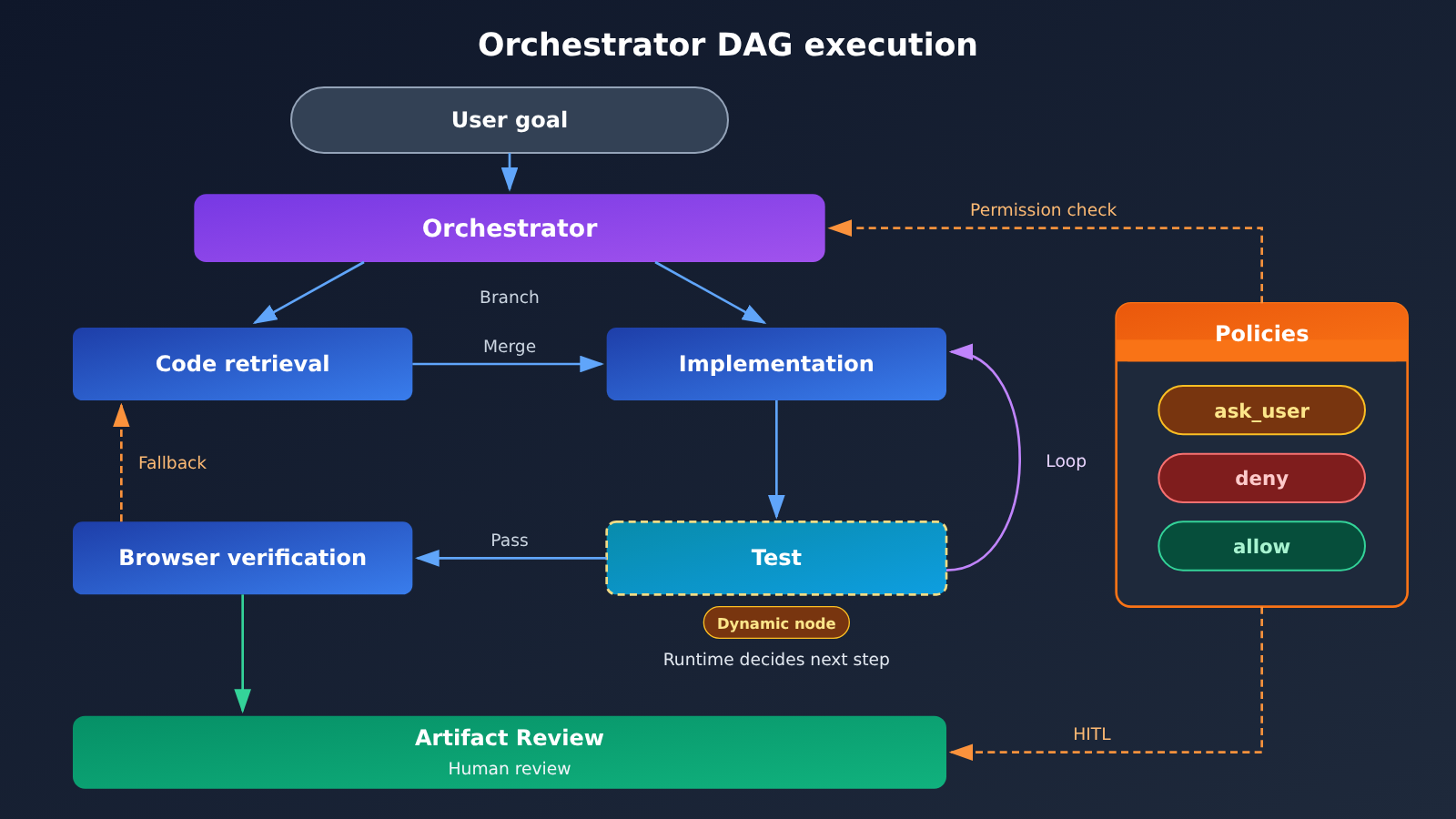
- Graph execution rather than linear flow: Traditional agent frameworks mostly execute in the order Step 1 → Step 2 → Step 3, while Antigravity uses directed graph execution, supporting branching, merging, loops, and rollback. Its key innovation is the “dynamic node”—the next step is decided at runtime rather than compiled in advance.
- Declarative rather than imperative: Developers define the agent’s capabilities, tools, and permissions, and the agent decides on its own how to complete the task.
- HITL as a first-class citizen: Through the Policies system’s ask_user mode, the Tool Confirmation Flow, and Artifact Review after completion, human review is embedded into the workflow.
The source material includes an illustrative declarative configuration code sample that shows this approach:
# Declarative: define agent capabilities and permissions (illustrative sample code from the source material, not full SDK usage)
config = LocalAgentConfig(
    system_instructions="You are an expert...",
    tools=[get_weather, search_code],
    policies=[deny("run_command"), allow("view_file")],
)
# The agent decides on its own how to complete the task
This configuration contains no step-by-step description of “what to do first, what to do next”—it only defines the capability scope (tools) and permission boundaries (policies). Denying command execution and allowing file viewing: this “whitelist + blacklist” pattern is exactly the foundation for putting HITL and security policies into practice.
Antigravity vs. Competitors: Product Positioning
| Competitor | Representative Product | Google’s Counterpart |
|---|---|---|
| Microsoft / GitHub | Copilot + Copilot Agent | Antigravity IDE + Extensions |
| Anthropic | Claude Code + Agent SDK | Antigravity SDK + CLI |
| OpenAI | Codex CLI + Swarm | Antigravity /swarm + CLI |
| Cursor | Cursor IDE | Antigravity IDE (VS Code fork) |
| Cognition | Devin | Antigravity /swarm + Orchestrator |
As the table shows, Google isn’t targeting just a single rival — it’s responding to each market segment with five product lines. The Antigravity IDE is built on a VS Code fork, the same approach Cursor took.
Linus Torvalds Writes Python with Antigravity
On January 11, 2026, Linus Torvalds wrote in the README for his AudioNoise project that the Python visualization tool in the project was “basically written by vibe-coding.” He said he knows more about analog filters than he does about Python, and at first he was still writing in a “look it up and copy the pattern” kind of way — then he just decided to “cut out the middleman — namely, me” and used Google Antigravity directly to build the audio sampling visualization tool. Simon Willison later covered it on his blog.
Antigravity’s Exposed Security Issues
In November 2025, Simon Willison published an analysis of the data exfiltration risks in Google Antigravity. The source material also points out that attack surfaces such as prompt injection have been demonstrated multiple times. This shows that once an agent can read files, execute commands, and access the web, security issues are no longer merely theoretical.
Analysis and Assessment of Google’s Bet on Antigravity
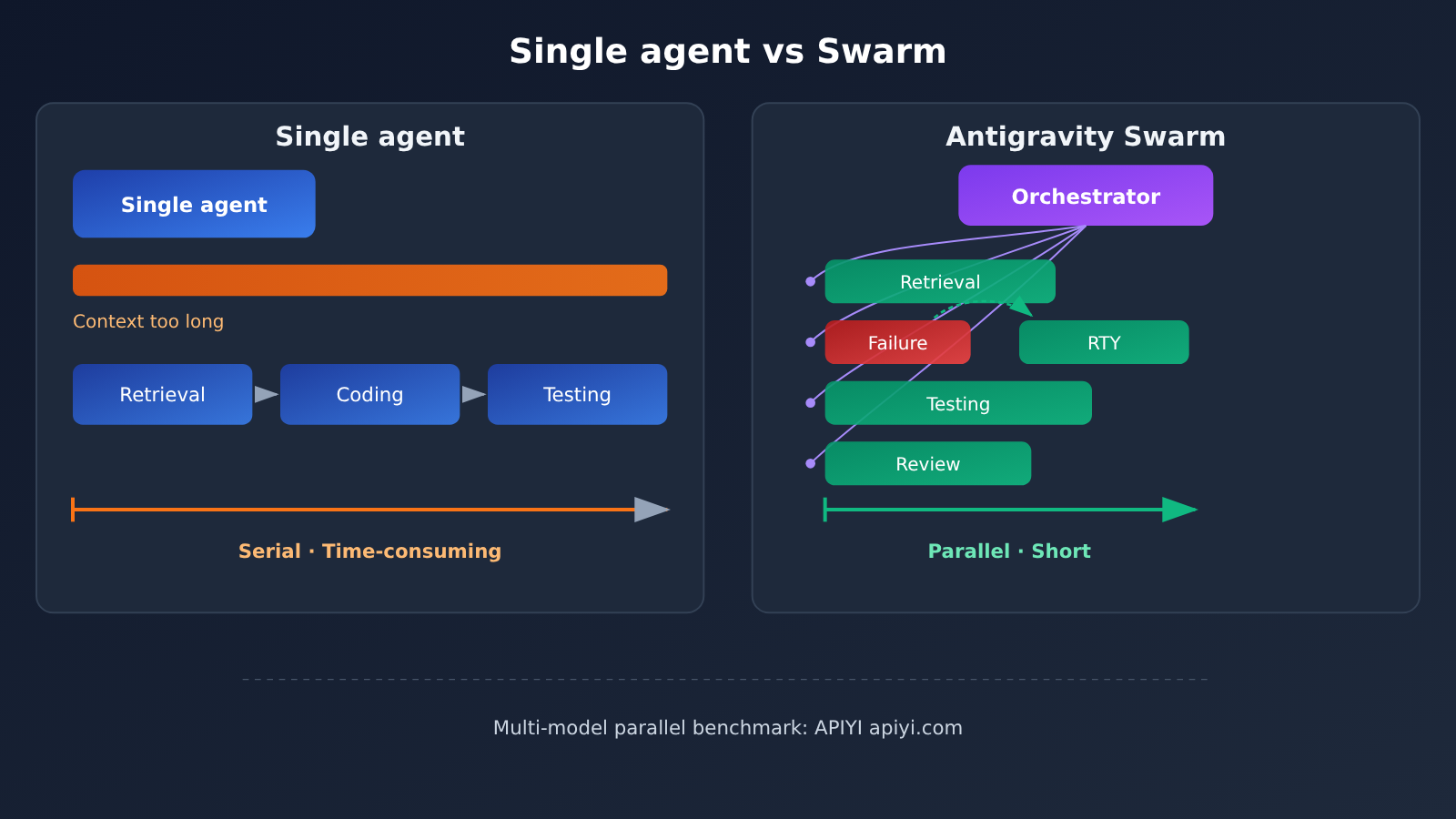
Point 1: Swarm solves the structural bottleneck of single agents
The limitations of a single agent aren’t just about “the model not being smart enough” — most of it is a structural problem. The context window has a hard ceiling, complex tasks demand multiple capabilities at once (retrieval, implementation, testing, documentation), and long-running tasks are prone to attention decay and hallucination. Throwing more parameters at the model won’t fix all three at the same time.
Swarm’s approach borrows from the decentralized collaboration of bee colonies and ant colonies: break the big task into smaller ones, give each sub-agent a single narrow domain, and run them in parallel so a single point of failure won’t drag down the whole system. The table below compares the two modes:
| Dimension | Single Agent | Swarm |
|---|---|---|
| Context pressure | All information crammed into one window | Each sub-agent holds only local context |
| Specialization | One agent must juggle multiple capabilities | Sub-agents focus on a single narrow domain |
| Execution efficiency | Sequential, time grows linearly with the task | Sub-tasks run in parallel, total time drops significantly |
| Fault tolerance | A mid-way failure often means starting over | A single sub-agent failure can be retried locally |
| Main cost | Quality decay on long tasks | Scheduling overhead, result consistency, and higher cost |
That said, Swarm’s advantages are conditional. If the task itself is hard to split or the sub-tasks are tightly coupled, the coordination cost of parallelism can cancel out the gains. Which is why the Orchestrator’s ability to decompose and merge is the precondition for this philosophy to hold — and it also explains why Google puts graph execution and dynamic nodes at the core.
Point Two: Multi-Model Tiering Is the Fuel for Swarm
Swarm has another implicit premise: model diversity. Not every sub-agent needs the strongest, most expensive model. Tasks like code retrieval and formatting cleanup are well suited to lightweight models, while architecture design and tricky debugging are worth bringing in a flagship model. The source material mentions Gemini’s model matrix tiering strategy — Carbon / Neon / Hydrogen — and that’s exactly what gives Swarm workers at different “job grades.”
That thinking isn’t limited to Google’s ecosystem. Developers building their own multi-agent workflows can also assign different models to sub-agents based on task difficulty. The table below is a general tiering approach; model names should follow the lists each platform actually supports:
| Sub-agent role | Capability requirement | Model selection approach | Invocation reference |
|---|---|---|---|
| Task orchestration / planning | Strong reasoning, long context | Flagship model | APIYI apiyi.com unified interface |
| Code implementation | Strong coding, stable | Main workhorse model with standout code performance | Switch model names with the same API key |
| Retrieval / summarization / formatting | Fast, low cost | Lightweight model | Pay-as-you-go, great for high-frequency subtasks |
| Result review | Forms a cross-check against the implementation model | A model from a different vendor | Cross-vendor comparison reduces same-source bias |
Using models from different vendors for cross-review is a common way to reduce blind spots like “the same model grading its own homework.” If you want to validate this tiering design without pulling in multiple SDKs, you can lean on an OpenAI-compatible aggregator interface. Here’s a minimal example showing how a single client can call different models to complete a two-step “implement + review” collaboration:
import openai

client = openai.OpenAI(
    api_key="YOUR_API_KEY",
    base_url="https://api.apiyi.com/v1"  # APIYI OpenAI-compatible interface
)

def ask(model: str, prompt: str) -> str:
    resp = client.chat.completions.create(
        model=model,
        messages=[{"role": "user", "content": prompt}]
    )
    return resp.choices[0].message.content

# Replace the model names with ones actually available in the platform's model list
code = ask("gemini-2.5-pro", "用 Python 写一个读取 WAV 并绘制波形的函数")
review = ask("claude-sonnet-4-20250514", f"审查以下代码的潜在问题:\n{code}")
print(review)
View the full example: a simple “orchestrator + parallel sub-agents” implementation
import openai
from concurrent.futures import ThreadPoolExecutor

client = openai.OpenAI(
    api_key="YOUR_API_KEY",
    base_url="https://api.apiyi.com/v1"  # APIYI gives unified access to multiple models
)

# Sub-agent role -> model mapping (actual names depend on platform support)
AGENTS = {
    "planner": "gemini-2.5-pro",
    "coder": "claude-sonnet-4-20250514",
    "reviewer": "gpt-4o",
}

def call(model: str, system: str, prompt: str) -> str:
    resp = client.chat.completions.create(
        model=model,
        messages=[
            {"role": "system", "content": system},
            {"role": "user", "content": prompt},
        ],
    )
    return resp.choices[0].message.content

def orchestrate(goal: str) -> dict:
    # 1. Planning: break the goal into subtasks (one per line)
    plan = call(AGENTS["planner"],
                "You are a task orchestrator; break the goal into 3 independently completable subtasks, one per line.",
                goal)
    subtasks = [s.strip() for s in plan.splitlines() if s.strip()][:3]

    # 2. Parallel execution: Swarm-style sub-agents
    with ThreadPoolExecutor(max_workers=3) as pool:
        results = list(pool.map(
            lambda t: call(AGENTS["coder"], "You are an engineer focused on a single subtask.", t),
            subtasks))

    # 3. Review: automatic cross-check before human review
    merged = "\n\n".join(results)
    review = call(AGENTS["reviewer"],
                  "You are a code reviewer; point out risks and give revision suggestions.", merged)
    return {"subtasks": subtasks, "results": results, "review": review}

if __name__ == "__main__":
    out = orchestrate("Implement a small command-line tool that visualizes audio sampling")
    print(out["review"])
This example only minimally simulates the “plan → parallel → review” flow. It doesn’t include Antigravity’s dynamic nodes, fallbacks, or permission policies. For real production use, you’d also need to add failure retries, result-merge validation, and a human confirmation step.
🚀 Practical tip: Before deciding whether to adopt a multi-agent architecture, test how different models perform in each sub-role using small-scale tasks. With APIYI apiyi.com, you can call Gemini, Claude, GPT, and other models using a single API key. New users get free testing quota, making it a great way to quickly validate whether a layered approach is feasible.
Judgment 3: Google’s structural advantage is “full stack,” not any single point
Looking at the model or the IDE on its own, Google isn’t the only option — but it can connect multiple pieces into a closed loop, and that’s something competitors find hard to replicate:
- In-house Gemini models: can be deeply optimized for agent scenarios, with more controllable costs
- Google Cloud: Vertex AI and Cloud Run cover the whole chain from training to enterprise deployment
- Chrome / Web ecosystem: browser extensions let agents “see” and “operate” web pages, a clear edge in browser testing scenarios
- Over 40,000 internal users: a very large internal beta group for agentic coding, with an extremely short feedback loop
- Search and Knowledge Graph: agents can pull in real-time information
- Gemini Spark: extends Antigravity’s runtime capabilities to ordinary users
The move from Gemini CLI to the closed-source Antigravity CLI can be read as Google clearing the path for full-stack integration. An open-source CLI is good for community experimentation, but it’s hard for it to carry deep integration with Cloud, Chrome, and custom models — plus the commercialization that goes with it. This is an inference based on facts; Google’s official announcement frames it mainly as a “transition and upgrade.”
Judgment 4: The real significance of the Linus case is “cross-domain output”
The Linus case is often read as an endorsement from a big name, but what deserves more attention is the scenario he used it in: using a language he isn’t familiar with to build an auxiliary tool in a domain he isn’t strong in. The line “remove the middleman — myself —” accurately describes the shift of agents from “assistive” to “autonomous.”
The takeaway for ordinary developers is that the biggest marginal benefit of agent tools may not show up in your main domain, but in peripheral tasks where you “understand the requirement but aren’t familiar with the implementation.” That said, Linus himself has extremely strong judgment and can tell whether the output is usable. Not every user comes with that prerequisite.
Judgment Five: The Risk List Sets Antigravity’s Ceiling
Google’s bet on Antigravity faces four categories of risk, and we think their impact isn’t the same:
- Security vulnerabilities (most direct impact): Prompt injection and data leakage have already been publicly analyzed. The more agent permissions you have, the bigger the attack surface. Policies and HITL design can reduce risk, but they can’t eliminate it.
- Core closed-source (affects trust): Gemini CLI went from open source to closed source, which may make some open-source community developers take a wait-and-see approach, and enterprise security teams will find it harder to audit its behavior.
- Ecosystem lock-in (affects enterprise procurement): Once you’re deeply tied to Google Cloud, compatibility with AWS and Azure becomes a concern for multi-cloud enterprises.
- Product fragmentation (affects onboarding cost): Five product lines run in parallel—App, IDE, CLI, SDK, and Extensions—which makes for a steep learning curve, and new users find it hard to figure out where to start.
The following is a prediction: over the coming period, whether Antigravity can go from “works well inside Google” to “the go-to choice for outside developers” may hinge not on Swarm’s performance metrics, but on whether Google can give a more convincing answer on security and openness.
How Developers Should Respond to the Changes Antigravity Brings
For developers and teams currently evaluating agent coding tools, here are some practices to consider:
- Treat review skills as a core competency: The more agents produce, the more humans need to judge “is this code trustworthy?” Artifact Review shouldn’t be a formality.
- Start with least privilege: Following the declarative policy approach, deny command execution by default and open it up item by item as needed.
- Avoid single-vendor dependency: Decouple orchestration logic from specific models, and keep the ability to switch to other vendors’ models. With OpenAI-compatible aggregation endpoints like APIYI apiyi.com, you only need to change the model name to switch, reducing lock-in risk.
- Start with tasks that can be split up: Try Swarm mode on loosely coupled tasks like test generation, documentation completion, and script tooling first, then gradually expand scope.
If your team isn’t planning to migrate to Antigravity for now but wants to build experience with multi-model collaboration first, you can use the examples above to build a small prototype on APIYI apiyi.com. The platform bills by usage, which is good for controlling costs during the evaluation phase.
This bet from Google is essentially answering one question: when the entity writing code shifts from a person to a group of agents, who defines the scheduling rules, permission boundaries, and review processes? Antigravity gives Google’s answer, and whether that answer becomes an industry standard will depend on how it performs next on security, openness, and usability.
References
- xkcd 353: The comic behind the “import antigravity” easter egg
- Link:
xkcd.com/353
- Link:
- Google Developer Blog: Official announcement on the Gemini CLI migration to Antigravity CLI
- Link:
developers.googleblog.com/an-important-update-transitioning-gemini-cli-to-antigravity-cli
- Link:
- Linus Torvalds’ AudioNoise README: The original Antigravity usage text
- Link:
github.com/torvalds/AudioNoise
- Link:
- Simon Willison’s Blog: Coverage of the Linus Torvalds case
- Link:
simonwillison.net/2026/Jan/11/linus-torvalds
- Link:
- Simon Willison’s Blog: Security analysis of the Google Antigravity data exfiltration
- Link:
simonwillison.net/2025/Nov/25/google-antigravity-exfiltrates-data
- Link:
- Simon Willison’s Blog: Google I/O 2026 coverage
- Link:
simonwillison.net/2026/May/20/google-io
- Link:
Author: APIYI Technical Team
Technical Discussion: Feel free to visit the APIYI (apiyi.com) homepage to get in touch with us. For more multi-model integration resources, check out the docs.apiyi.com documentation center.


