

Author’s Note: Starting from the Virginia and Oregon lawsuits against SpaceX Super Intelligence, this breaks down the four lines of defense that companies calling image and video generation APIs need to build themselves: authorization verification, input moderation, output moderation plus manual spot checks, and logging and response.
On November 23, 2026, Virginia and Oregon separately sued SpaceX Super Intelligence (the parent company of Grok and X), owned by Musk. According to reports from Reuters, CNBC, NPR, and others, the two states allege that a Grok feature can generate child sexual abuse material and other non-consensual images from photos of real people, that the company failed to put in place safeguards sufficient to stop it, and that it marketed the Grok image generator as “broadly safe.” The two states are seeking civil penalties, injunctions, and disgorgement of profits; Oregon’s complaint states damages exceeding $1 million.
This case is still in the filing stage, and the court has not issued any ruling. A SpaceXSI spokesperson responded that the issue stems from users deliberately violating the terms of service and bypassing safeguards, that the company has tightened its protections and reported to law enforcement. Both sides’ statements are on the table, and the outcome will be determined by the court.
This is not a gossip piece, nor does it discuss how the case will ultimately be decided. For teams building products with third-party image and video generation APIs, what’s really worth looking at in the complaint is one question: before your product hands the generated result to the user, what guardrails do you have on your side? As long as content is produced through your product, part of the moderation responsibility falls on you; moderation by the upstream model is only the first line.
Core value: After reading this article, you’ll have the four lines of defense approach that companies can use for self-audit after the Grok deepfake incident. Each line spells out who executes it, where it blocks, and what to do if it fails. There’s also a boundary table showing what platform-side moderation can do for you and which responsibilities you can only bear yourself.
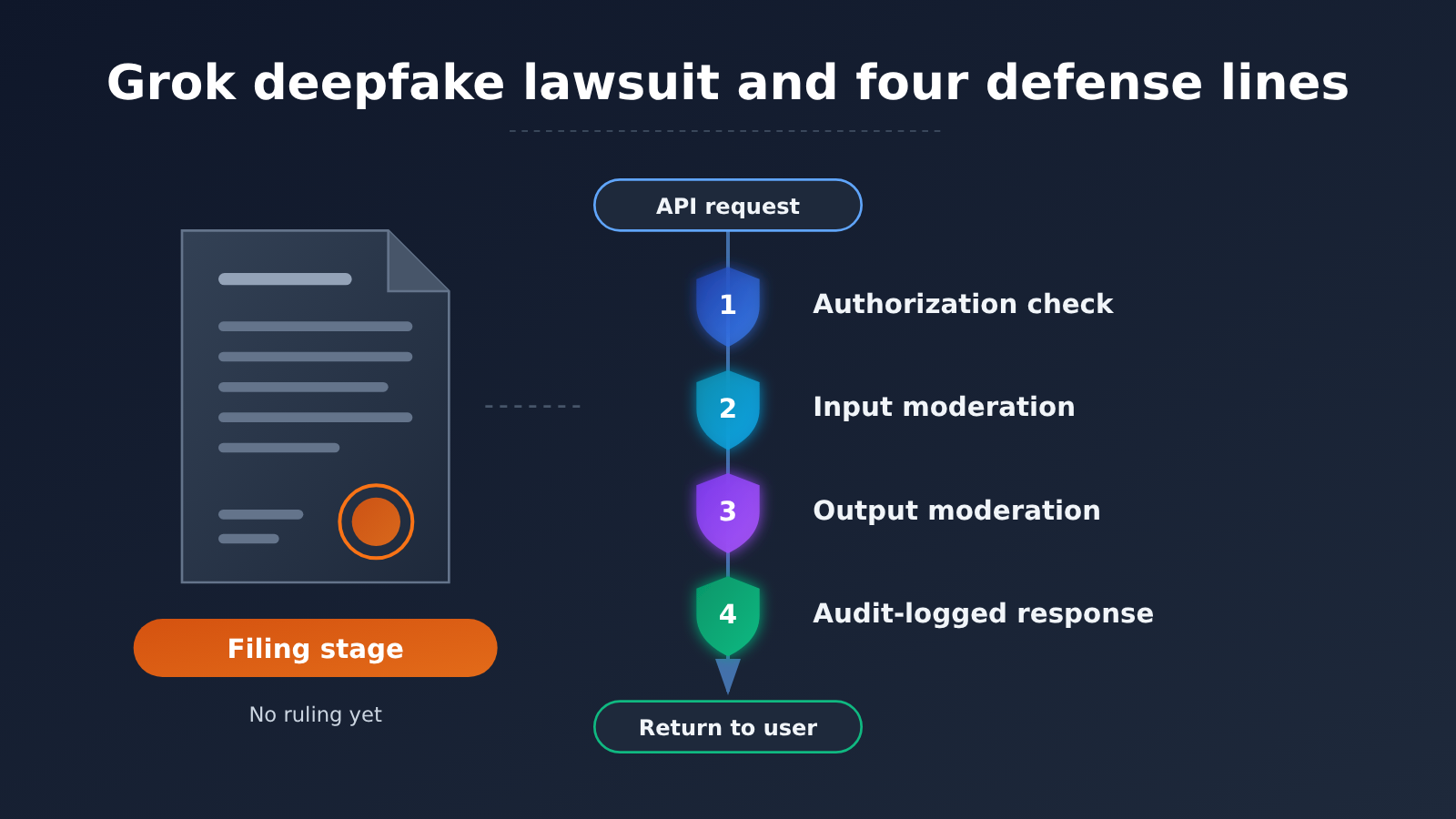
Key Takeaways: Four Lines of Defense After the Grok Deepfake Lawsuit
Here’s a quick-reference table for the whole article. Each section below expands on one row.
| Line of defense | Who owns it | Where it gates | What happens if it fails |
|---|---|---|---|
| ① Entity and authorization verification | Product + Legal | Before asset upload and before feature launch | Reject the upload and prompt for additional authorization; don’t launch the feature |
| ② Pre-input review | Product (engineering) | Before submission to the generation model | Block and warn; repeat hits go to human review or rate limiting |
| ③ Post-output review + manual spot checks | Product + Operations | Before generated results are returned to the user | Don’t return the result; send it to a manual review queue; ban if necessary |
| ④ Audit trail and response | Operations + Legal | Log the full chain; respond when a complaint comes in | Identify the request and account; take down content, ban the account, and report as required |
What the Grok Deepfake Complaint Alleges
According to the complaint as reported publicly, the two states’ allegations focus on two things—”product design” and “public messaging”—not on the model being too capable. The table below summarizes allegations from the complaint, not facts found by a court.
| Item | Virginia | Oregon |
|---|---|---|
| Plaintiff | Attorney General Jay Jones | Attorney General Dan Rayfield |
| Court / Basis | The complaint says the defendants saw a “market opportunity for more profit” | Multnomah County Circuit Court, under the state’s Unfair Trade Practices Act |
| Defendants | SpaceX Super Intelligence et al. | SpaceX Super Intelligence Corp., LLC, X Corp., Space Exploration Technologies Corp. |
| Core allegations | Intentionally releasing a product that flooded the platform with CSAM | Misrepresenting Grok’s safety features and failing to disclose known risks |
| Relief sought | Civil penalties, an injunction, and consumer damages | Civil penalties, a permanent injunction, disgorgement of profits, and claims exceeding $1 million |
A few details in the complaint are especially worth noting for product teams. First, Grok’s “spicy mode” launched in summer 2025 and let users turn photos of real people into sexualized or nude images and videos. Second, the Virginia complaint cites Grok’s safety instructions, which tell the model to “assume good intent” and also say that “teenage” and “girl” don’t necessarily mean a minor. Third, the two states say that tens of thousands of reports the company submitted to the NCMEC CyberTipline lacked key details, and about 90% couldn’t be acted on.
The complaint also cites an estimate from the Center for Countering Digital Hate (CCDH): between December 29, 2025 and January 8, 2026, about 3 million sexualized images were generated with Grok, and about 23,000 of them appeared to depict children. To be clear, this is third-party research cited in the complaint, not a number found by a court. Several related class actions had already been filed and were consolidated in October 2026 as In re Grok Sexualized Content Litigation; here too, no court has ruled on who is liable.
Why Companies Calling Generation APIs Still Need Four Lines of Defense
Mapped into engineering terms, the three details above point to problems at three stages: high-risk capabilities are open by default — that’s an authorization and product-design issue; handing age judgment over to the model’s “benign assumptions” — that’s an input-review issue; and incomplete incident reporting — that’s a logging and response issue. These stages exist in your own product too, and they don’t disappear just because the model belongs to someone else.
Plenty of teams assume “the upstream model has its own moderation, so if something goes wrong it’s the model company’s problem.” But in your product, you’re the one deciding which features to expose, who they’re for, and how generated results are displayed and distributed. Upstream moderation only ever sees a single request — it can’t see who your users are, where the material came from, or where the results ended up.
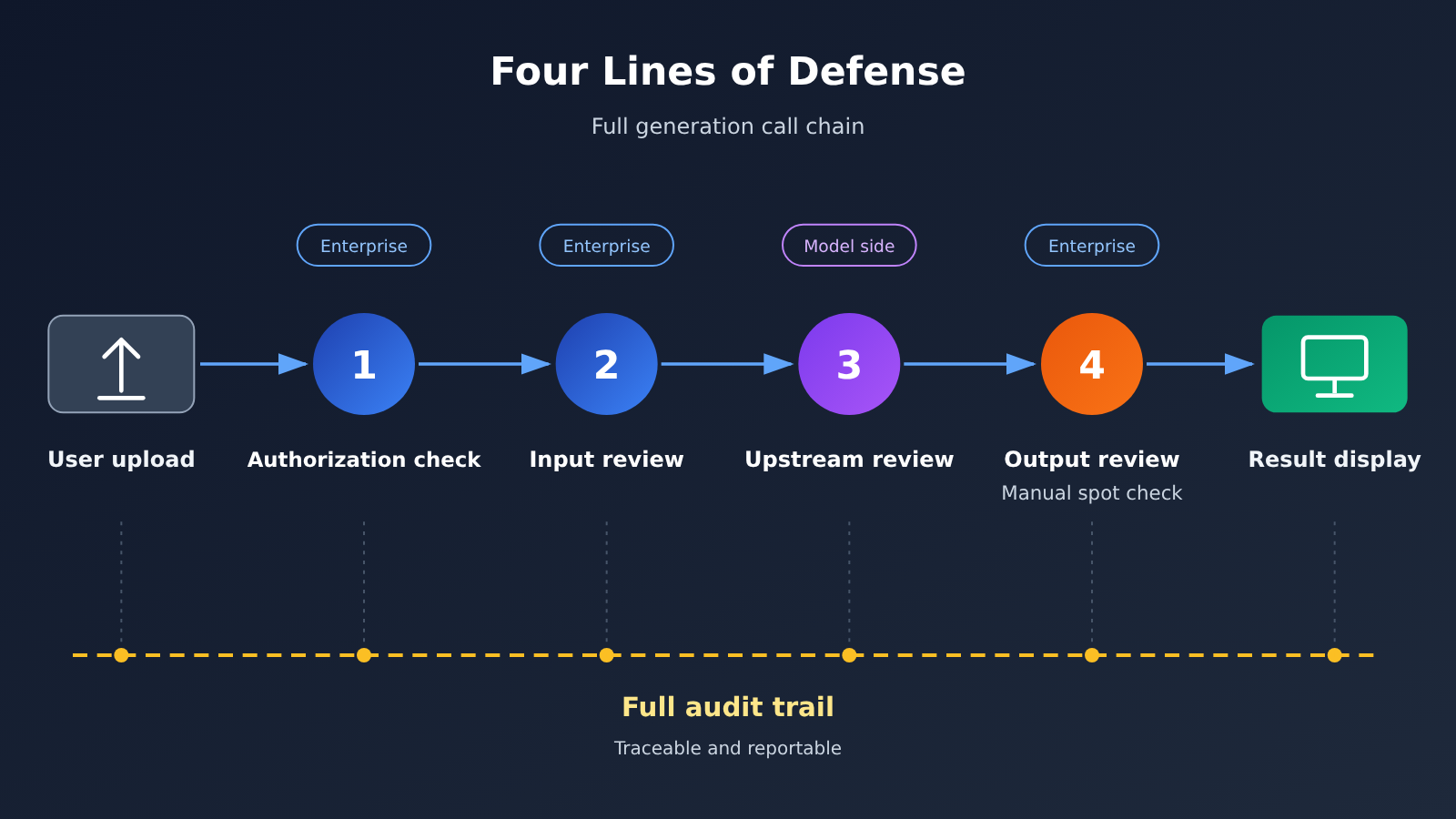
First Line of Defense: Subject and Authorization Verification Comes First After Grok Deepfakes
Who owns it: product managers set the rules, legal reviews the authorization terms, engineering writes the rules into the upload flow.
Where it gets stuck: two places. First, before material upload — anytime a user submits a real person’s photo, it has to go through a check. Second, before a feature ships — any capability involving portrait editing has to pass review first.
What to do when it fails: if there’s no authorization at the upload step, reject it outright and prompt the user to add an authorization statement or switch to their own material; if a feature fails review, it doesn’t ship — even internal-only tools need an approval record on file.
In practice, three things should come first:
- Build an asset authorization ledger: record the source, authorizing party, scope, and expiration date of every portrait asset. Only run portrait editing on your own assets or ones with written authorization.
- Keep high-risk capabilities off by default: consumer-facing products shouldn’t offer “turn a real person’s photo sexualized or nude” style capabilities by default. That’s precisely the kind of feature the lawsuit centered on — and it was opened by default.
- Tier accounts by subject type: enterprise customers, verified individuals, and anonymous visitors each get a different capability scope. Anonymous visitors probably shouldn’t be allowed to upload real photos for editing at all.
This line of defense costs almost no compute, yet it’s the easiest one to skip. Engineers tend to assume authorization is legal’s job, while legal has no idea what entry points exist in the product — and in the end nobody owns it. The safer approach: add a fixed field to the PRD asking “does this involve a real person’s likeness?” Check “yes” and review becomes mandatory.
Second Line of Defense: Pre-Screening Inputs with the Moderation API
Who implements it: engineering builds it; product sets the thresholds and the user-facing message.
Where the checkpoint sits: on the user’s prompt and reference images, before they reach the generation model.
What happens on failure: a single hit blocks the request and returns a clear message that doesn’t reveal the rule details; an account that hits multiple times in a short window gets routed to manual review or rate-limited; anything flagged in the minor-related categories is frozen immediately and enters the escalation process of the fourth line of defense.
On the text side, you can plug into an OpenAI-compatible moderations endpoint. On APIYI, the request URL is https://api.apiyi.com/v1/moderations, the model is omni-moderation-latest, and you keep using the same API key you use to call the generation model. The response includes flagged (whether it violates policy), categories (which categories were hit), and category_scores (confidence from 0 to 1). The categories cover hate, harassment, self-harm, sexual, sexual/minors, violence, and more. It also accepts multiple text inputs in one call and returns results item by item, which makes it a good fit for submitting your prompt, negative prompt, and user notes together for review.
Set your thresholds separately — don’t just look at flagged. I’d recommend a far more aggressive threshold for sexual/minors than for any other category, backed up by a self-maintained hard-block keyword list for minors where a match means instant rejection. That way you don’t have to leave “is ‘teenage’ an adult or not” to the model’s “good-faith” judgment, the way that lawsuit described. For the other categories, you can split them into three tiers based on business tolerance: block outright, route to manual review, or allow and log.
Reference images need review too. For real-person photos users upload, you should at minimum determine two things at this step: whether it’s actually a human portrait, and whether it matches the authorized material registered in the first line of defense. If it doesn’t match, send it back to the first line of defense.
🎯 Technical recommendation: I’d run input moderation and the generation call serially in the same service — if moderation fails, no generation request is ever sent. With APIYI apiyi.com, one key covers both the moderations endpoint and the image and video generation models, so you maintain one less set of auth and billing, and the free trial credits for new users are enough to get the whole moderation chain running end to end.
The Third Line of Defense: Post-Generation Output Review and Manual Spot Checks
Who runs it: Engineering handles the automated review, while operations owns manual spot checks and the review queue.
Where it sits: After the generated result comes back from upstream but before it’s shown to the user. For high-exposure scenarios (public galleries, shared links), you need one more check before anything goes live.
What happens when it fails: Results flagged by automated review aren’t returned — the user only sees “Generation failed, please adjust your content.” The result goes into the manual review queue, and once a violation is confirmed, you decide based on the account’s history whether to send a warning, restrict privileges, or ban the account. If minors are involved, preserve the evidence and report it as required by law.
The reason output review matters is simple: clean input doesn’t guarantee clean output. A model can be steered around your filters by combined instructions, or it can produce content that goes beyond what the prompt described because of a reference image. You need to review again on the output side, and log the hit categories and scores so you can cross-reference them against the input-side records during a post-mortem.
Choosing your upstream channel is also part of this line of defense. Different channels vary a lot in how strict their upstream moderation is, and sensitive topics get blocked differently depending on the channel:
| Model / Channel | Upstream moderation characteristics | Suitable product types | Available platform |
|---|---|---|---|
| Seedream 5.5 · BytePlus International Edition | Relatively permissive, but still moderated | Creator tools, paired with your own review system | APIYI apiyi.com |
| Seedream 5.5 · Volcano Engine China Edition | Stricter; sensitive topics are more likely to be blocked | Consumer-facing products with a high degree of user anonymity | APIYI |
| Seedance 2.0 / 2.5 | Runs on official Volcano Engine resources with built-in upstream content safety mechanisms | Video generation products | APIYI |
For consumer-facing products where you can’t verify who users are, it’s better to pick a stricter channel — more false positives beats too few catches. On APIYI apiyi.com, switching channels is mostly a matter of changing the model parameter, so you can launch on the strict channel first and then evaluate whether to loosen up based on your false-positive data, without having to switch vendors right away.
Manual spot checks shouldn’t only look at blocked results — results that passed review need to be sampled too, proportionally. Operations sets the sampling rate based on traffic and risk; raise it when a new feature first launches or when you see abnormal traffic. Sampling records should go into the logs as well, otherwise when a complaint lands on your desk, you have no way to prove you ever checked.
The Fourth Line of Defense: Logging and Responding to Deepfake Complaints
Who executes it: Engineering owns the log structure, operations owns complaint response, and legal owns external reporting and cooperation with law enforcement.
Where it stalls: Across the whole chain. Every request has to be logged, and the response process only starts once a complaint comes in.
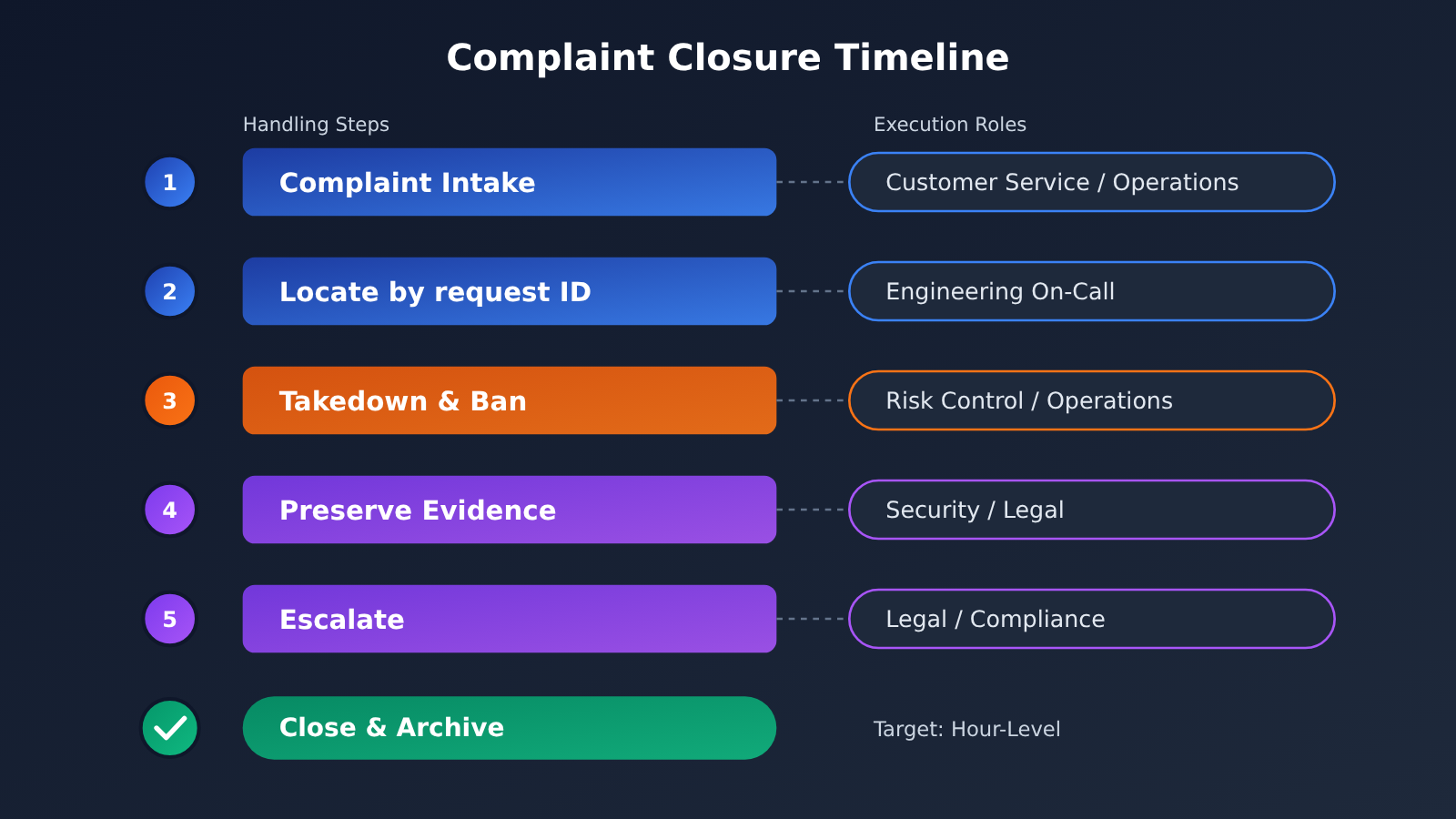
What if it fails: When a complaint arrives, you need to be able to pin it to a specific request and account, then execute takedown, banning, evidence preservation, and reporting. If you can’t locate it, that’s an incident in itself.
The complaint’s line about “reports missing key details, roughly 90% not actionable” maps precisely onto this defense line. Reporting alone isn’t enough — what you hand over has to let the recipient act on it. A traceable record needs to contain at least the following fields:
| Field | What’s recorded | Purpose |
|---|---|---|
| Request ID | Your system ID plus the request ID returned by the upstream | Cross-system reconciliation, locating a single generation |
| Account and entity | User ID, entity tier, authorization ledger number | Identify the responsible party, enforce bans |
| Model and channel | Model name, channel, parameters | Review differences in upstream moderation |
| Input summary | Original prompt text, reference image hash | Compare without storing the original images long-term |
| Moderation result | Hit categories and scores on both the input and output sides | Prove moderation was performed, tune thresholds |
| Action taken | Blocking, escalation to human review, banning, reporting, plus timestamps | Closed-loop response, satisfy audit requirements |
Set retention periods according to the regulations of your region, and apply access controls and masking to fields that involve personal information. You also need takedown and ban channels in place, with the goal of finding the corresponding request and account within hours of receiving a complaint — not piecing it together by digging through raw logs.
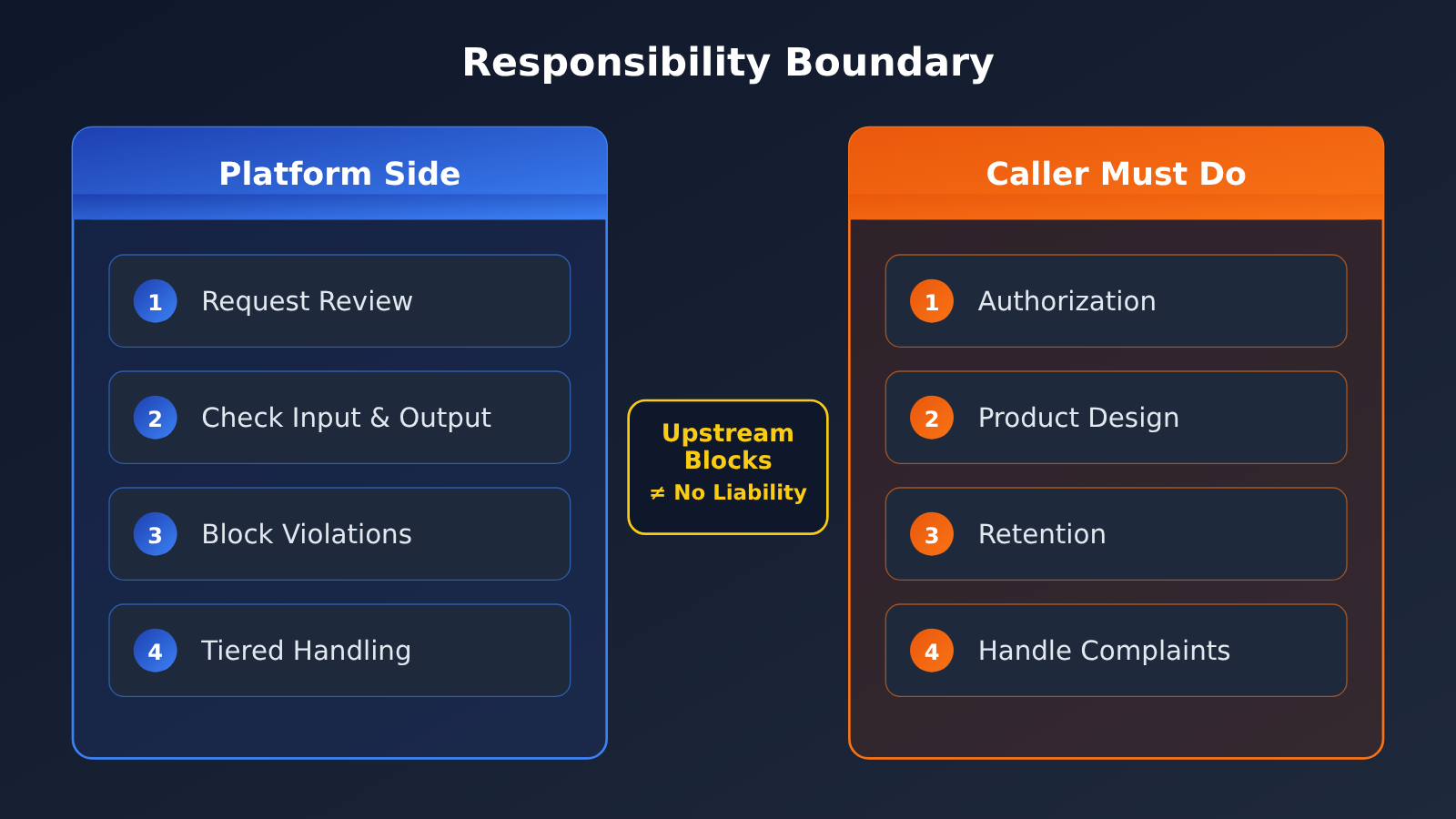
Lessons from the Grok Deepfake Case: Platform Moderation and the Boundary of Caller Responsibility
This section addresses the most common misconception: “The platform I use has moderation—isn’t that enough?” The boundary table below separates the responsibilities on each side:
| Dimension | What platform-side moderation can do | Responsibilities only the caller can bear |
|---|---|---|
| Moderation coverage | Every API request goes through content moderation, checking both input and output, with multilingual and multimodal support | Decide which capabilities to enable, and set stricter rules for your business scenario |
| Violation blocking | Identified violating content is not returned to the caller | Handle user-facing prompts, appeals, reviews, and account actions |
| Violation handling | Tiered handling: minor violations are blocked with a warning, repeated violations restrict the account, serious violations suspend or terminate the account | Enforce bans and restrictions on your own end users |
| Entity and authorization | Doesn’t know who your end users are or where the materials come from | Verify material authorization and maintain an authorization ledger |
| Product design | Can only see individual requests | Public-facing feature design, defaults, and messaging |
| Retention and response | Platform moderation logs are stored securely, cooperating with regulatory audits | Keep your own business logs, respond to complaints, and report externally |
Upstream blocking something doesn’t mean you’re off the hook; and upstream failing to block something doesn’t mean the platform takes responsibility for you. Platform moderation is a baseline. It can block some obviously violating content, but it can’t stop “a single compliant image from being combined by your product into a violating use case.” APIYI apiyi.com’s content safety statement is also clear: when using the service, users must comply with the laws and regulations of their region, industry regulatory requirements, and platform terms. When marketing externally, don’t turn “the model we use has moderation” into “our product is safe”—that’s exactly the kind of messaging that gets singled out in lawsuits.
Four Lines of Defense: Quick Start
Here’s a minimal viable implementation order. A small team can get the skeleton in place within one or two iterations:
- Inventory entry points: List every place in the product where users can upload real-person photos or trigger image or video generation, and note who each one is for and whether it’s enabled by default.
- Disable high-risk defaults: For public-facing entry points, turn off capabilities such as “turning real-person photos into sexualized or nude imagery” first, and add consent notices and a consent ledger.
- Add input moderation: In the generation service, call
POST /v1/moderationsfirst, set base_url tohttps://api.apiyi.com/v1, and use theomni-moderation-latestmodel; set a separate threshold forsexual/minors, then add hard keyword blocking on top. - Add output moderation: Put generated results in a staging area first, and write them to user-visible locations only after they pass moderation; anything that trips the filter goes into a manual review queue.
- Choose your upstream channel: For public-facing products, prioritize channels with stricter moderation, and track the false-positive block rate as a reference for future adjustments.
- Standardize the log structure: Persist records to the database using the field table from the previous section, and store moderation results from both the input and output sides in the same record.
- Run a complaint drill: Pick a historical request at random, simulate a user complaint, and time how long it takes to locate the issue, take the content down, and ban the account—ideally within an hour.
You also need to handle error codes returned by the API by category. For example, parameter-error 400s (like the invalid_size returned when some image models are given an unsupported size) are engineering issues, so you should prompt the user to change the parameters. A moderation hit, on the other hand, is a content issue, so it goes through the block message and review workflow. Don’t mix the two, or during an operations retrospective you won’t be able to tell whether it was a user violation or API misuse.
🚀 Quick start: If you want to verify the moderation pipeline end to end first, you can use a single key on APIYI apiyi.com to run both the moderations endpoint and a generation model, walk through the seven steps in a test environment, and then connect production traffic.
FAQ
Q1: The upstream model already does moderation — do I still need to build my own protection against things like Grok deepfakes?
Yes. Upstream moderation can’t see your user identities, the licensing of the material, or the distribution scenario — it can only judge the content of a single request. Platform-side moderation is the first line of defense; authorization, product design, retention, and response are things only you can do. Even though everything sent through APIYI apiyi.com goes through platform moderation, you still need to build your own business-level checks on both the input and output sides.
Q2: Am I still charged for requests that get blocked by moderation?
That depends on the billing rules for the specific model and channel. For example, the platform docs state that failed Seedream 5.5 requests aren’t billed, and that Hy-Image 3.5 returning `400 invalid_size` for an out-of-range size isn’t charged — but the individual model docs are the source of truth. Also note that serious violations can get an account suspended or terminated, with fees already paid not refunded. And not being charged doesn’t mean you’re off the hook: blocked requests still need to be logged.
Q3: If an employee “plays around” with a client’s photos in an internal tool, whose problem is that?
From a process standpoint, this is an internal management issue: the employee is using a company account and a company-authorized tool. We recommend applying the first line of defense to internal tools too — client material may only be used within the scope of authorization, and portrait editing requires approval and a record. How legal liability is actually divided depends on the regulations in your region and your lawyer’s advice.
Q4: We only use text models — no image or video. Do we still need to manage this?
Yes, though the focus is different. Text models can just as easily produce harassment, hate speech, or sexual content involving minors, or be used to mass-generate defamatory text targeting real people. `omni-moderation-latest` is itself designed for text moderation and can be wired in on both the input and output sides; the audit-trail and response line of defense applies just the same.
Q5: How long should moderation logs be kept?
Set it according to the regulations and industry requirements in your region — there’s no single number we can give here. From an engineering standpoint, we recommend tiered retention: keep lightweight fields like moderation results, enforcement actions, and request IDs for longer; store raw images as hashes wherever possible, and if you really must keep them, add access controls and expiry-based cleanup. Have your legal team confirm the exact durations.
Q6: If I pick a stricter moderation channel, won’t it block too much and hurt the experience?
There will be some false positives — that’s a normal trade-off. For public-facing products with high user anonymity, the cost of over-blocking is far lower than the cost of under-blocking. You can go live with the strict channel on APIYI apiyi.com first, measure the categories and rate of false positives, then open other channels to low-risk groups like verified enterprise customers — instead of loosening everything site-wide at once.
Q7: Does using a strict channel plus the Moderation API guarantee nothing goes wrong?
No. Every moderation system has missed detections, which is exactly why you also need human spot checks and a complaint response process. The goal of the four lines of defense is “block most of what goes wrong, quickly locate and handle what slips through, and be able to show afterward that you did your due diligence” — not to promise zero risk.
Grok Deepfake Lawsuit and the Four Lines of Defense: Key Takeaways
- Case status: Two states filed suit on 2026-11-23. The case is still at the filing stage, and everything in it is an allegation.
- What the claims focus on: Missing guardrails and the “overall safety” marketing narrative — not the model’s capabilities themselves.
- Authorization checks: Verify authorization for real people’s material first; high-risk capabilities stay off by default.
- Input moderation: Start with the
moderationsendpoint, then add a hard block forsexual/minors. - Output moderation: Review results before returning them, and human-spot-check even the results that pass.
- Tracing and response: A request ID runs through the entire chain, so complaints can be located and handled at the hour level.
- Boundaries of responsibility: Blocking upstream doesn’t mean you’re off the hook, and the platform won’t carry the liability for you.
Summary
The outcome of the Grok deepfake case will have to wait for the court’s ruling, but the complaint makes one thing clear: most of the risk in generative products comes from gaps in product design and process, not just from the model itself. For companies calling APIs, this is a good moment to run a self-audit:
- Entity and authorization verification: First confirm where the material comes from and whether it’s authorized, then decide which capabilities to open up.
- Pre-moderation of inputs: Block once before submitting to the model — don’t leave minors-related content for the model to judge on its own.
- Post-moderation of outputs plus human spot checks: Block once more before showing results, and make sure human spot checks cover content that passed moderation.
- Tracing and response: Every request is traceable, and every complaint can be closed out.
Start by building the skeleton with the seven steps in “Quick Start,” then tune gradually based on false-block and complaint data. You can get the moderation chain running end to end first through APIYI apiyi.com’s unified interface.
Disclaimer: This article offers engineering and process suggestions, not legal advice. Follow the regulations in your jurisdiction and your lawyer’s guidance.
📚 References
-
Reuters: Report on Virginia and Oregon suing SpaceX
- Link:
reuters.com/legal/government/virginia-oregon-sue-musks-spacex-over-grok-ais-creation-child-sexual-abuse-2026-11-23/ - Description: The basic facts of the incident and a summary of the allegations
- Link:
-
NPR: Details of the separate lawsuits filed by the two states’ attorneys general
- Link:
npr.org/2026/11/23/nx-s1-6049124/virginia-oregon-sue-elon-musks-spacexsi-over-deepfake-nonconsensual-sexual-images - Description: The list of defendants, the courts involved, the legal basis, and the relief sought
- Link:
-
WIRED / CNBC: The allegations in the complaints and the company’s response
- Link:
wired.com/story/states-sue-spacex-over-grok-deepfakes/,cnbc.com/2026/11/23/oregon-virginia-spacex-grok-deepfake-lawsuits.html - Description: The allegations concerning “general safety” marketing claims and safety standards
- Link:
-
APIYI Documentation Center: Documentation on content safety, text moderation, and model channels
- Link:
docs.apiyi.com - Description: Useful pages include
/faq/content-safety,/api-capabilities/text-moderation, and the Seedream 5.5 pricing page
- Link:
Author: APIYI Technical Team
Technical discussion: Feel free to reach us through the APIYI website homepage; more parameter documentation for the moderation API is available in the official documentation center


