
Author’s note: This article breaks down Cognition SWE-2.1 across five coding benchmarks, showing where it’s strong, where it’s weak, and how to validate it at minimal cost during the two-week free period.
Let’s start with the bottom line. Cognition SWE-2.1 is a coding model that Cognition created by applying pure reinforcement learning post-training to the open-source base Kimi K3. Its strengths are long-horizon, multi-step tasks and “writing PRs that maintainers are willing to merge”; its weakness is terminal-operation tasks. Right now it’s only offered through three entry points—Devin Cloud, Devin Desktop, and Devin CLI—and there’s no public API.
This isn’t a recap of a launch post claiming it “comprehensively surpasses the frontier.” Every score below comes from the benchmark table Cognition self-reported on 2026-11-24; FrontierCode 2.0 is also a leaderboard that Cognition maintains itself. We’ll list the score deltas between SWE-2.1 and the previous-generation SWE-2, the same-base Kimi K3.1 Pro, and Claude Opus 5.5 item by item—not just say it “improved.”
Core value: After reading this, you’ll be able to decide whether SWE-2.1 is worth a try on a real repository during the free period. If what you really need is the base model underneath it, this article will also explain how you can access it.
Cognition SWE-2.1 Core Capabilities: What Kind of Model Is It, Really?
Before you can understand SWE-2.1, you need to get its positioning clear: it’s the dedicated brain behind Devin, the coding agent—not a general-purpose chat model. The table below summarizes the facts that matter most for choosing a model.
| Point | Details | What it means for you |
|---|---|---|
| Base model | Kimi K3 (2.8T total parameters / 104B active, 1M context window, open-source weights) | Its capability ceiling comes from the same lineage as the Kimi family |
| Training approach | Pure reinforcement learning post-training on Kimi K3, following the same route as SWE-2 | Specialized for coding and agent workflows, not a general-purpose model |
| Available entry points | Devin Cloud, Devin Desktop, Devin CLI | No public API, so you can’t plug it into your own agent |
| Free period | The blog says Free through 12/8 (Desktop and CLI); tweets say Devin Pro / Max / Teams are free for two weeks | Validation costs are basically zero |
| Discount window | Discounted pricing across all three entry points runs through 1/30 | You still get a low-cost observation window after the free period |
| Models released alongside it | SWE-2.1 Cyber (security-focused), a 10x-speed version (tweets call it Lightning, the blog says Ultrafast, built with Cerebras) | There are specialized variants beyond the main model |
Key Changes in SWE-2.1’s Training Method
According to the official blog, SWE-2.1’s progress comes mainly from two things. The first is data and environments: tasks expanded from short-horizon to long-horizon workflows, covering areas such as scientific computing, performance engineering, and cybersecurity. The second is the post-training algorithm: Cognition improved control over rollout length. Previously, length oscillation undermined training stability; once the oscillation was brought under control, the model could train stably on tasks lasting anywhere from a few minutes to several hours.
The official results show that training can run stably for many days in a row, with held-out evaluation scores continuing to climb. Test-time scaling also improved: as task duration increases, the pass rate rises roughly log-linearly. That explains its big gains on long-horizon benchmarks, and it’ll line up with the scores you see later.
The security side is worth mentioning too. Cognition red-teamed the training environment—especially the sandbox—and set up canary evaluations, so any attempt by the model to escape the sandbox would trigger an alert. During training, the model found new sandbox vulnerabilities four times, and researchers addressed all of them. For teams planning to run agents on their own infrastructure for long periods, this is one more item for the risk checklist.
Why SWE-2.1 and Kimi K3.1 Pro Are “Same Base, Different Paths”
Kimi K3.1 Pro is post-trained by Moonshot from Kimi K3, following a large-scale joint reinforcement learning route that covers hundreds of downstream domains. SWE-2.1, by contrast, is post-trained by Cognition on the same Kimi K3 solely for coding agents. So they’re two routes from the same base: one pursues breadth, the other pursues coding depth.
This relationship makes Kimi K3.1 Pro the fairest reference point when comparing SWE-2.1. Because the base is the same, the score gap can largely be attributed to the different post-training paths.
Cognition SWE-2.1 Benchmarks in Practice: A Breakdown of All Five
First, a note on methodology: all the data below is self-reported by Cognition. It isn’t third-party reproduction, and we didn’t run any benchmarks ourselves for this article. In the table, “frontier best” means the highest-scoring closed-source model for that benchmark in the same table.
| Benchmark | SWE-2.1 | SWE-2 | Kimi K3.1 Pro | Claude Opus 5.5 | Best in row |
|---|---|---|---|---|---|
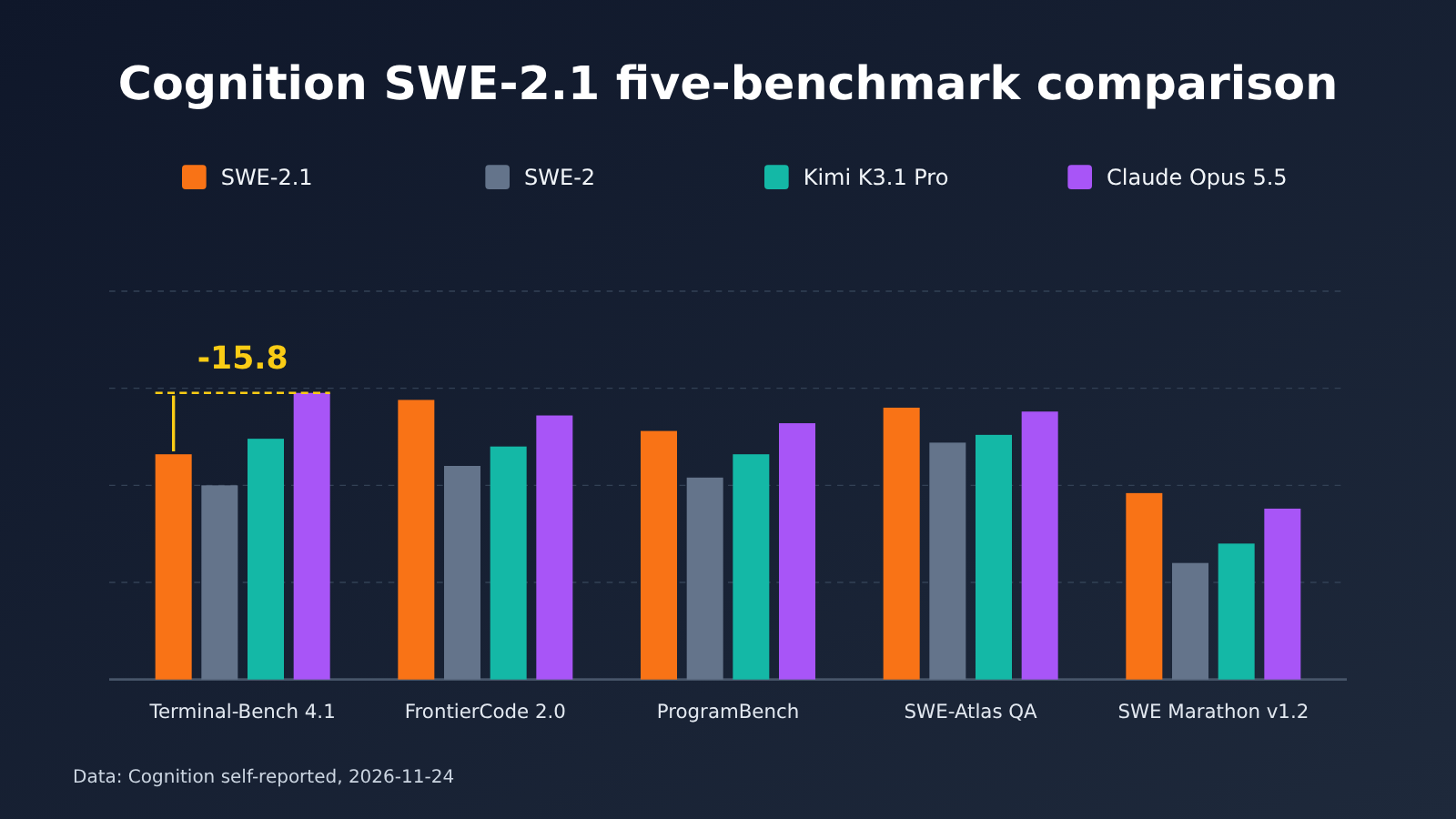
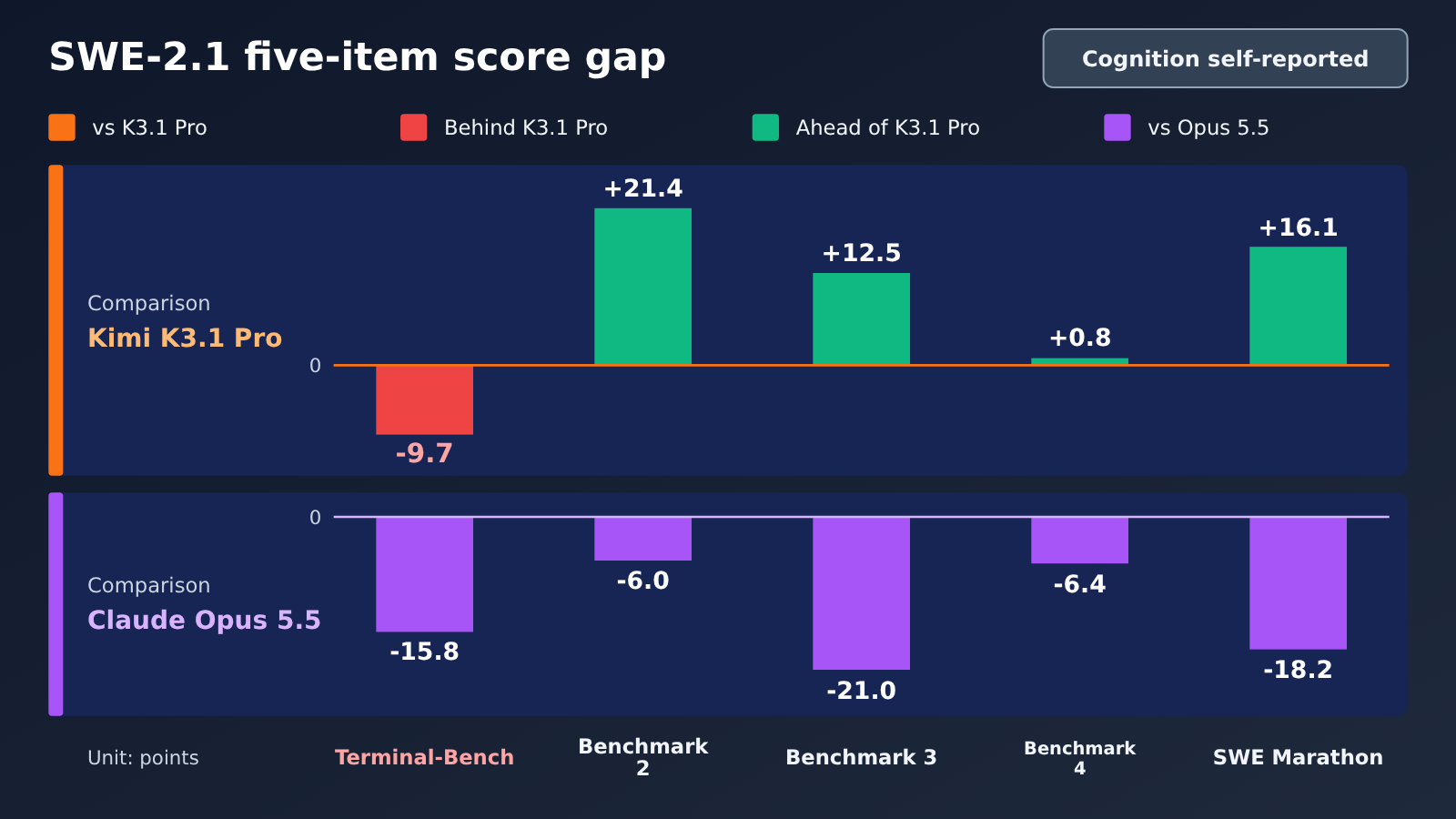
| Terminal-Bench 4.1 | 50.0 | 24.2 | 59.7 | 65.8 | 65.8 (Opus 5.5) |
| FrontierCode 2.0 | 41.3 | 24.1 | 19.9 | 47.3 | 47.3 (Opus 5.5) |
| ProgramBench | 44.0 | 17.0 | 31.5 | 65.0 | 66.0 (GPT-6.2 Sol) |
| SWE-Atlas QA | 71.0 | 63.7 | 70.2 | 77.4 | 77.4 (Opus 5.5) |
| SWE Marathon v1.2 | 54.9 | 32.5 | 38.8 | 73.1 | 73.1 (Opus 5.5) |
Terminal-Bench 4.1: Still the Most Obvious Weak Spot, Even After Doubling
Terminal-Bench 4.1 measures terminal-operation tasks. SWE-2.1 scores 50.0, which is 25.8 points above SWE-2’s 24.2 — more than a doubling. But looking sideways across the field, it trails Claude Opus 5.5’s 65.8 by 15.8 points, and that’s the “15 points behind the frontier” the title refers to. Gemini 4 Neon (65.2) and GPT-6.2 Sol (61.5) also both sit above 60.
What’s more notable is the same-base comparison: Kimi K3.1 Pro scores 59.7 on this benchmark, 9.7 points higher than SWE-2.1. Across all five benchmarks, this is the only metric where SWE-2.1 loses to its same-base sibling Kimi K3.1 Pro. So calling terminal tasks its weak spot isn’t just about trailing the closed-source frontier — it also fails to hold the line against its base-model sibling here. SWE-2.1’s 50.0 still beats Grok 4.7 (38.8) and Muse Wonder (47.0).
FrontierCode 2.0: An In-House Leaderboard for Whether a PR Would Actually Get Merged
FrontierCode 2.0 is Cognition’s own leaderboard, and before reading the scores, you need to understand how it grades. It has 132 tasks, written by more than 20 open-source maintainers, with each task taking over 40 hours to build. There’s only one criterion: would the maintainer actually merge this PR? The evaluation covers correctness, test quality, scope of changes, and whether the work fits the codebase’s style and conventions. Internet access is restricted during evaluation; consulting documentation is fine, but getting the reference solution means an automatic zero.
Cognition also makes it clear that scores on this leaderboard are affected by the harness—in other words, the same model can score differently under a different agent framework. With that caveat in mind, SWE-2.1 scored 41.3, which is 17.2 points above SWE-2’s 24.1 and more than double the 19.9 from Kimi K3.1 Pro, which shares the same base. It’s still 6.0 points shy of Claude Opus 5.5’s 47.3 and 2.5 points behind GPT-6.2 Sol’s 43.8.
ProgramBench: The Biggest Gain, but Also the Biggest Gap to the Frontier
ProgramBench requires passing at least 95% of the tests for a task to count as complete. SWE-2.1 went from SWE-2’s 17.0 to 44.0, a 27.0-point jump—the largest absolute gain among the five. It also leads Kimi K3.1 Pro (31.5) by 12.5 points.
However, GPT-6.2 Sol (66.0) and Claude Opus 5.5 (65.0) are both around 65, so SWE-2.1 is about 21 to 22 points behind, and Muse Wonder (50.0) is ahead of it as well. The testing conditions here are also worth noting: SWE-2.1 and SWE-2 ran with a 250k context window and up to 3 compactions (1M cumulative), while the other models used mini-swe-agent and their own native context windows. Since the conditions aren’t the same, take cross-comparisons with a grain of salt.
SWE-Atlas QA: repository Q&A, the smallest gap
SWE-Atlas QA measures question answering over code repositories. SWE-2.1 lands at 71.0 — 7.3 points above SWE-2’s 63.7 and 0.8 above Kimi K3.1 Pro’s 70.2, which is basically a tie. Claude Opus 5.5 leads at 77.4, while Grok 4.7 and Muse Wonder both sit at 73.4, just ahead of SWE-2.1. GPT-6.2 Sol scores only 61.3 here, trailing SWE-2.1. The takeaway: these models don’t all have the same strengths.
SWE Marathon v1.2: long-horizon, multi-step tasks show off the training changes best
SWE Marathon v1.2 measures long-running, multi-step tasks — exactly the rollout length control and long-horizon training discussed earlier. SWE-2.1 gets 54.9, which is 22.4 points above SWE-2’s 32.5 and 16.1 above Kimi K3.1 Pro’s 38.8. This is one of the areas where its advantage over the same base model is most obvious.
To be fair, the absolute gap to the frontier is still substantial here too: Claude Opus 5.5 sits at 73.1, GPT-6.2 Sol at 68.8, and Gemini 4 Neon at 58.1. So “strong at long-horizon” really means: on the Kimi K3 base, Cognition’s post-training pushes long-horizon capability much further than the general-purpose route does — but it hasn’t caught up with the strongest closed-source models yet.
FrontierCode 2.0 Public Leaderboard: A Cost Perspective
The FrontierCode public leaderboard calculates the USD cost of each rollout based on list API prices, which makes it a good place to compare value for money. The table below shows a selection of entries read on 2026-11-25. SWE-2.1 is not on this leaderboard yet, so there’s no public figure for its per-rollout cost.
| Entry | Harness | Score | Cost per rollout |
|---|---|---|---|
| Claude Opus 5.5 max | Claude Code | 47.3% | $12.82 |
| Gemini 4 Neon high | Antigravity CLI | 46.2% | $4.38 |
| GPT-6.2 Astra max | Codex | 44.2% | $5.97 |
| GPT-6.2 Sol max | Codex | 43.8% | $1.29 |
| SWE-2 high | Devin CLI | 24.1% | $0.96 |
| Kimi K3.1 Pro max | Devin CLI | 19.9% | $3.03 |
| Kimi K3 high | Devin CLI | 18.9% | $4.47 |
Two things stand out from the table. First, each entry uses a different harness, and Cognition itself admits that the harness affects scores, so you can’t treat this table as a neutral ranking of model capability. Second, GPT-6.2 Sol delivers near-frontier scores at a much lower cost, making it a strong reference point for value. The cost SWE-2.1 posts once it lands on the leaderboard will directly determine whether it’s worth paying for after the free period ends.
A quick side note: security benchmarks
Cognition also released security benchmarks, again self-reported numbers. SWE-2.1 scores 80.0 on ExploitBench (SWE-2: 36.1), below Claude Opus 5.5’s 91 and GPT-6.2 Sol’s 100. It scores 65.8 on CWE-Bench v2 Public, up from SWE-2’s 54.0. The model actually aimed at security use cases is SWE-2.1 Cyber, released in the same batch. It powers Devin Security, with looser guardrails that make it easier for defenders to carry out advanced defensive work.
So you want to use the same base model: where SWE-2.1 and Kimi K3 diverge
Many teams reading this will ask: can we plug SWE-2.1 into our own coding agent? The answer is no. There’s no public API; SWE-2.1 is only available through three entry points: Devin Cloud, Devin Desktop, and Devin CLI. If you want to use it, you have to use Devin itself.
If what you’re after is the base model underneath, the path is different. Kimi K3 is an open-weight model with API model ID kimi-k3; the general-purpose enhanced version built on the same base is kimi-k3.1-pro. Both are listed on APIYI (apiyi.com), and the API is OpenAI-compatible: set base_url to https://api.apiyi.com/v1, then change model to kimi-k3 or kimi-k3.1-pro, and you can switch it in your own agent. The invocation path uses the chat endpoint, /v1/chat/completions.
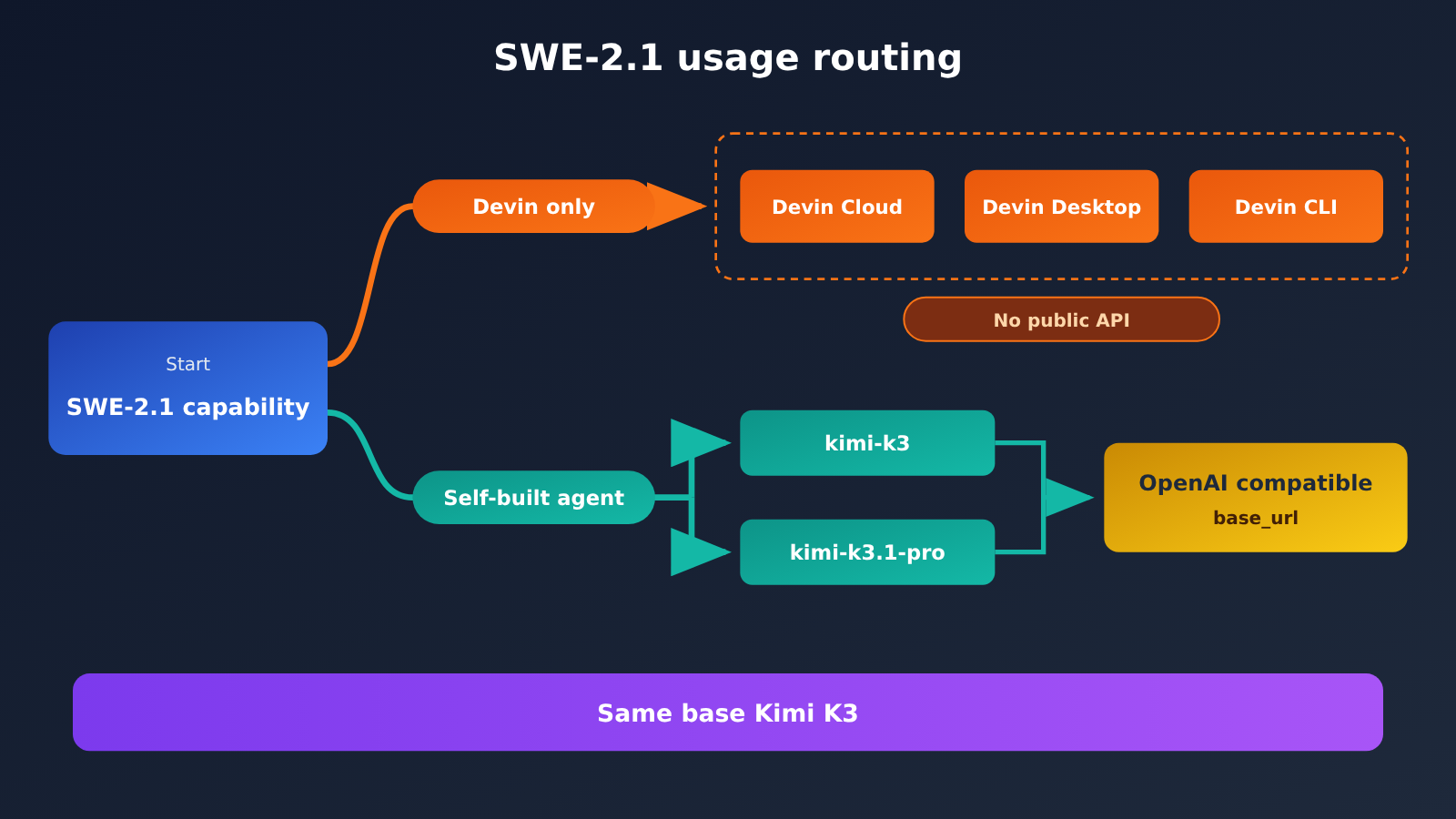
The right-hand branch in the diagram maps to the Kimi family models on APIYI (apiyi.com), suited to teams that need to plug the base model into their own workflows. Prices in the table below are in USD per million tokens; data date is 2026-11-25.
| Model | Input | Output | Cache read | Endpoint | Available platform |
|---|---|---|---|---|---|
kimi-k3 |
3 | 15 | 0.3 | chat | APIYI |
kimi-k3.1-pro |
2 | 10 | 0.2 | chat | APIYI |
kimi-k3.1-pro-highspeed |
4 | 20 | 0.2 | chat | APIYI |
claude-opus-5-5 |
4 | 20 | 0.2 | chat, messages | APIYI |
gpt-6.2-sol |
2 | 10 | 0.1 | responses, chat | APIYI |
gpt-6.2-sol pricing applies to the 0 to 272k token range; input above 272k is billed at $3 per million. Model IDs and prices are subject to the platform’s model list.
🎯 Technical recommendation: Keep in mind that the Kimi K3 base is not the same as SWE-2.1. Looking at the scores above,
kimi-k3.1-proactually beats SWE-2.1 by 9.7 points on Terminal-Bench 4.1, but it clearly lags behind on FrontierCode 2.0 and long-horizon tasks. You can claim free test credits through APIYI (apiyi.com) and putkimi-k3.1-pro,claude-opus-5-5, andgpt-6.2-solinto the same harness to run your own tasks.
How to Validate Cognition SWE-2.1 During Its Two-Week Free Period
The free period runs until 12/8. The easiest way to validate it isn’t to rerun public benchmarks — it’s to pick a real task from your own repo and hand it to the model. FrontierCode’s criterion is “would the maintainer merge this?”, so use your team’s maintainers’ actual judgment to validate it.
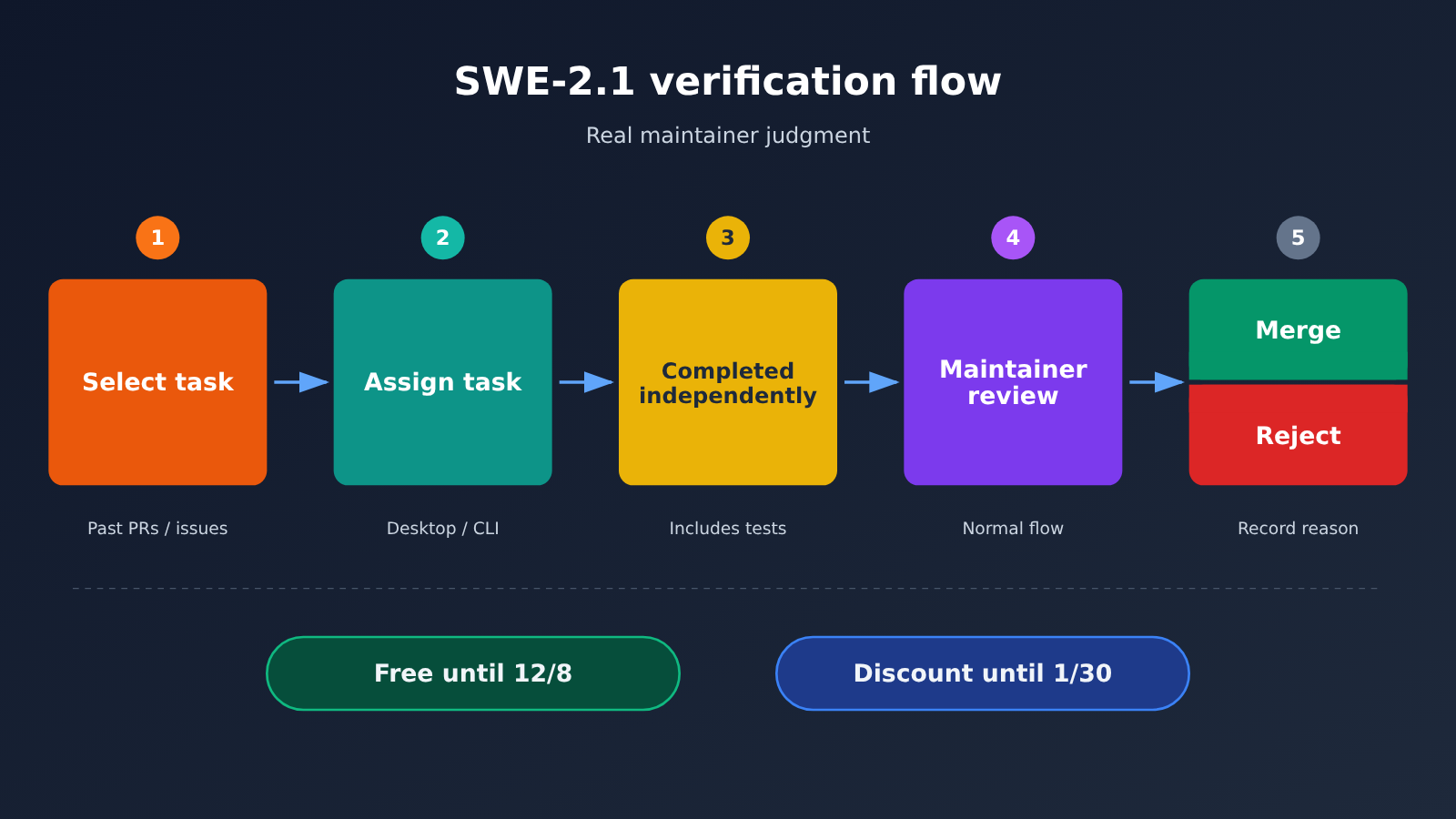
Here are the specific steps:
- Pick the task: Choose a historical PR that has already been merged, or a moderately sized pending issue. Ideally, it covers multi-file changes and test writing, so you can evaluate both merge quality and long-horizon capability.
- Run one terminal-heavy task separately: Since Terminal-Bench is its weak spot, pick a task that depends on build scripts, environment setup, or command-line debugging, and see how it performs on that kind of work.
- Review it through the normal process: Hand the result to the original maintainer without telling them in advance that an agent wrote it. Focus on whether the change scope is restrained, whether tests are adequate, and whether the style follows conventions.
- Record rejection reasons: When it’s rejected, record whether the reason is a logic error, scope creep, or a style issue. This is more useful than an overall pass rate.
After validation, if you still want to compare the general-purpose route built on the same base model, you can give the same task to kimi-k3.1-pro in your own agent and see whether the score gap aligns with the direction Cognition reported.
Cognition SWE-2.1 Strengths and Weaknesses
Strengths
- All five benchmarks improved: Compared with SWE-2, gains range from +7.3 on SWE-Atlas QA to +27.0 on ProgramBench, with Terminal-Bench 4.1 and ProgramBench nearly or more than doubling.
- Merge quality improved significantly: FrontierCode 2.0 scores 41.3, more than double the score of Kimi K3.1 Pro on the same base model, and only 2.5 points behind GPT-6.2 Sol.
- Big gains on long-horizon tasks: SWE Marathon v1.2 scores 54.9, 16.1 points ahead of the same base model, which lines up with the long-horizon stability training and test-time scaling improvements described in the official release.
- Low validation cost: The free period runs through 12/8, and discounts are available afterward through 1/30.
Limitations
- Terminal tasks are the weak spot: Terminal-Bench 4.1 is 15.8 points lower than Claude Opus 5.5 and 9.7 points lower than Kimi K3.1 Pro on the same base model. If your workflow relies heavily on the command line, it’s worth testing this task type separately.
- It doesn’t reach the frontier overall: On all five benchmarks, SWE-2.1 scores lower than Claude Opus 5.5, with gaps on ProgramBench and SWE Marathon approaching or exceeding 20 points.
- The evaluation setup skews toward in-house benchmarks: All data is self-reported by Cognition. FrontierCode is an in-house leaderboard and is affected by the harness, and ProgramBench’s context settings also differ from those used for other models.
- No public API: It’s only available inside Devin. Teams building their own agents can only connect to the base model or other models—they can’t swap in SWE-2.1 directly.
- Cost is unknown: SWE-2.1 hasn’t yet appeared on the public FrontierCode leaderboard, and there’s no public per-run cost figure, so its cost-effectiveness after the free period can’t be assessed yet.
FAQ
Q1: What is Cognition SWE-2.1?
It’s a coding model that Cognition post-trained with pure reinforcement learning on top of the open-source Kimi K3 base. It’s built specifically for the Devin coding agent, not as a general-purpose chat model. Released on 2026-11-24, it’s only available in Devin Cloud, Desktop, and CLI.
Q2: What’s the difference between SWE-2.1 and Kimi K3.1 Pro?
Both are based on Kimi K3. Kimi K3.1 Pro follows a general-purpose joint reinforcement learning route covering hundreds of domains, while SWE-2.1 is trained only for the coding agent. According to Cognition’s self-reported data, SWE-2.1 leads by a wide margin on FrontierCode, ProgramBench, and SWE Marathon, but trails by 9.7 points on Terminal-Bench 4.1.
Q3: How long does the free period last?
The official blog says “Free through 12/8” (Desktop and CLI), and the official tweet says Devin Pro / Max / Teams are free for two weeks. After that, the three access points are offered at a discounted price through 1/30.
Q4: Are the FrontierCode 2.0 scores trustworthy?
It’s Cognition’s own leaderboard, with 132 tasks, judged by “would the maintainer merge this PR?” The design is meant to mirror real work. But it’s not a neutral third-party evaluation, and Cognition explicitly notes that scores are affected by the harness. A reasonable way to use it is as directional guidance, then validate on your own repo.
Q5: Can I call SWE-2.1 through an API?
No. SWE-2.1 has no public API, and it doesn’t appear in model listings on any third-party platform. If you want to use its base model in your own agent, you can call `kimi-k3` or `kimi-k3.1-pro` on APIYI apiyi.com. The API is OpenAI-compatible—just change the `model` field to switch.
Q6: Which model should I choose for building my own coding agent?
It depends on the task type. When there’s a lot of terminal work, `kimi-k3.1-pro` has a higher self-reported score on Terminal-Bench. If you’re chasing the highest score, check out `claude-opus-5-5`. If cost efficiency matters, `gpt-6.2-sol` has a lower per-run cost on the public FrontierCode leaderboard. I’d recommend running your own tasks on APIYI apiyi.com with the same harness before deciding.
Q7: How are the SWE-2.1 Cyber and Ultrafast versions different?
SWE-2.1 Cyber is Cognition’s first model dedicated to cybersecurity, used by Devin Security, with looser guardrails. The 10x-speed version was launched in partnership between Cognition and Cerebras. The tweet calls it Lightning, while the blog post calls it Ultrafast—it’s aimed at speed-sensitive use cases.
Cognition SWE-2.1 Key Takeaways
- Positioning: A coding-specific model post-trained with pure reinforcement learning on Kimi K3, available only in Devin.
- Across-the-board gains: All five benchmarks improved over SWE-2, with ProgramBench rising from 17.0 to 44.0.
- Merge quality: FrontierCode 2.0 scored 41.3, more than double the same-base Kimi K3.1 Pro.
- Terminal weakness: Terminal-Bench 4.1 scored 50.0, 15.8 points below Opus 5.5 and 9.7 points below the same-base model.
- Reporting caveat: All results are self-reported by Cognition; FrontierCode is its own leaderboard, and scores are affected by the harness.
- How to validate: The free period runs until 12/8. Submit a real PR from your own repo for maintainer review.
- Base model access: If you need API access, you can call
kimi-k3orkimi-k3.1-prothrough APIYI apiyi.com.
Summary
The core conclusions about Cognition SWE-2.1 come down to three points:
- The progress is real: All five benchmarks improved, and its advantages in long-horizon tasks and merge quality over the same-base model are clear, which aligns with the training changes described by the official team.
- The weakness is equally clear: Terminal tasks are 15.8 points below Claude Opus 5.5, and this is the only metric where it loses to the same-base Kimi K3.1 Pro. Overall, it still hasn’t caught up with the closed-source frontier.
- The usage boundaries are clear: It’s only available in Devin, has no public API, and per-run cost hasn’t been disclosed.
If you’re already using Devin, try it on a real PR before the free period ends on 12/8—that’s the lowest-cost way to judge it. If you’re building your own agent and need a model that can plug into your own harness, you can compare kimi-k3.1-pro, claude-opus-5-5, and gpt-6.2-sol on the same task suite through APIYI apiyi.com, then decide which model to use as your main one.
📚 References
-
Cognition Official Blog – Introducing SWE-2.1: release notes and benchmark table
- Link:
cognition.com/blog/swe-2-1 - Details: covers the training method, coding and safety benchmarks, the free period, and availability
- Link:
-
Cognition Official X Account: announcement tweet
- Link:
x.com/cognition - Details: confirms the pure reinforcement learning approach based on Kimi K3 and the two-week free arrangement
- Link:
-
APIYI Model List: pricing and endpoints for the Kimi series and comparison models
- Link:
docs.apiyi.com/models - Details: pricing data in this article was read on 2026-11-25; refer to the platform’s latest listing for the authoritative figures
- Link:
Author: APIYI Technical Team
Technical discussion: feel free to reach out to us via the contact details on the APIYI homepage; more integration materials are available in the documentation center at docs.apiyi.com


