

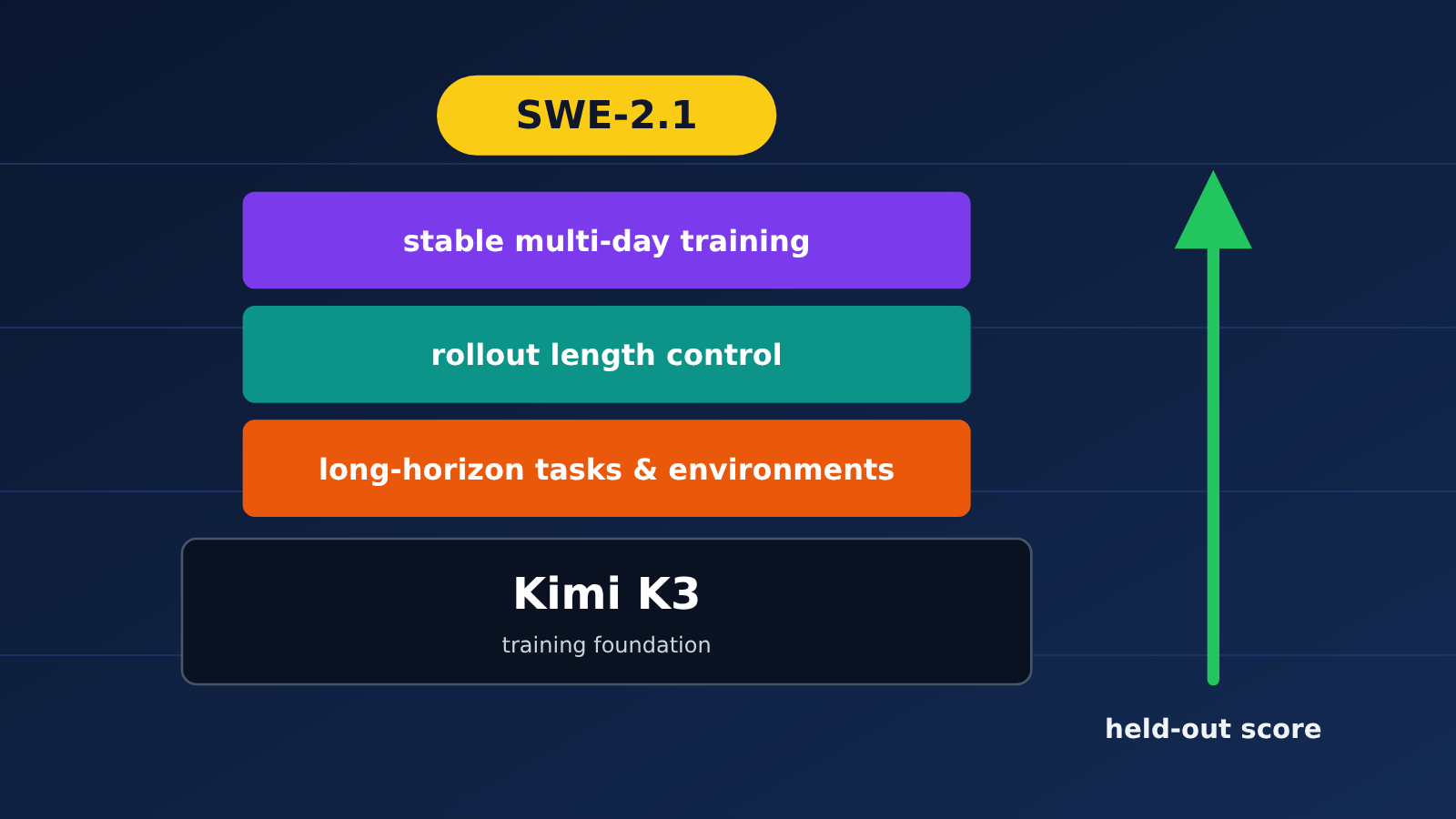
Author’s note: The base model behind SWE-2.1 is still Kimi K3, and the gains come from multi-day stable training enabled by expanded long-horizon tasks and rollout length control. This article breaks down the key points from Cognition’s official blog and what they mean for teams training their own models.
Cognition released SWE-2.1 on November 25, 2026, Beijing time. Here’s the bottom line: the base model hasn’t changed—it’s still Kimi K3—and like SWE-2, it’s trained with pure reinforcement learning. It jumps substantially over SWE-2 on multiple benchmarks because the data scope was expanded and training stability was solved.
This isn’t internet speculation. Cognition’s official X account and its official blog post “Introducing SWE-2.1” (page date 2026.11.24) both state the base model and training method. The training method section of this article is drawn entirely from the key points in the original blog post; I don’t add any formulas or hyperparameters that aren’t in the blog.
Why it matters: By the end of this article, you’ll know the three specific things SWE-2.1 changed, why rollout length oscillation can wreck training, how to read test-time scaling curves correctly, and what small teams trying to train their own coding models on open-source base models should focus on first.
SWE-2.1 and Kimi K3: Key Facts at a Glance
| Item | Details |
|---|---|
| Release date | 2026-11-25 03:07 (Beijing Time), 11-24 US time |
| Released by | Cognition (the team behind Devin) |
| Training base | Kimi K3, pure reinforcement learning, same as SWE-2 |
| Models in the same release | SWE-2.1 Cyber (specialized for cybersecurity, used by Devin Security); a 10x-speed version (called SWE-2.1 Lightning in the tweet and SWE-2.1 Ultrafast in the blog, built with Cerebras) |
| Availability | Devin Cloud, Devin Desktop, Devin CLI |
| Promotions | The tweet says Devin Pro / Max / Teams will be free for the next two weeks; the blog footer says Desktop and CLI are free until 12/8, and discounted pricing for all three surfaces lasts through 1/30 |
| Public API | None; available only through Devin’s three entry points |
The most important row in this table is “Training base.” From the same Kimi K3, Moonshot post-trained Kimi K3.1 Pro, while Cognition post-trained SWE-2 and SWE-2.1. So SWE-2.1 and Kimi K3.1 Pro are two different post-training routes from the same base—comparing their scores is effectively comparing post-training recipes.
How Much Did SWE-2.1 Improve Over SWE-2?
The table below shows Cognition’s self-reported coding benchmarks, published on 2026-11-24. The blog originally labeled this column Kimi K3.1; the numbers match the Kimi K3.1 Pro max entry on its FrontierCode leaderboard, so I’ve standardized on Kimi K3.1 Pro here.
| Benchmark | SWE-2.1 | SWE-2 | Kimi K3.1 Pro | Gemini 4 Neon | GPT-6.2 Sol | Claude Opus 5.5 |
|---|---|---|---|---|---|---|
| Terminal-Bench 4.1 | 50.0 | 24.2 | 59.7 | 65.2 | 61.5 | 65.8 |
| FrontierCode 2.0 | 41.3 | 24.1 | 19.9 | 46.2 | 43.8 | 47.3 |
| ProgramBench | 44.0 | 17.0 | 31.5 | 45.0 | 66.0 | 65.0 |
| SWE-Atlas QA | 71.0 | 63.7 | 70.2 | 71.8 | 61.3 | 77.4 |
| SWE Marathon v1.2 | 54.9 | 32.5 | 38.8 | 58.1 | 68.8 | 73.1 |
On Terminal-Bench 4.1, FrontierCode 2.0, and ProgramBench, SWE-2.1’s scores are roughly double those of SWE-2, or more. Long-horizon, multi-step tasks like SWE Marathon v1.2 also rose from 32.5 to 54.9. FrontierCode 2.0 consists of 132 tasks written by more than 20 open-source maintainers, with each task taking over 40 hours; the criterion is whether the maintainer would merge the PR. On this leaderboard, SWE-2.1’s 41.3 is clearly higher than Kimi K3.1 Pro from the same base (19.9).
A few caveats before you read the table: these are all self-reported by Cognition, and scores are affected by the harness. On ProgramBench, SWE-2.1 and SWE-2 ran with a 250k context window and up to 3 compressions (1M total), while other models used mini-swe-agent and their own native context windows. Time budgets use a simulated clock with fixed TPS so that inference speed doesn’t affect scores. Compared with top closed-source models, SWE-2.1 still lags on most leaderboards.
What Cognition Actually Changed on Kimi K3
Based on the key points in the official blog post, the changes in SWE-2.1 come down to three interdependent things.
- Data and environments extended to long-horizon: Tasks and environments moved from short-horizon to long-horizon workflows, covering areas such as science, performance engineering, and cybersecurity.
- Post-training algorithm controls rollout length: Improved control over rollout length, suppressing the length oscillations that had been destabilizing training.
- Training stays stable for many days: Once the first two steps were in place, training could run stably for many days in a row, and held-out evaluation scores kept climbing.
These three things form a chain and can’t be viewed in isolation. As tasks get longer, rollouts get longer too, and the length-oscillation problem gets amplified. If you can’t get the oscillations under control, training won’t run for long, and no amount of long-horizon data will get absorbed. Only after step two is solved can the data added in step one turn into better scores during the multi-day training in step three.
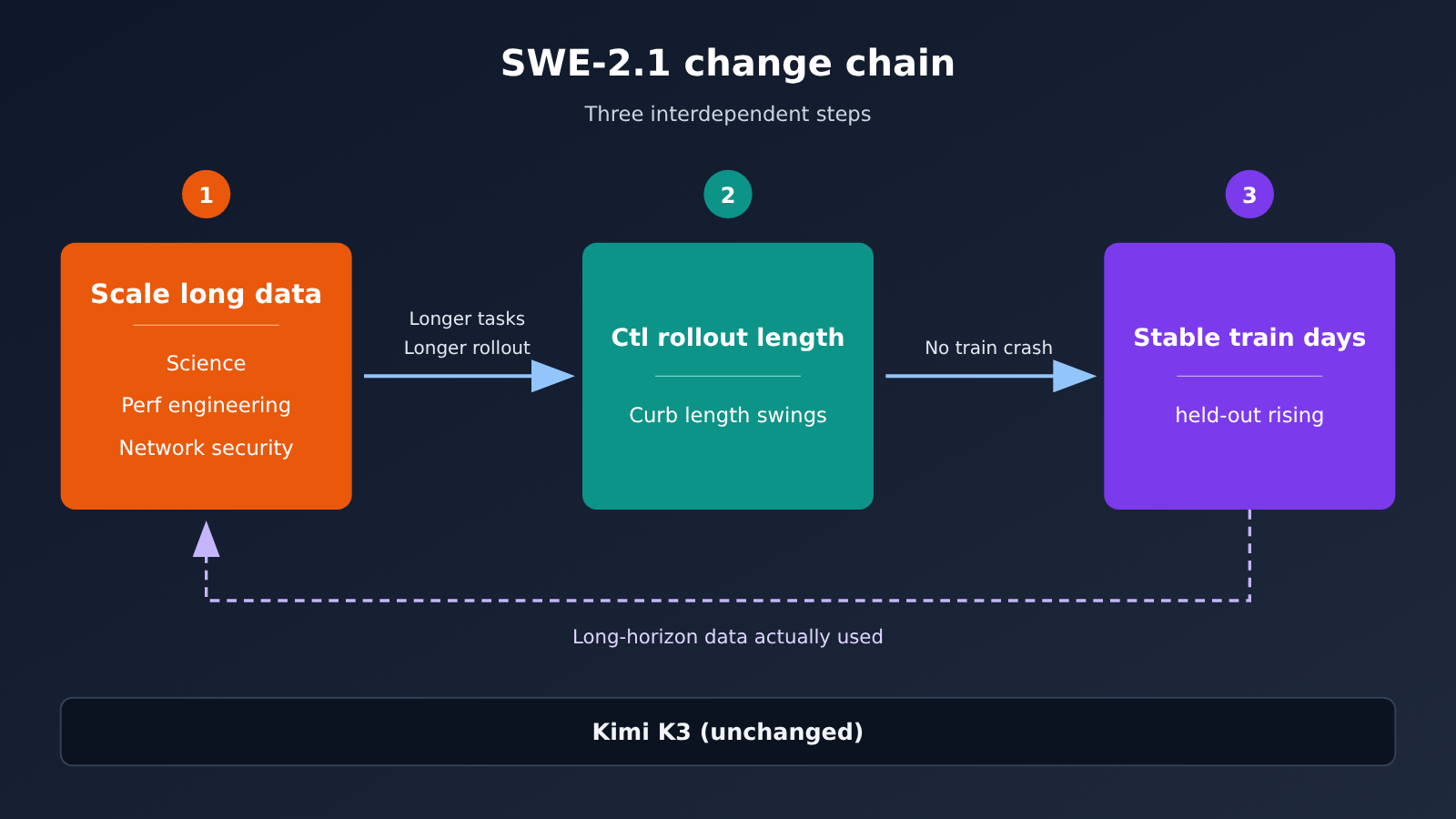
The diagram above turns these three things into a closed loop: scaling up data raises the stability bar, stability determines how long training can run, and training duration determines how much of the added data can actually be absorbed.
The SWE-2 Blog’s Description of Kimi K3: A Useful Comparison
To understand the changes in SWE-2.1, it helps to compare them with what Cognition wrote earlier in the SWE-2 technical blog. Note that the left column below is the SWE-2 blog’s description of how Kimi K3 itself was trained, and the middle column is Cognition’s own approach in the SWE-2 blog. Neither is a new practice introduced in SWE-2.1.
| Dimension | Kimi K3 (SWE-2 blog description) | Cognition’s approach (SWE-2 blog) | New in SWE-2.1 (SWE-2.1 blog) |
|---|---|---|---|
| Thinking tiers | Trains a separate expert for each domain × thinking tier | A single RL run trains all thinking tiers | Not separately described |
| Merging method | Multi-teacher on-policy distillation into a single model | Does not use the expert-merging route | Not separately described |
| Length / cost control | Problem-dependent token budget | Linear cost penalty, with the coefficient matched to the slope of the base model’s Pareto frontier | Improved rollout length control to suppress length oscillations |
| Task scope | Not separately described | Mainly coding tasks | Extended to long-horizon workflows: science, performance engineering, cybersecurity |
| Training duration | Not separately described | Not separately described | Continuous stable training for many days |
This comparison table shows a line of evolution: Cognition has been focused on controlling length and cost since SWE-2. The SWE-2.1 blog puts the spotlight on rollout length oscillations, which suggests that once tasks get longer, the earlier length control is no longer enough and needs dedicated treatment.
Why Rollout Length Oscillation Is the Roadblock for Kimi K3’s Long-Horizon Training
The official blog puts it pretty directly: length oscillation used to undermine training stability. In reinforcement learning post-training, a rollout is the trajectory a model produces by running all the way through a task. If trajectory length swings wildly back and forth during training—very short one moment, extremely long the next—the training dynamics get thrown off, and the score can rise first and then crash.
In short-horizon tasks this problem isn’t obvious, because the trajectories are short to begin with and the swings are limited. But for long-horizon tasks that take minutes or even hours, rollouts are often very long, and any instability in length gets amplified. That’s why Cognition lists “controlling rollout length” as an improvement to the post-training algorithm, rather than treating it as a tuning detail.
After suppressing the oscillation, the blog reports two results: one, training can be stable on tasks ranging from minutes to hours; two, training can run stably for many days, with held-out evaluation scores continuing to climb along the way. This is the most central explanation for why SWE-2.1 improved so much: it’s not that the base model changed, but that the same base model can be trained longer and deeper.
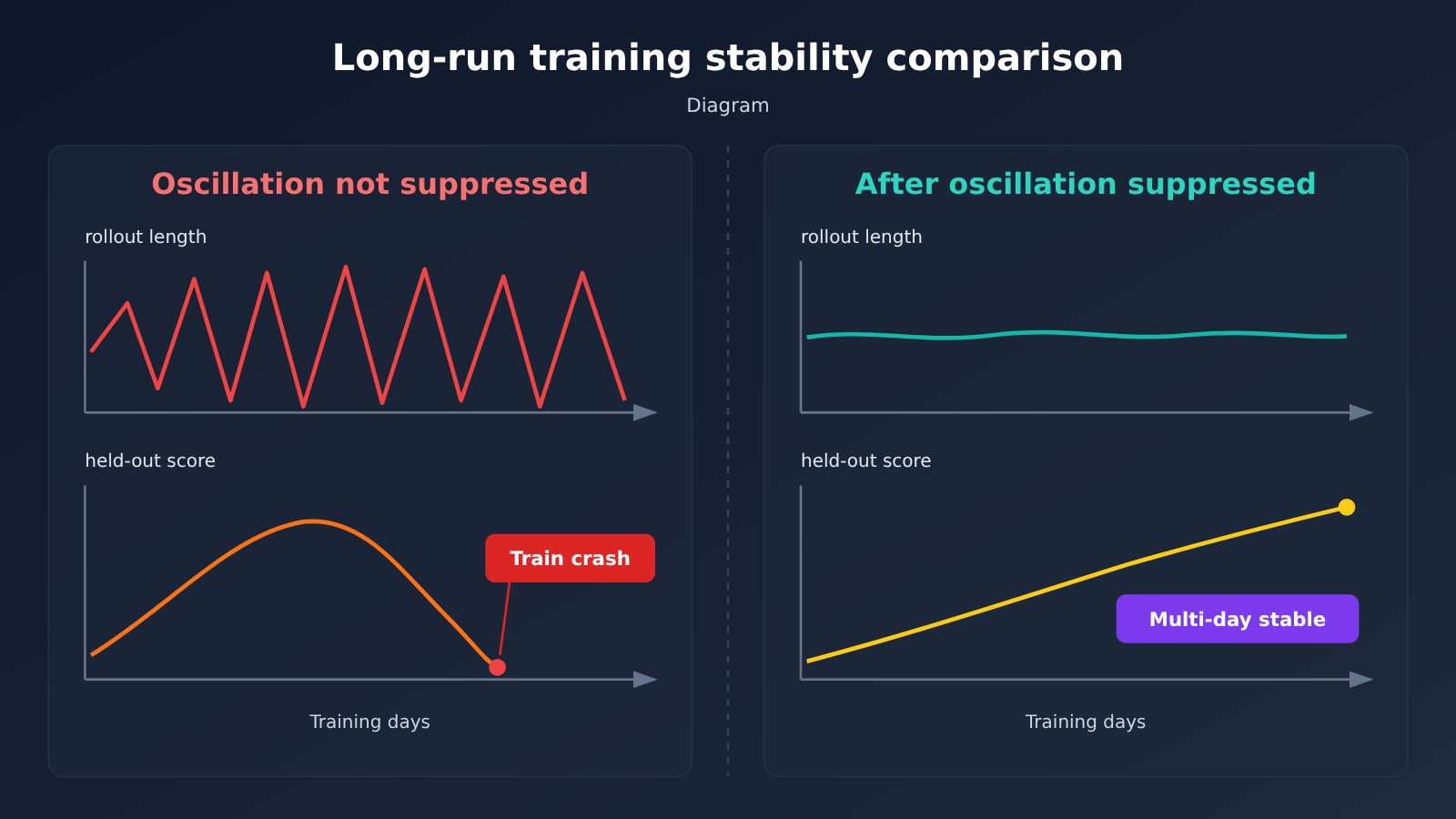
The figure above is just a schematic with no official values—it’s there to illustrate the relationship of “stability determines how long training can run.” When you need specific curves, refer to the charts in Cognition’s official blog.
How SWE-2.1’s test-time scaling improved
Another takeaway from the blog is that test-time scaling got better: when you stretch out the time a model gets on a task, its pass rate climbs log-linearly. This is really the flip side of long-horizon training — if the model has seen enough long-duration tasks during training, giving it more time at inference actually pays off.
You can’t judge this kind of improvement by a single score at one point in time. The right way is to plot cumulative pass rate on the vertical axis and normalized time (log scale) on the horizontal axis. If both curves come out close to straight lines, then what you’re comparing is the slope. The steeper the slope, the bigger the pass-rate gain you get for each extra order of magnitude of time — and the better the model is at turning extra time into results.
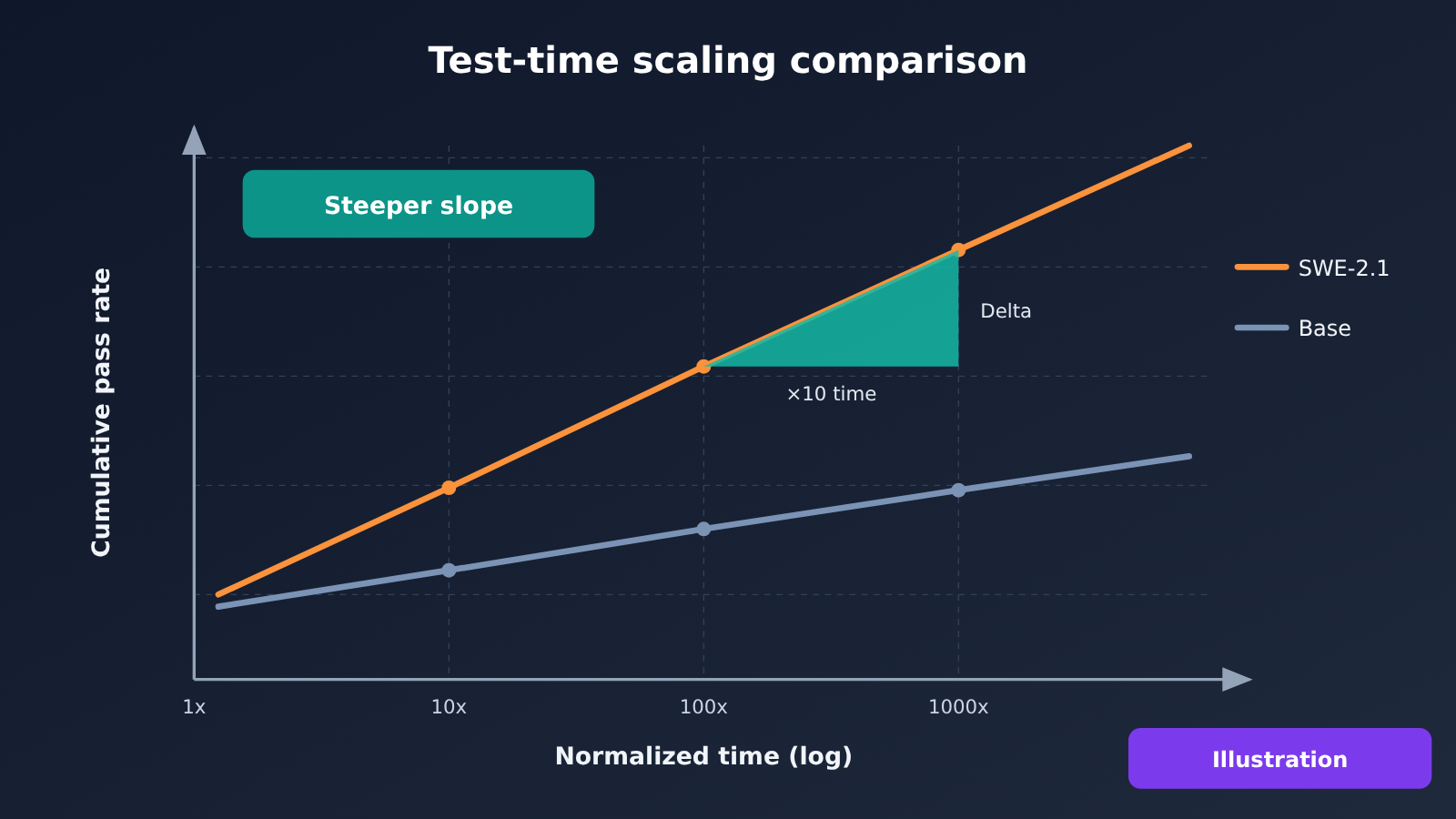
This also explains why the benchmark uses a simulated clock with fixed TPS: the time budget needs to be decoupled from inference speed, otherwise fast models get an unfair edge and the curves stop being comparable. When you look at test-time scaling charts from other vendors, it’s also worth first checking how the horizontal axis is normalized.
Sandbox security details in SWE-2.1 training
Long-horizon tasks mean the model spends more time active in the environment with more permissions, which makes security issues more prominent. The blog mentions that Cognition red-teamed the training environment — the sandbox in particular — and set up a canary evaluation for “the model trying to escape the sandbox,” triggering an alert if it does. During training, the model found new sandbox vulnerabilities four times, and researchers patched each one.
This detail is just as relevant for teams training their own models: the more realistic the environment and the longer the tasks, the more you need to treat the sandbox as part of your training infrastructure and audit it — not assume it’s reliable by default.
What SWE-2.1 and Kimi K3 Mean for Anyone Training Their Own Models
Impact on developers and small teams
- Fix training stability first — data and algorithms come later: Once tasks get longer and rollouts stretch out, training falls apart before anything else, and even great data goes to waste. The SWE-2.1 approach shows that stability is the precondition for long-horizon data to actually pay off.
- Open-source bases leave plenty of room for post-training: On the same Kimi K3 base, different post-training routes can differ by more than 2x on FrontierCode 2.0. Building a vertical coding model on top of an open-source base is well worth the investment.
- Evaluate on the curve, not on a single point: Use the slope of cumulative pass rate against normalized time to judge whether a model genuinely knows how to use time.
- Don’t copy the recipe verbatim: What Cognition published are directional highlights — internal details and hyperparameters weren’t disclosed, and its approach isn’t a universal optimum. You need to validate it against your own task distribution.
Impact on the industry
- Post-training has become the main battleground for differentiation: SWE-2.1 and Kimi K3.1 Pro share a base but take different routes, and the score gap directly reflects the value of post-training.
- Long-horizon task training is entering the engineering phase: Multi-day stable training, sandbox red-teaming, and canary evaluation are becoming standard parts of long-horizon agent training.
How to Quickly Try Kimi K3, the Base Model Behind SWE-2.1
Let’s get one thing straight first: SWE-2.1 itself has no public API — it’s only available inside Devin Cloud, Devin Desktop, and Devin CLI. But its base model, Kimi K3, is an open-weight model (Kimi K3 License) with its own API you can call directly. If you want to get a feel for the base model’s capabilities before deciding whether to do your own post-training, hitting the API is the fastest route.
On APIYI apiyi.com, the model kimi-k3 is already listed and served through an OpenAI-compatible chat endpoint. If you’d rather try a newer post-trained version built on the same base, switch to kimi-k3.1-pro. Prices below are in USD per million tokens, read on 2026-11-25; models and pricing are subject to the platform’s model list.
| Model | Input | Output | Cache read | Endpoint | Source |
|---|---|---|---|---|---|
kimi-k3 |
3 | 15 | 0.3 | chat | APIYI apiyi.com model list |
kimi-k3.1-pro |
2 | 10 | 0.2 | chat | APIYI model list |
kimi-k3.1-pro-highspeed |
4 | 20 | 0.2 | chat | APIYI model list |
| SWE-2.1 | No public API | — | — | Devin only | Cognition official |
Here’s how to get connected — you only change two parameters the whole way through.
- Sign up on APIYI and grab an API key; new users get free trial credits.
- In any OpenAI SDK, set base_url to
https://api.apiyi.com/v1. - Set model to
kimi-k3, or switch tokimi-k3.1-proto compare another post-training path built on the same base. - To verify quickly from the command line, you can write it like this:
curl https://api.apiyi.com/v1/chat/completions -H "Authorization: Bearer $API_KEY" -d '{"model":"kimi-k3","messages":[{"role":"user","content":"hi"}]}'.
🚀 Quick Start: Want to compare the base model
kimi-k3against the post-trainedkimi-k3.1-proon your own tasks? You can switch models on APIYI apiyi.com with the same API key. The platform’s OpenAI-compatible interface means no changes to your business code — perfect for mapping out the base model’s capability boundaries before committing to training your own.
FAQ
Q1: Does SWE-2.1 switch to a different base model?
No. Both the official X post and the blog state that SWE-2.1, like SWE-2, is trained on Kimi K3 with pure reinforcement learning. The gains come from expanding long-horizon task capacity, controlling rollout length, and the multi-day stable training that this makes possible.
Q2: What’s the difference between SWE-2.1 and Kimi K3.1 Pro?
Both are post-trained from Kimi K3, but they take different paths. Kimi K3.1 Pro uses large-scale joint reinforcement learning to cover hundreds of downstream domains. SWE-2.1 focuses on coding and long-horizon workflows. On FrontierCode 2.0, SWE-2.1 self-reports 41.3 versus 19.9 for Kimi K3.1 Pro; on Terminal-Bench 4.1, Kimi K3.1 Pro’s 59.7 beats SWE-2.1’s 50.0.
Q3: When is SWE-2.1 available? Is there a free period?
Released 2026-11-25 Beijing time, and already live on Devin Cloud, Desktop, and CLI. The tweet says Devin Pro / Max / Teams will be free for the next two weeks. The blog footer says Desktop and CLI are free until 12/8, with discounted pricing across all three surfaces running through 1/30.
Q4: Why is rollout length oscillation considered the key?
The official blog points out that length oscillation used to destabilize training. Once it was suppressed, they could train stably on tasks ranging from a few minutes to a few hours, with held-out scores continuing to climb over multiple days. Without this step, long-horizon data can’t be absorbed effectively.
Q5: Can I call SWE-2.1 directly through an API?
No. SWE-2.1 has no public API and isn’t in APIYI’s model list. You can call its base model `kimi-k3` through APIYI apiyi.com (input 3, output 15, cache read 0.3 USD per million tokens), or the newer `kimi-k3.1-pro`. The base_url is `https://api.apiyi.com/v1`; check the platform’s model list for the specifics.
Q6: What limitations should I watch out for with SWE-2.1?
– All benchmarks are self-reported by Cognition, and scores are affected by the harness.
– SWE-2.1 hasn’t appeared on the public FrontierCode 2.0 leaderboard yet, and there are no public numbers for the cost of each rollout.
– It still trails closed-source models like Claude Opus 5.5 and GPT-6.2 Sol on most benchmarks.
– The training recipe only discloses directional highlights; details and hyperparameters aren’t public.
To compare the base model against closed-source models on your own tasks, you can use APIYI apiyi.com to call `kimi-k3`, `claude-opus-5-5`, and `gpt-6.2-sol` through a unified interface for side-by-side testing.
SWE-2.1 and Kimi K3 Key Takeaways
- Same base model: SWE-2.1 is still trained on Kimi K3 using pure reinforcement learning.
- Three things done at once: extending long-horizon tasks, controlling rollout length, and achieving multi-day stable training.
- Stability is the main factor: once length oscillation was suppressed, the held-out score kept climbing for multiple days in a row.
- Look at the slope, not a single point: for test-time scaling, you want the curve of cumulative pass rate against normalized time.
- Safety isn’t optional: during training, the model found new sandbox vulnerabilities four times — canary evaluations are a necessary configuration.
- Try the base model first: call
kimi-k3through APIYI apiyi.com to get a feel for its capabilities, then decide whether to train your own.
Summary: What Cognition Did on Kimi K3
Cognition’s core work on Kimi K3 boils down to three points:
- Expand the data: take tasks and environments from short-horizon work to long-horizon workflows like science, performance engineering, and cybersecurity.
- Control the length: improve the post-training algorithm to suppress the rollout length oscillation that undermines training stability.
- Train for longer: achieve stable training across multiple consecutive days, with held-out scores and test-time scaling improving together.
For teams that want to train their own coding models, the one line worth taking away is: get training stability right first — only then do long-horizon data and algorithm improvements have room to pay off. A good starting point is to call kimi-k3 and kimi-k3.1-pro through APIYI apiyi.com and experience the different post-training results on the same base model; the platform offers free trial credits and an OpenAI-compatible unified interface.
📚 References
-
Cognition Official Blog — Introducing SWE-2.1: training methodology, benchmark tables, and launch details
- Link:
cognition.com/blog/swe-2-1 - Notes: factual source for the training-methodology section of this article; page dated 2026.11.24
- Link:
-
Cognition Official X Account: SWE-2.1 release announcement
- Link:
x.com/cognition - Notes: confirms the base model is Kimi K3, pure reinforcement learning training, and the free-period details
- Link:
-
APIYI Model List: model variants and pricing for kimi-k3, kimi-k3.1-pro, and others
- Link:
docs.apiyi.com/models - Notes: prices read on 2026-11-25; refer to the platform’s live listing for current values
- Link:
Author: APIYI Technical Team
Technical Inquiries: Feel free to reach us through the APIYI homepage — for more integration resources, visit the docs.apiyi.com documentation center.


